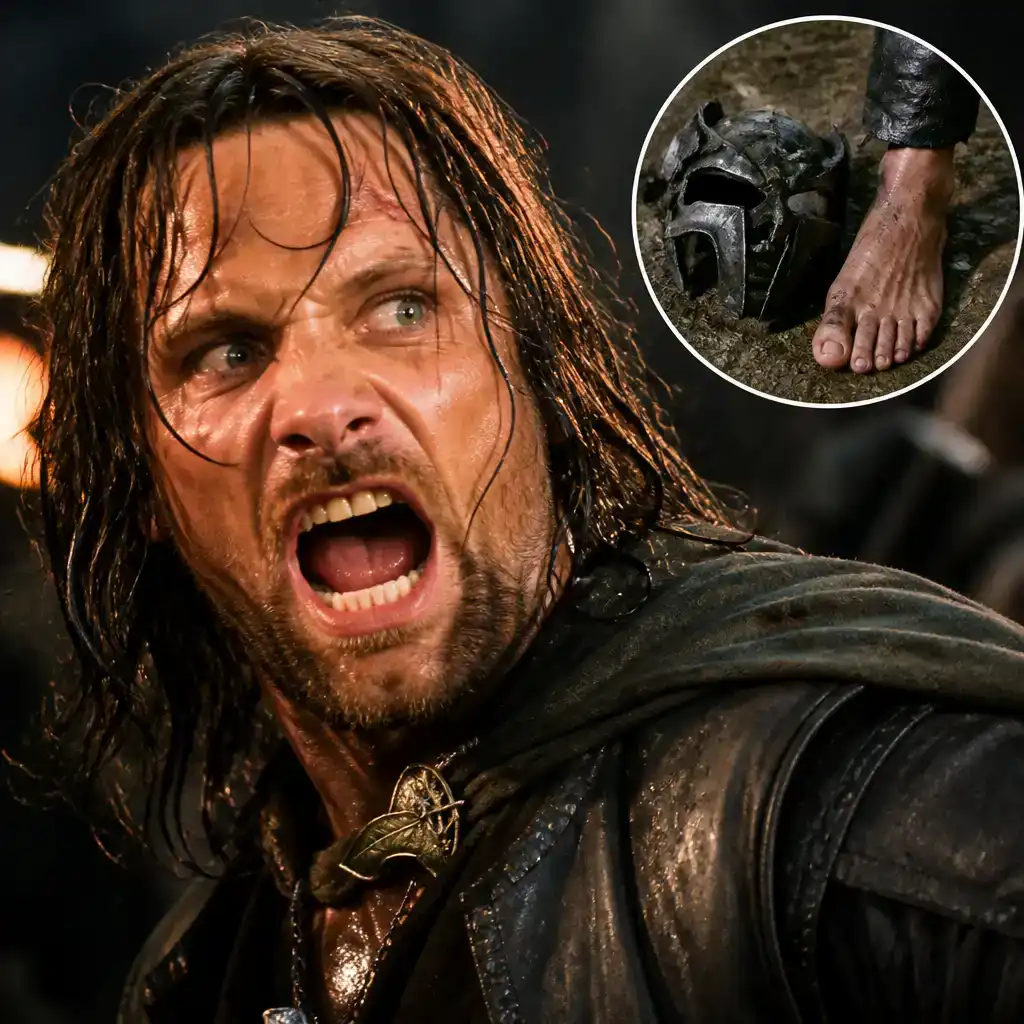
Believing they have arrived too late, he kicks a heavy helmet across the ground, screams and drops to his knees. Legolas and Gimli watch nearby as the search appears to end in failure.
The audience later learns that Merry and Pippin escaped into Fangorn Forest. Aragorn does not yet know that, leaving Mortensen to play the scene as a sudden confrontation with guilt and loss.
Mortensen broke two toes during the fifth take
Jackson wanted Mortensen to kick the helmet towards the camera. Four takes had already been filmed, but the director decided to try the action once more.
On the fifth take, Mortensen struck the prop hard enough to break two toes. His reaction — the cry, the contorted expression and the collapse — was therefore driven by genuine physical pain as well as Aragorn’s grief.
Mortensen did not immediately step out of character or bring the scene to a halt. Instead, he completed the moment, allowing the camera to capture a reaction that required little embellishment.
Jackson considered the take exceptionally powerful and used it in the film. According to accounts of the production, the director did not initially realise that Mortensen had injured himself while performing it.
How a painful accident became part of the performance
The injury did not create the scene’s dramatic meaning. Aragorn’s despair was already built into the story, and Mortensen still had to communicate the character’s belief that he had failed two vulnerable members of the Fellowship.
What the accident supplied was an involuntary physical intensity. Mortensen’s scream carries both the fictional anguish of Aragorn and the rather less fictional discovery that kicking solid objects can have consequences.
That distinction matters. The scene works because Mortensen remained connected to the character when the accident occurred, not simply because he was hurt. An injury by itself is not a performance, and productions have good reason to prevent actors from acquiring broken bones in pursuit of authenticity.
Here, however, the unexpected pain matched the required emotion closely enough that the take remained usable. Rather than breaking the illusion, Mortensen folded the accident into it.
The moment became part of the trilogy’s mythology
The helmet kick is now frequently cited among the best-known behind-the-scenes stories from Jackson’s Lord of the Rings trilogy. It also fits Mortensen’s reputation for throwing himself into the role of Aragorn with unusual commitment.
Yet the story has endured because viewers can see the result for themselves. Even without knowing what happened to the actor, the scream feels harsher and less controlled than a polished expression of cinematic grief.
That fifth take preserved a narrow overlap between accident and performance: Aragorn believes he has lost Merry and Pippin at precisely the moment Mortensen discovers the helmet has won. The Hobbits survived. His toes were less fortunate.