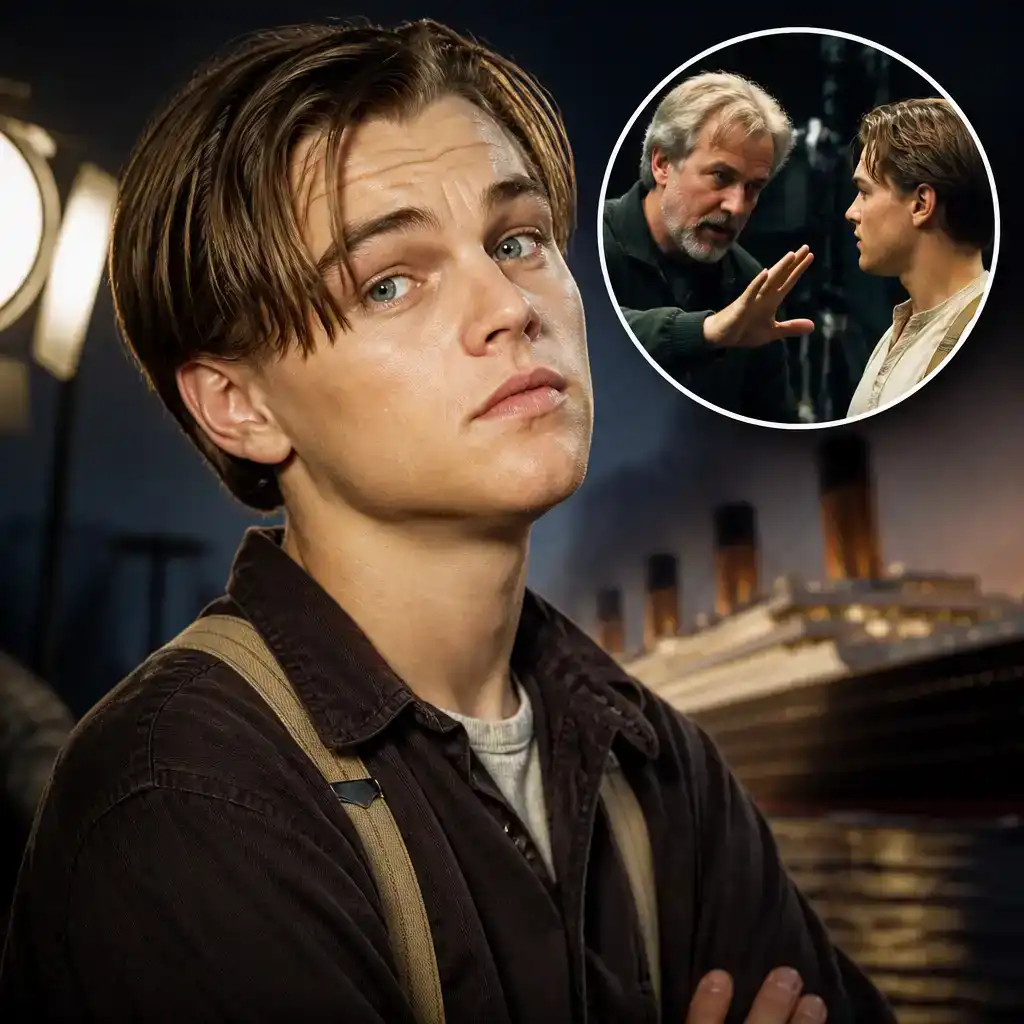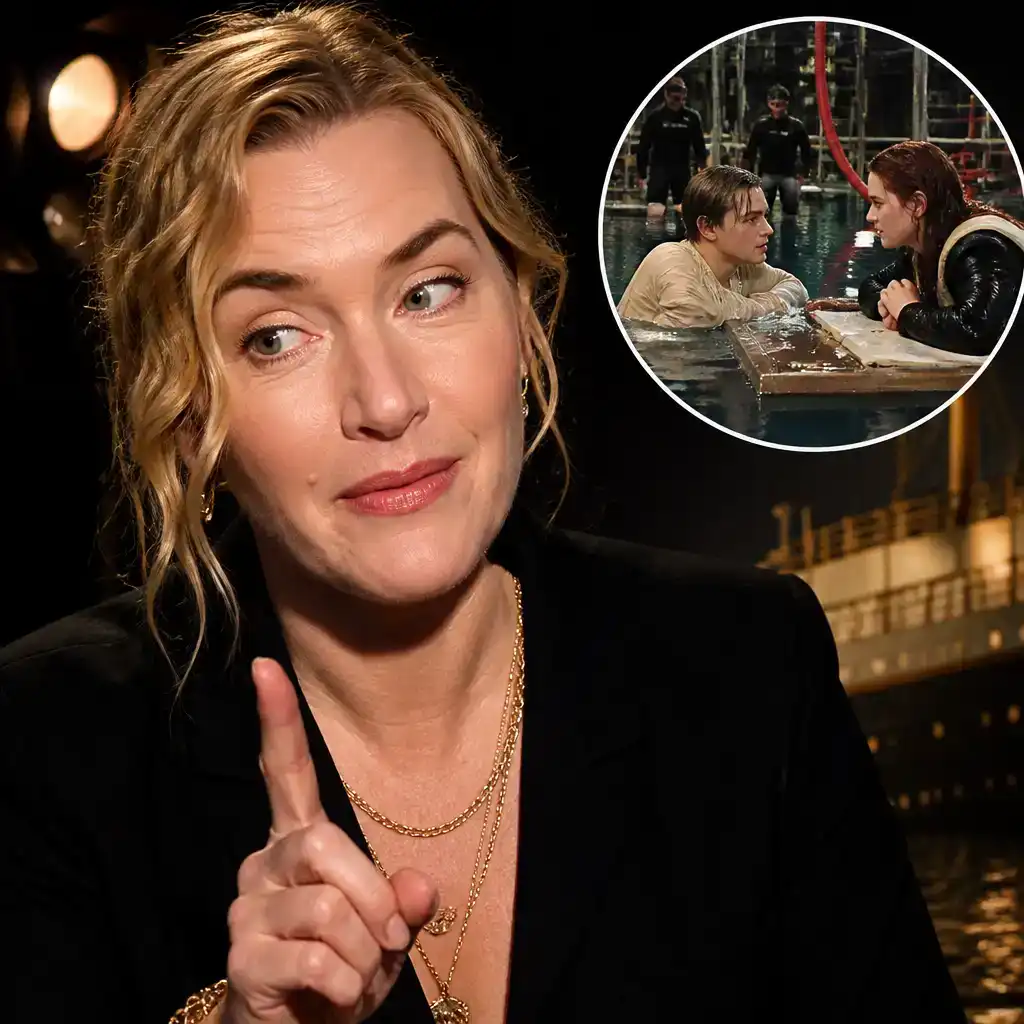
One of cinema’s most famously brutal death scenes was apparently filmed in water shallow enough for Leonardo DiCaprio to kneel on the bottom. Kate Winslet has revealed that Titanic’s iconic door scene was shot in a “waist-height” tank, stripping away a little of the frozen-Atlantic illusion that has survived since 1997.
Speaking on Josh Horowitz’s Happy Sad Confused podcast, Winslet described the practical reality behind the sequence in which Rose clings to floating wreckage while Jack slowly succumbs to the freezing water.
“Well that was quite an awkward tank, that one,” she said. “To burst a bubble, it was waist-height, that tank.”
The limited depth meant Winslet could simply climb off the prop and walk to the edge whenever filming stopped — although getting out was evidently less graceful than the finished film might suggest.
Winslet says DiCaprio was kneeling beneath the water
Winslet recalled that the edge of the tank was about 20 feet away, turning even a routine bathroom break into a small production of its own.
“So first of all, I was regularly like, ‘Ugh, can I just go for a pee,’ and then I’d get up, get off the door, walk to the edge of the tank that was sort of 20 feet away, and I’d literally have to fling my leg over and climb out the tank and go for a pee and then come back and crawl on the door again,” she said.
DiCaprio, meanwhile, was not suspended above some vast artificial abyss. According to Winslet, he was kneeling on the tank floor while performing Jack’s final moments.
“It’s terrible to admit these things … Leo is, I’m afraid, kneeling down on the bottom of the tank,” she joked. “I shouldn’t be saying any of these things. James Cameron’s gonna be ringing me like, ‘Why are you telling them all that?’”
The confession does not make the scene less bleak, though it does make the mechanics considerably less oceanic.
The rushing water created a major sound problem
The tank’s shallow depth was not its only revealing feature. Winslet said the set used an infinity-tank design, with water continually flowing over its edges to help create the impression of an open, unbroken sea.
That visual trick came with an acoustic cost.
“The thing that was amazing about the edges of the tank was that it was an infinity tank, so there was constant water rushing, and you could hear the constant sound of water,” Winslet explained.
She said the noise was so persistent that roughly the final 20 minutes of Titanic had to be completed using ADR, the process through which performers re-record dialogue and other vocal sounds after filming.
That reportedly included the characters’ shaky breathing and Rose’s cries for Jack. The terror audiences hear in the finished sequence was therefore recreated in a recording environment, after the splashing, climbing and waist-deep filming had ended.
The door debate has outlived the production secrets
Titanic, directed by James Cameron and starring Winslet and DiCaprio as Rose and Jack, has remained an unusually durable part of popular culture. The epic romance has been quoted, parodied and repeatedly revisited for decades, but few moments have generated as much argument as Jack’s death.
Viewers have long debated whether the floating wreckage could have supported both characters, potentially allowing Jack to survive. The discussion has become so familiar that Horowitz declined to relitigate it during the podcast.
Instead, he joked that DiCaprio might have developed PTSD from being asked about the scene so often.
“He probably got PTSD from the whole thing,” Winslet replied.
Her comment was delivered as a joke, but it neatly captured the strange afterlife of the sequence: a few minutes of film have produced decades of questions for the actors who shot it.
A convincing tragedy built from ordinary practicalities
Winslet’s account emerged during a wider discussion of her career, spanning films including Heavenly Creatures, Sense and Sensibility, Eternal Sunshine of the Spotless Mind and Lee.
Yet Titanic continues to command particular attention, partly because its enormous scale and emotional weight encourage viewers to imagine that making it must have been equally monumental at every moment.
The reality, at least during the door sequence, involved a shallow tank, an actor kneeling underwater and frequent interruptions for Winslet to clamber over the side.
None of that prevented the scene from becoming one of the most recognisable endings in modern cinema. It merely confirms that movie magic occasionally operates at waist height.