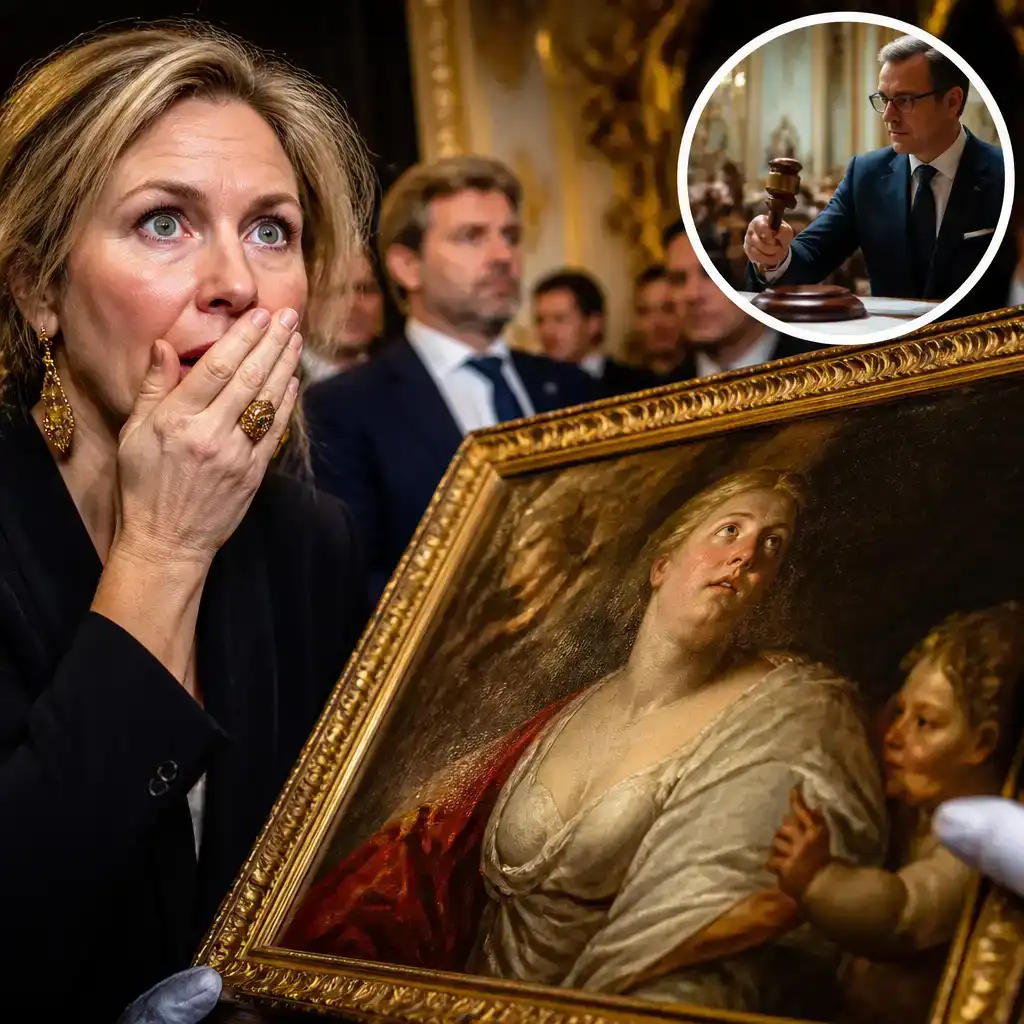
Auctioneer Jean-Pierre Osenat, however, suspected that the attribution underestimated what was hanging in front of him.
“I immediately had a hunch about this painting, and I did everything I could to try to have it authenticated,” Osenat told The Associated Press. “And finally, we managed to have it authenticated by the Rubenianum, which is the Rubens committee in Antwerp.”
The eventual sale price was roughly 230 times the painting’s earlier valuation. In the art market, four centuries of obscurity can apparently be corrected rather briskly once the right name is attached.
Scientific analysis supported the Rubens attribution
Osenat auction house said both the painting’s authenticity and its provenance were confirmed following a scientific examination.
Microscopic analysis of the paint layers found white, black and red pigments in the areas depicting flesh. Researchers also identified blue and green pigments, colours that Rubens characteristically incorporated when rendering human skin.
Such technical evidence can help specialists distinguish an original work from paintings produced by followers, assistants or later imitators. It is particularly important in Rubens scholarship because the artist operated a large and productive Antwerp studio, complicating questions of authorship centuries later.
The authentication therefore rested on more than visual resemblance. According to the auction house, the materials and painting technique were consistent with Rubens’s established practice, while the work’s ownership history also survived scrutiny.
The crucifixion scene contains an unusual detail
The subject itself helped establish the painting’s importance. Rubens frequently returned to the crucifixion, but expert Nils Büttner said he rarely represented “the crucified Christ as a dead body on the cross.”
The newly authenticated painting goes further, depicting blood and water emerging from the wound in Christ’s side.
“So this is the one and only painting showing blood and water coming out of the side wound of Christ, and this is something that Rubens only painted once,” Büttner said before the auction.
That combination of subject matter and treatment makes the work unusual within Rubens’s known output. Rather than merely adding another crucifixion scene to his catalogue, the painting appears to preserve a singular version of an image the artist explored repeatedly.
A rediscovery becomes a multimillion-dollar sale
Rubens was one of the central figures of European Baroque painting, known for large-scale religious scenes, historical subjects and portraits marked by dramatic movement and colour. Works connected to his workshop remain numerous, but an authenticated painting executed by Rubens carries an entirely different scholarly and commercial status.
The Versailles auction supplied the commercial verdict: €2.3 million for a work that, until recently, was treated as a comparatively minor production from the artist’s wider circle.
The sale also underlined how attribution can radically alter the fate of an old painting. Scientific testing, provenance research and specialist judgment did not change the object found inside the Paris townhouse. They changed what could confidently be said about who painted it.
After more than 400 years out of public view, the crucifixion has re-entered the art world not as a workshop curiosity, but as a rare Rubens whose most distinctive detail may have helped bring it back into the light.