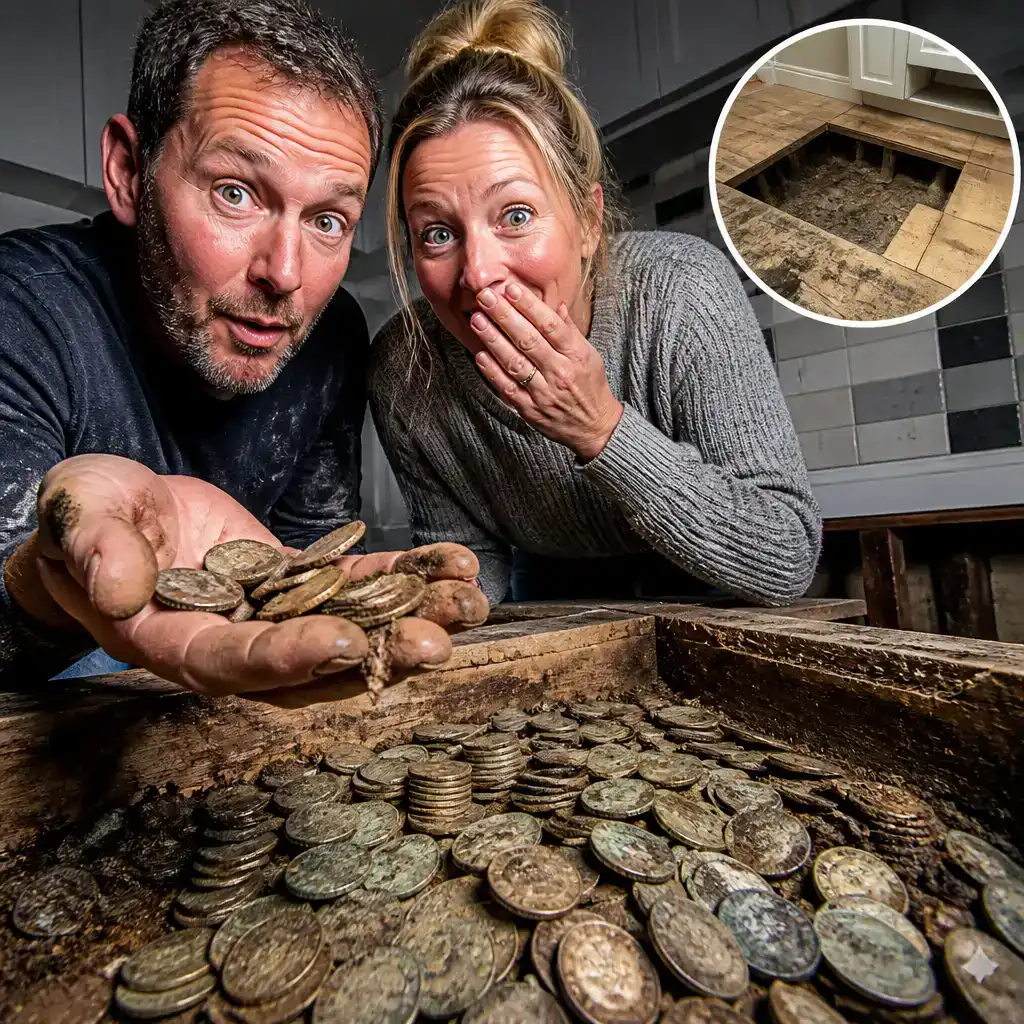
“He put all the coins in a bucket,” she said. “If we hadn’t lowered the floor, they would still be hidden there. I presume the person intended to retrieve them but never got the chance.”
Some sections beneath the concrete contained old flagstones, according to Julian Smith, a specialist at Duke’s auctioneers. The hoard, however, was found in an area of bare earth.
The collection spans several Tudor and Stuart reigns
The discovery includes gold coins from the reigns of James I and Charles I, along with silver half-crowns, shillings and sixpences.
It also contains silver shillings and sixpences issued under Elizabeth I and during the joint reign of Philip and Mary. The range gives the collection a history extending across several monarchs, although experts believe the coins were buried together rather than accumulated underground over time.
After making the discovery, the couple reported it to their local finds liaison officer. The hoard was then sent to the British Museum for cleaning and identification.
“The coins have been with the British Museum for identification and cleaning, and they feel the coins were deposited on one occasion,” Smith said.
Why the money was buried remains unknown
No information supplied with the discovery establishes who concealed the coins or precisely when they did so. Betty’s suggestion that the owner planned to return for them is plausible, but remains an interpretation rather than a documented history.
The presence of Charles I coins means the collection includes money from a period of profound upheaval in 17th-century Britain. Even so, the available evidence does not prove that the hoard was buried because of any particular conflict or crisis.
What is clearer is that somebody placed a substantial store of wealth beneath the property and, for whatever reason, never recovered it. Four centuries later, a modern renovation finally completed the withdrawal.
The Poorton hoard heads to auction
Duke’s auctioneers in Dorchester was due to sell the coins on 23 April, with the complete collection estimated at about £35,000.
For the Fooks family, the find offered an unlikely return on a demanding restoration project. The farmhouse needed its floors and ceilings removed and its walls exposed before the couple could rebuild it.
The renovation gave them the additional ceiling height they wanted. It also revealed that the most consequential part of the house was not above their heads, but beneath their feet.