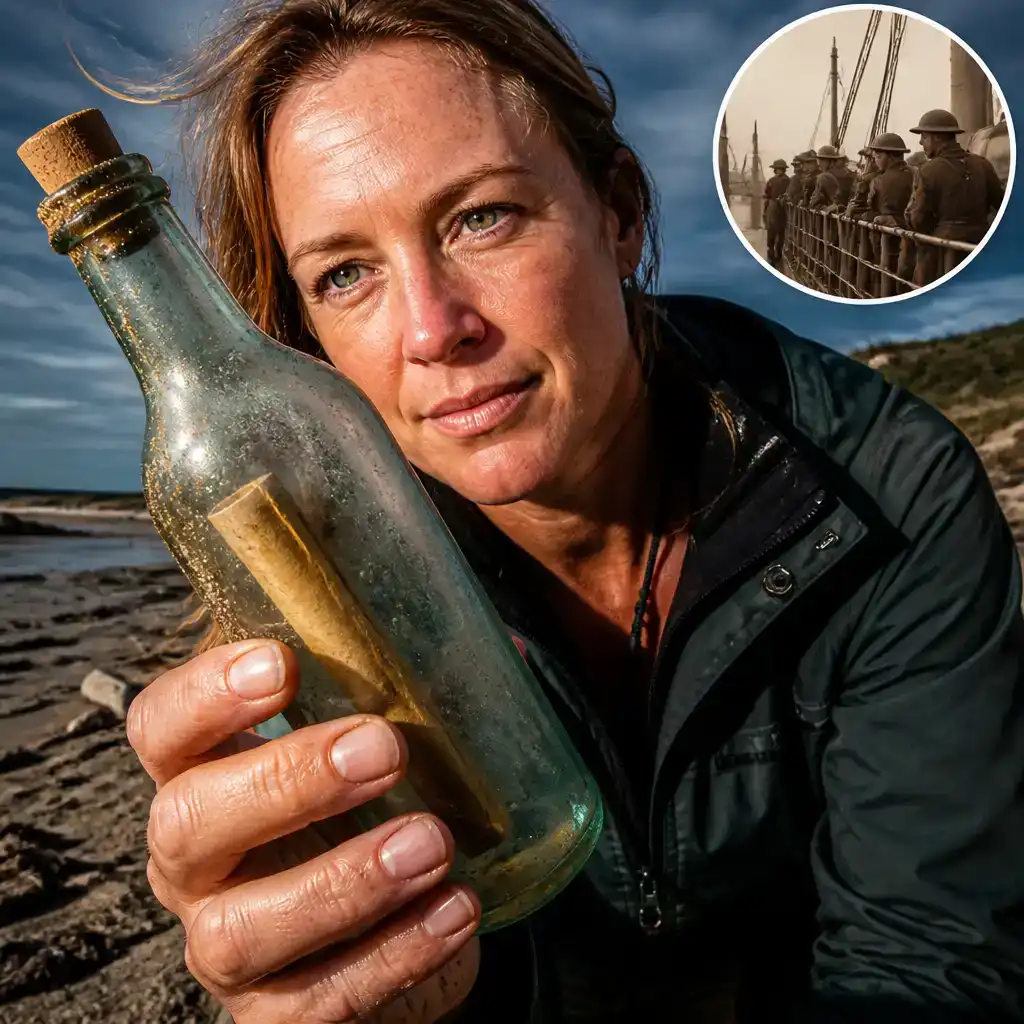
Inside were two wet but readable sheets of paper, each carrying a message from a soldier aboard HMAT A70 Ballarat.
The troop ship had departed Adelaide on August 12, 1916, carrying men who were to reinforce the 48th Australian Infantry Battalion on the Western Front. Neville was 27; Harley was 37.
Both described their location in deliberately broad terms. Neville wrote that he was “Somewhere at Sea,” while Harley placed the ship “Somewhere in the Bight” — a reference to the Great Australian Bight, the vast open bay stretching from east of Adelaide towards Esperance.
Their notes captured an unexpectedly light moment at the beginning of a journey whose consequences neither man could know.
Neville described good food, rough seas and high spirits
Neville addressed his letter to his mother, Robertina Neville, and asked whoever found it to deliver the message to her at Wilkawatt, a South Australian settlement that is now virtually a ghost town.
He told her he was “having a real good time, food is real good so far, with the exception of one meal which we buried at sea.”
The ship, he added, was “heaving and rolling, but we are as happy as Larry,” using an Australian expression meaning extremely happy. The optimism is striking with hindsight, particularly because Neville would be killed in action the following year.
Harley’s mother had died by 1916, so his instructions were less specific. He told whoever discovered his letter that they could keep it.
“May the finder be as well as we are at present,” he wrote.
Harley survived the war, although he was wounded twice. He died in Adelaide in 1934 from cancer which, according to his family, was caused by exposure to German gas in the trenches.
The bottle may have spent a century beneath the dunes
Although messages in bottles invite stories of long voyages across oceans, Brown believes this one probably did not travel very far.
Her theory is that the bottle washed ashore relatively soon after it was thrown overboard and remained buried in the sand dunes for much of the next century. Large swells and extensive erosion at Wharton Beach in recent months may finally have exposed it.
The bottle’s remarkably clean condition supports that possibility, she said.
“It doesn’t have any growth of any barnacles on it,” Brown explained. “I believe that if it had been at sea or if it had been exposed for that long, the paper would’ve disintegrated from the sun. We wouldn’t have been able to read it.”
The glass was described as pristine, while the writing survived even though the paper had become wet. A century in open water would ordinarily be an ambitious preservation strategy, even by the forgiving standards of bottled correspondence.
Because the names and writing could still be read, Brown was able to trace relatives of both men and tell them about the discovery.
The discovery reconnected two families with their past
Harley’s granddaughter, Ann Turner, said the news left her family “absolutely stunned.”
“We just can’t believe it,” Turner told the Australian Broadcasting Corp. “It really does feel like a miracle and we do very much feel like our grandfather has reached out for us from the grave.”
For Neville’s relatives, the letter offered a rare glimpse of him before the war reached him in earnest: young, upbeat and joking about an unsuccessful meal while his ship rolled through the Bight.
His great-nephew, Herbie Neville, said the discovery had brought the family together.
“It sounds as though he was pretty happy to go to the war,” he said. “It’s just so sad what happened. It’s so sad that he lost his life.”
“Wow. What a man he was,” he added.
Neville’s request that the finder contact his mother could no longer be fulfilled as he intended. Instead, the bottle reached another generation of his family, more than a century late but with his handwriting, humour and optimism intact.