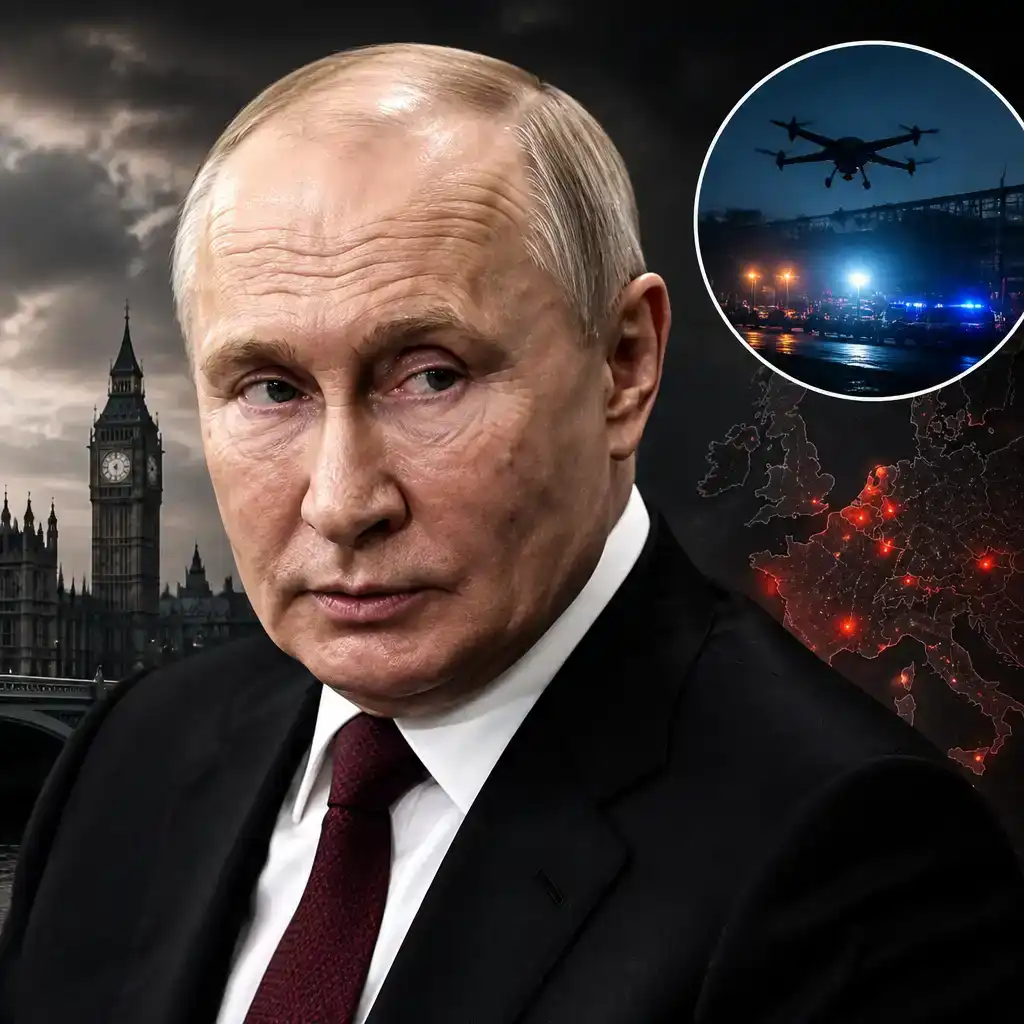
Putin accused Germany of planting evidence. Russia’s embassy in Berlin called the allegation “absurd.” Moscow’s position, as usual, is that the evidence is fabricated and the suspicion is somehow the real offence.
Leipzig/Halle is not merely a civilian transport hub. The airport supports NATO’s Strategic Airlift International Solution, which moves equipment to alliance forces across Europe, from Finland to Romania. That gives any attempted disruption an obvious strategic dimension without requiring an attack on a traditional military base.
Andy Burnham said Britain stood in “full solidarity with Germany” after what he called Russia’s “egregious and reckless attack.” He also said the United Kingdom would not retreat from efforts to secure a “just and lasting peace” in Ukraine.
The British government’s public certainty over Leipzig contrasts with a separate United Kingdom defence investigation into suspicious domestic drone sightings. That inquiry found no conclusive evidence connecting those incidents to Russia. Not every unidentified drone is a Kremlin operation, inconvenient though that may be for the simpler version of the story.
Europe still lacks an easy response to hybrid attacks
Western officials have attributed about 200 acts of sabotage or other malign activity in Europe to Russia since the full-scale invasion of Ukraine began in February 2022, according to reporting by the Associated Press. The alleged operations span cyberattacks, propaganda, sabotage and threats to critical infrastructure.
NATO classifies such tactics as hybrid operations. Whether any individual incident triggers the alliance’s collective-defence provisions depends on its scale and circumstances. NATO has said an attack on an ally would receive a “resounding response,” but deciding what counts as an attack remains the difficult part.
European Union officials have considered responses to the Leipzig case while struggling to find measures strong enough to deter Moscow without escalating into direct military confrontation. Conventional retaliation would be a major step. Another sanctions package may be safer, but Russia has had years to adapt to those.
Deniability gives hybrid activity much of its value. A damaged cable, disrupted airport, cyberattack or unexplained drone sighting can create economic and political pressure while leaving governments debating attribution. By the time officials reach agreement, public attention may already have moved elsewhere.
Why Britain remains a prominent Russian target
Britain is one of Ukraine’s major arms suppliers and also serves as a logistics, naval and sanctions centre for Western pressure on Russia. That makes it useful to Kyiv and conspicuous to Moscow.
The United Kingdom has sanctioned more than 500 vessels linked to Russia’s shadow fleet, the network used to transport oil while avoiding Western restrictions. British forces also monitor Russian submarine activity, while government agencies face the continuing risk of cyber operations and interference with infrastructure.
London plans to raise defence spending to 2.6% of gross domestic product from 2027. That signals a long-term response to the Russian threat, although spending targets do not solve the immediate problem of how to answer an incident designed to remain just ambiguous enough.
Putin reinforced the message at his press conference by describing Western countries as sharks. “If anyone tries to drag us down the food chain, to gobble us up or devour us, they might get punched in the teeth,” he said. “Russia is ready to do that, despite the rapidly growing appetites and teeth of these sharks.”
The Russian president has increasingly relied on animal comparisons to explain geopolitics. He recently invoked killer whales “tearing polar bears apart” while defending the war in Ukraine. The zoology is vivid. The policy underneath it is straightforward intimidation.
Putin projects confidence despite Russia’s costs
During the 45-minute press conference in Bishkek, Kyrgyzstan, Putin appeared combative and confident of victory. He was most animated while discussing Russia’s confrontation with the West and the continuing war in Ukraine.
“I have no doubt that the enemy will crumble,” he declared. Yet the conflict has lasted more than four and a half years, Ukraine continues to resist, Russia has suffered enormous battlefield losses and its economy remains under considerable pressure.
The Kremlin officially retains the phrase “special military operation,” but Putin himself used a more accurate word. “War is a brutal and unpredictable thing,” he said.
His remarks came as Moscow and Kyiv threatened to increase attacks on each other’s infrastructure. The Associated Press placed his comments alongside an order for large-scale Russian strikes on Ukrainian energy facilities following Ukrainian attacks inside Russia. In that context, the refusal to exclude British targets carried more weight than an isolated piece of theatrical ambiguity.
Putin nevertheless claimed he remained open to negotiations, provided the people across the table were acceptable to Moscow and any settlement reflected Russian demands.
Trump’s envoys receive a warmer invitation
Putin singled out Donald Trump’s envoys Jared Kushner and Steve Witkoff as preferred American intermediaries.
“We are absolutely comfortable working with those people we know well and generally trust,” he said. “Kushner and Witkoff are always welcome guests. It’s a pleasure working with them.”
He offered no comparable praise for Central Intelligence Agency Director John Ratcliffe, who made a surprise visit to Moscow the previous week. The Kremlin said Putin did not meet Ratcliffe during that trip.
No meeting with Kushner or Witkoff had been scheduled at the time of the press conference. If they do travel to Moscow, they will encounter a Russian leader presenting himself as confident, dismissive of Western pressure and determined to secure peace on Russia’s terms.
For Britain and its European allies, the more urgent issue is not whether Putin has secretly approved a missile strike on the United Kingdom. There is no evidence that he has. The challenge is responding to pressure that sits between hostile rhetoric and open warfare, where every incident produces an argument over evidence, proportionality and escalation.
That uncertainty is not a flaw in the Kremlin’s approach. It is the central feature.