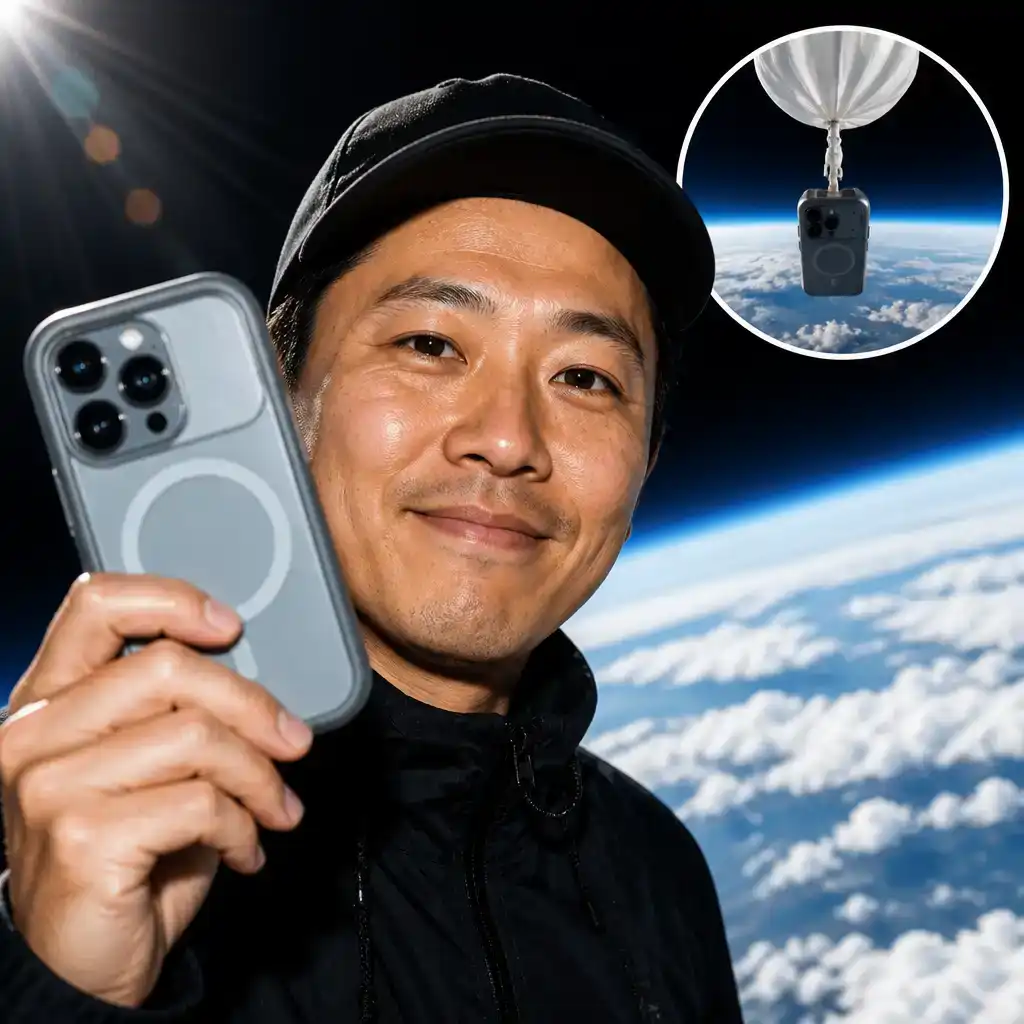
Once recovered, officials confirmed that the iPhone could:
- Switch on and off
- Make telephone calls
- Take photographs
- Operate without visible exterior damage
The result established the record for the “highest drop of a mobile phone in a phone case (natural landforms).” RhinoShield Brand Experience Manager Mujou Hsiao said the team had “prepared for the absolute worst and hoped for the best.”
Was the iPhone really dropped from space?
Not quite. The phone was released in the stratosphere, which NASA places roughly between 12 and 50 kilometres above Earth. The widely accepted boundary of space, known as the Kármán line, sits at about 100 kilometres.
At 30.6 kilometres, the iPhone reached around 31% of that altitude. “Near space” is a fair marketing description. “From space” is considerably more ambitious, unless space has recently agreed to move closer for promotional purposes.
The phone still faced harsh conditions. Sent Into Space co-founder Chris Rose identified communications interference, difficult terrain and recovery as major uncertainties. The team could not verify whether the handset had survived until it was physically found.
The AirX case is made from a single recyclable material. RhinoShield says its structure draws inspiration from vehicle airbags and the shock-absorbing cushioning used in athletic footwear. Chief executive Eric Wang said the project aimed to show that a recyclable, single-material case could still provide serious protection.
The company also claims AirX can isolate 81% of impact energy and offers 30 times greater extended durability. Those wider product claims were not independently tested by the Guinness attempt, which measured one spectacularly long fall under specially arranged conditions.
Why do the official accounts disagree?
Guinness’s news report presented the stunt as a single phone falling without a parachute, heating system or additional protective layer. Its more detailed record page describes a more complicated operation.
According to that account, the mission involved three AirX-protected phones intended for release at 26, 28 and 30 kilometres. A fourth payload was used to capture marketing footage. The record-setting handset was reportedly released unintentionally at 30,607 metres rather than at its planned altitude.
The detailed page also says custom payloads used drogue chutes designed to reproduce the terminal velocity of an unencumbered phone. That conflicts with the simpler claim that there was “no parachute.” Guinness’s published material does not clearly reconcile the two descriptions.
There are further differences:
- Guinness lists June 24 as the official achievement date, but its detailed account refers to an attempt on June 22.
- The record phone reportedly took more than five hours to locate.
- Recovering all the mission’s payloads took two days.
None of those discrepancies changes the recorded release height or the phone’s condition after recovery. Guinness, RhinoShield and subsequent coverage agree on the central result: the device dropped from 30,607 metres and remained functional. The conflicting details do, however, make the operation look less like someone simply released a phone from a balloon and waited for a fortunate noise in the forest.
What does the stunt prove about everyday drops?
The test demonstrated that the AirX case could protect one iPhone during a carefully engineered terminal-velocity fall onto remote natural terrain. It did not reproduce the conditions of an ordinary accident, where phones tend to hit concrete, steps, furniture edges or other inconveniently rigid objects.
After a certain distance, a falling object reaches terminal velocity and stops accelerating. A 30-kilometre fall therefore does not necessarily produce a proportionally harder impact than a much shorter fall once that maximum speed has been reached. The extreme altitude mainly added cold, low pressure, tracking problems and a very long retrieval job.
Phones have survived remarkable falls before. In 2024, an iPhone was found intact after dropping about 16,000 feet from an Alaska Airlines aircraft. That incident lacked a purpose-built record attempt and the benefit of engineers arranging the conditions in advance.
Protective-case designers have also pursued less practical goals. Previous products include a six-pound case intended to discourage constant scrolling and a limited-edition Dunkin’ design filled with imitation iced coffee. Against that competition, a recyclable case surviving the stratosphere is unusually relevant, even if most owners are more concerned about the distance between their hand and the pavement.