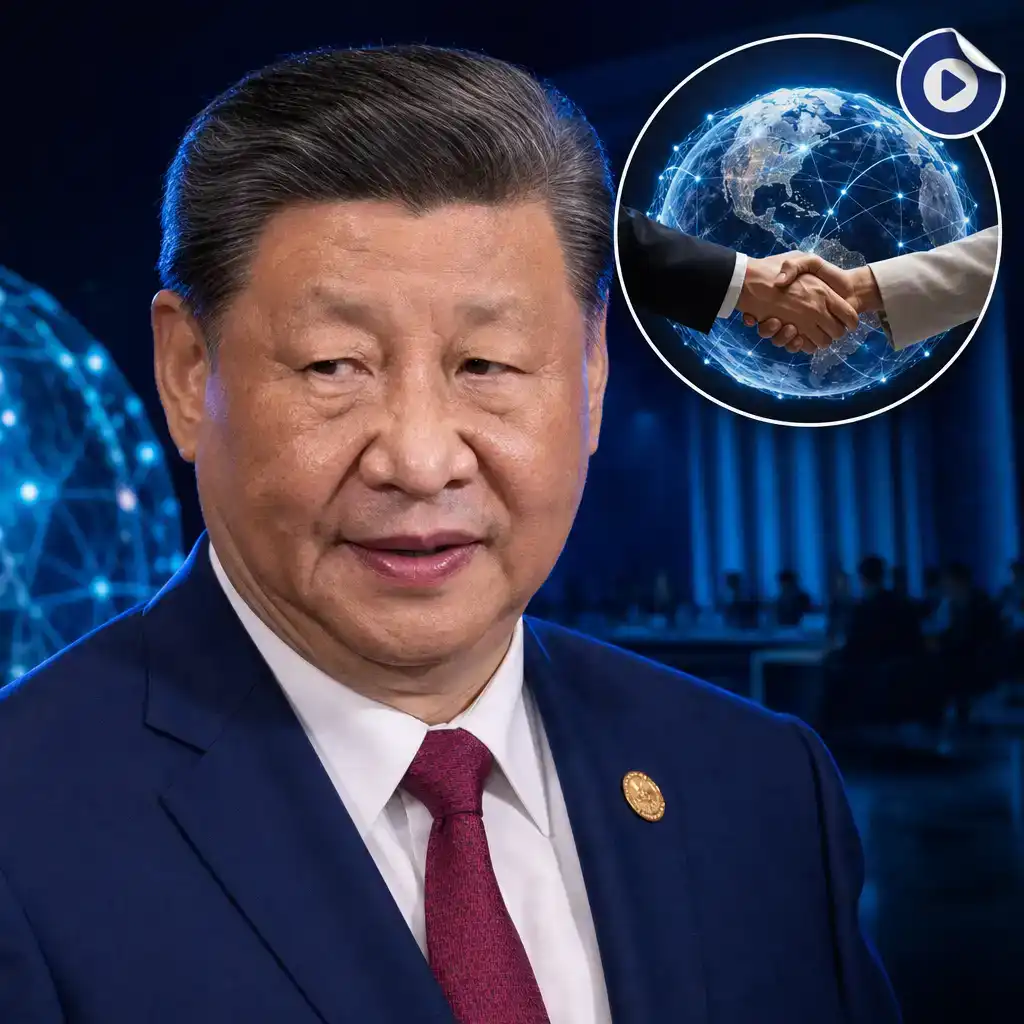
That line was not exactly subtle. The United States and the European Union have both placed restrictions on some Chinese technology imports, citing national security concerns. Beijing, unsurprisingly, sees at least some of those limits as strategic containment dressed up in policy language.
Why the Shanghai conference matters
The World Artificial Intelligence Conference is one of China’s major showcases for the sector. It puts Chinese companies, researchers and officials on a stage meant to demonstrate that the country is not merely catching up to the United States, but building an ecosystem that can compete globally.
Chinese AI models have been gaining attention outside the country, partly because many are cheaper to use than top US offerings. That cost advantage matters in a market where developers, businesses and governments are all trying to work out what they can afford to automate, analyse or generate next.
Still, the conference also lands at a moment when AI governance has become one of the defining policy fights around the technology. Governments are wrestling with questions like these:
- How should AI be used in military settings?
- What limits should apply to systems that can help hackers or criminal groups?
- Who should control access to advanced chips, models and computing power?
- How can developing countries avoid being locked out of the tools shaping future industries?
Those are not abstract seminar questions anymore. They are already shaping export controls, investment strategies and diplomatic arguments.
How export controls are shaping the AI race
Much of the current tension comes down to chips. Advanced AI systems require powerful semiconductors, and Washington has spent years tightening controls on what Chinese firms can buy.
In May, the United States Commerce Department issued guidance confirming that restrictions on advanced AI chip shipments also apply to subsidiaries of Chinese companies located outside China. The move was aimed at closing potential loopholes in the US export control system.
The guidance said licensing requirements apply to companies headquartered in China or those with a Chinese parent company. In practice, that means Washington is trying to prevent restricted chips from reaching Chinese firms through overseas units or affiliates.
The policy fight has not been limited to the US and China. European restrictions on Chinese tech imports have also been justified on security grounds, while recent friction between Washington and American AI labs has raised its own question: if the most powerful models are built by private firms, how much say should governments have over who gets access?
Xi’s remarks fed directly into that dispute. When he warned against “overstretching” national security arguments in AI, he was speaking into an active policy fight.
What did Xi mean by keeping AI under human control?
Xi also addressed another major anxiety around artificial intelligence: whether the systems being built are moving faster than the rules meant to govern them.
“We should put in place laws and regulations, technological monitoring, early warning, and emergency response systems, in order to … ensure AI is always under human control,” he said.
That message reflects a broader global consensus in tone, if not always in practice. Governments regularly say AI must be safe, accountable and human-led. The harder part is defining what that means once systems are used in real workplaces, surveillance networks, battle planning, financial tools or consumer products.
China’s own approach combines heavy state involvement with rapid commercial deployment. AI has become a strategic pillar of the country’s industrial policy, backed by public investment and focused on building a domestic chain from chip production to consumer applications.
State media, citing officials, has reported that daily “token” use in China, an industry measure of AI usage, has increased a thousandfold over the past two years. That gives a sense of scale, even if “token” remains one of those terms the AI industry has somehow made both technical and mildly annoying.
China’s energy advantage in the AI buildout
While China still trails the United States in access to the most advanced semiconductors, China has a big advantage in another part of the AI equation: electricity.
AI data centres require huge amounts of power. A typical data centre can use as much electricity as 100,000 households, according to the International Energy Agency. Next-generation hyperscale facilities can consume as much power as two million homes.
That is a problem for any country trying to expand AI infrastructure quickly. China, however, has access to a large supply of relatively cheap electricity and already generates more than twice as much power as the United States. Its lead is expected to grow as Beijing continues state-led investment in the national energy grid.
That matters because the AI race is not only about clever models or flashy demos. It is also about chips, data centres, power lines, cooling systems and the political will to build at enormous scale. Glamorous, no. Decisive, possibly.
Xi’s message in Shanghai was therefore both cooperative and strategic. China is presenting itself as a champion of wider AI access, especially for developing countries, while also pushing back against Western restrictions that could slow its own ambitions. The speech did not remove the rivalry at the centre of AI development. It simply made clear that Beijing wants more countries listening when it argues over the rules.