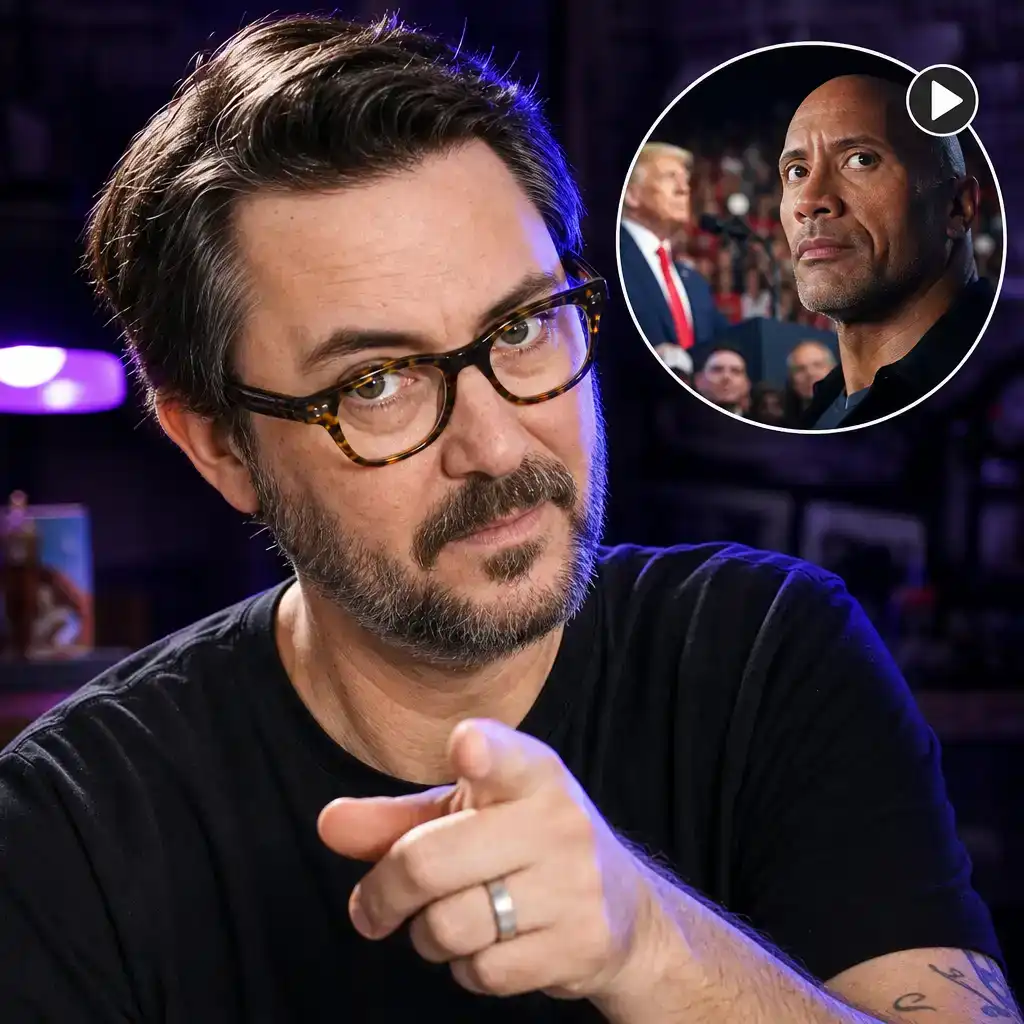
He described that “main thing” as creative work rather than public positioning.
“The main thing for me, the thing that in the morning I swing my legs out of bed and I run towards, is creating. It’s art. It’s storytelling.”
What Dwayne Johnson said about staying private
Johnson, who identifies as an Independent, said he is not ruling out political conversations entirely. He framed the shift as a decision about when and how to speak, not a vow of total silence.
“I’ve learned I’m going to keep my politics to myself,” he said. “There are moments when, hey, there’s nothing we can’t talk about.
“If I’m wrong, I’ll tell you I’m wrong. Or if I feel like I got a leg up and this is the right way to go, I’ll share it with you.”
Johnson also argued that people with opposing views should be willing to talk to one another rather than turn every disagreement into a public fight. In characteristically polished but still blunt terms, he said, “I hate the slinging. I hate all the bulls— that comes with it.”
That is a tidy sentiment, if also one that arrives in a media environment where celebrity neutrality is often treated less like a personal boundary and more like a suspicious object left unattended.
How Johnson’s political stance has shifted since 2020
Johnson has not always kept electoral politics at arm’s length. During the 2020 presidential election, he publicly endorsed Joe Biden. Ahead of the 2024 race, however, he said he would not endorse another presidential candidate.
At the time, Johnson said he regretted his previous endorsement because he believed it had contributed to division. That explanation put him in a familiar modern celebrity position: applauded by some for stepping back, criticized by others for treating political conflict as an avoidable branding hazard.
Wheaton has taken the opposite approach. He has been openly political for years and campaigned for Kamala Harris during the 2024 presidential election. So his response to Johnson is not exactly coming from the “let everyone have a quiet dinner” wing of Hollywood.
The disagreement reflects a larger tension around public figures: whether famous people have a responsibility to use their platforms, or whether audiences should accept that not every actor wants to turn a press tour into a civic seminar.
What Johnson has said about Trump and political violence
Although Johnson now says he plans to keep his politics private, he has still commented on major political events. After the July 2024 assassination attempt on Trump in Pennsylvania, Johnson condemned the attack and said political violence has no place in the United States.
“Whether you love Donald, don’t love Donald, it doesn’t matter. They tried to assassinate him. There’s no room for that,” Johnson said at The Value Conference in September 2024.
He added, “Despite it being who we were in that moment, I still believe in my core that is not who we are as a country.
“So him standing up at that moment, we wanted to see that.”
Johnson also said Trump had been a fan of his wrestling career for years and had attended his matches in New York City.
Trump later discussed Johnson during an October 2024 appearance on Six Feet Under with Mark Calaway, saying Johnson contacted Ultimate Fighting Championship chief Dana White after the assassination attempt to get Trump’s phone number.
“When I was shot, you may have heard about it, Rock called Dana White and said, ‘I want to have his number. I want to have his number. What he did is sort of incredible,’” Trump said.
“He considered it bravery. I don’t know, to me, I considered it, ‘What’s going on here?’ But it was very nice, The Rock.”
Why the backlash landed online
The online reaction around Johnson’s comments fits a now-standard pattern: a celebrity explains a boundary, another celebrity challenges the moral weight of that boundary, and social media gets a fresh object to sort into teams.
For Johnson, the message is that he wants storytelling, art, and career work to stay in front. For Wheaton, that posture appears to read as retreat at a moment when he believes public figures should be clear about where they stand.
Neither man is new to this terrain. Johnson has spent years managing a massive mainstream audience across film, wrestling, business, and public life. Wheaton has built part of his public identity around frank political commentary. Their clash is less a surprise twist than a reminder that in celebrity culture, saying “I’d rather not talk politics” is still, somehow, talking politics.