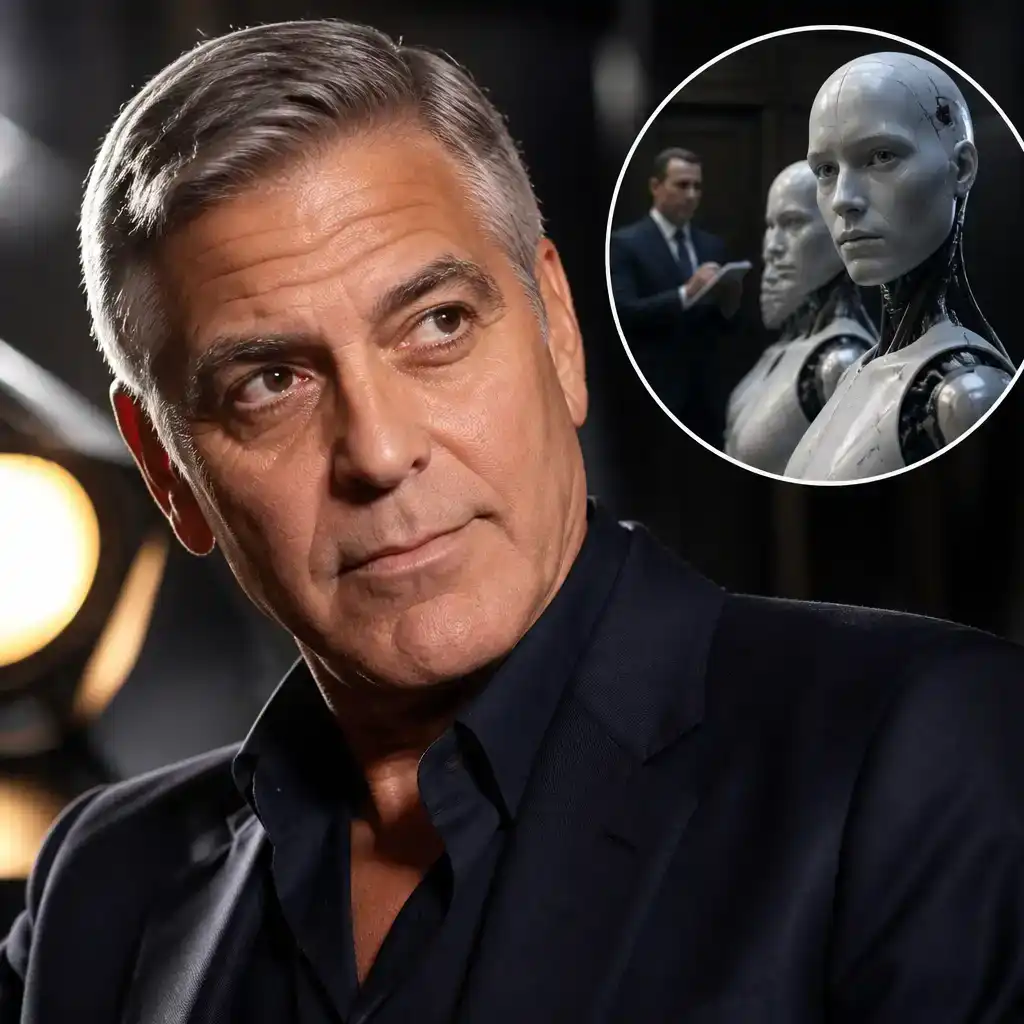
George Clooney’s comments on AI regulation were less a polished policy proposal than a warning that the people writing the rules may not understand the machinery. Speaking at a Venice Film Festival symposium hosted by CAA and Finch & Partners, the actor said he did not trust the government to oversee a technology capable of manufacturing evidence, rewriting history and reproducing people after their deaths.
That is not quite the same as arguing that artificial intelligence should remain unregulated. In fact, nearly every risk Clooney identified points toward enforceable safeguards. His position is closer to a familiar and inconvenient question: if governments cannot manage the technology, should the companies owned by some of the world’s richest people be trusted to manage themselves?
Clooney joined artist Kennedy Yanko, filmmaker Giuseppe Tornatore, Cardinal José Tolentino de Mendonça and National Gallery of Art president Darren Walker for a discussion about creativity’s future. The appearance followed his receipt of the Venice Film Festival’s Golden Lion for Lifetime Achievement on September 2.
Why does Clooney distrust government oversight?
Clooney illustrated his concern with a joke about Meta founder Mark Zuckerberg testifying before Senator Chuck Grassley.
“I sit and watch when Zuckerberg is testifying in front of, you know, a 94-year-old Chuck Grassley, and they’re like, ‘Well, how do you turn that computer on?’” he said. “These are not the people that you want to entrust the holy grail with.”
The age-based joke landed neatly, although it obscured a relevant detail: Grassley has been actively pressing for stronger judicial controls on AI. After staff working for two judges used artificial intelligence in orders containing invented parties, evidence, quotations or law, the senator called the technology “powerful and potentially dangerous” and urged the federal judiciary to introduce formal safeguards.
“The buck stops with them,” Grassley said of judges, rejecting AI as an excuse for human failures. Apparently, knowing where the power button is located does not guarantee sound policy, but neither does being young enough to locate it quickly.
Even OpenAI chief executive Sam Altman has supported a basic federal framework. Axios reported that Altman described voluntary government review of an advanced model as “a productive process.” The real dispute, then, is not simply government versus no government. It is about who sets the standards, how much power companies retain and whether anyone can enforce the rules.
How could deepfakes make real evidence weaker?
Clooney warned that artificial intelligence does more than produce false material. It can also make authentic images, recordings and documents easier to dismiss.
“It’s not just that you’ll see lies,” he said. “It also makes you question things that really do exist.”
Reuters reported that Clooney described deepfakes as technology that could “poison the well.” Once convincing fabrications become routine, genuine evidence can be waved away as synthetic. He used Holocaust denial as an example, warning that AI systems could give fabricated claims the same apparent weight as established facts.
The danger becomes more immediate when a fake depicts a political or military leader. Clooney asked what would happen if people saw a convincing video of Russian President Vladimir Putin announcing that he had launched a nuclear strike against the United States. The first minutes after such a video appeared would not leave much time for a careful seminar on media literacy.
Clooney said he had met leading AI developers but saw little progress on effective protections. He also worried that his likeness could be commercially exploited after his death, joking that he did not want to appear in a tampon advertisement 20 years later. The example was comic. The underlying issue of consent was not.
Are AI hallucinations already affecting courts?
Clooney said his wife, human rights lawyer Amal Clooney, had encountered legal material invented by artificial intelligence. AI tools can fabricate cases, citations and laws, he explained, while lawyers or judges who fail to verify the results may repeat those inventions in real proceedings.
Research supports that concern. Stanford University’s Institute for Human-Centered Artificial Intelligence found incorrect information in more than 17% of responses from Lexis+ AI and Practical Law AI. The rate exceeded 34% for Westlaw’s AI-Assisted Research.
Those products are designed specifically for legal work, rather than casual chat. An error rate of one in six, or worse, is not a minor technical inconvenience when someone’s rights, money or liberty may depend on the answer.
The judicial incidents cited by Grassley show how the problem moves from a model into an official document. AI generates the fiction, a human fails to check it and the authority of a court does the rest. Clooney’s warning therefore fits Grassley’s argument more closely than his joke suggested: the tools need controls, but human professionals remain responsible for what they sign.
What could artificial intelligence do to Hollywood jobs?
La Repubblica reported that Clooney estimated AI might eliminate roughly 30% of film-industry jobs, although he acknowledged that he did not know the actual figure. The uncertainty matters, but so does the direction of travel. Studios can already use synthetic voices, digital replicas and computer-generated performers to replace or reduce some forms of paid work.
Organised labour has responded by pursuing enforceable protections rather than trusting executives to show restraint. The Screen Actors Guild-American Federation of Television and Radio Artists, better known as SAG-AFTRA, said its June 2026 film and television contract strengthened protections against synthetic performers and unauthorised digital replicas.
Those provisions illustrate the gap in Clooney’s broader argument. Workers do not need regulators or unions to understand every technical detail inside an AI model. They need rules governing consent, compensation and acceptable use.
Venice Film Festival artistic director Alberto Barbera described artificial intelligence as a change potentially greater than the Industrial Revolution, while also asking what useful creative tools it could provide. That question leaves room for AI in filmmaking without assuming every available use should automatically become standard practice.
What protections already exist?
Some rules have begun to arrive, although they cover only parts of the problem. Federal removal requirements under the TAKE IT DOWN Act took effect in May 2026, targeting non-consensual intimate deepfakes. SAG-AFTRA’s contract addresses digital replicas and synthetic performers within covered film and television work.
Neither measure solves the broader risks Clooney raised about election disinformation, false military announcements, fabricated history or posthumous commercial use. They do show that regulation can focus on specific harms without requiring lawmakers to personally build an AI model before breakfast.
Clooney said uncertainty over who is “fully in charge” was part of the danger, particularly because the leading tools belong to extremely wealthy technology interests. Leaving those companies to police themselves would still be a regulatory choice, just one made without public accountability.
Which political figures did Clooney support?
The discussion also moved to the next US presidential election. Clooney praised Georgia Senator Jon Ossoff, Illinois Governor J.B. Pritzker and Kentucky Governor Andy Beshear as younger political figures who could bring new ideas.
“We need young voices in there that are coming up with some new ideas and some new thoughts,” he said.
He also stressed the need for checks and balances, arguing that disagreement is central to democracy. That principle applies rather neatly to artificial intelligence. Governments may lack technical expertise, companies have commercial incentives and courts are already discovering that software can invent legal authorities with remarkable confidence.
Clooney’s critique identifies the right danger but stops short of a complete answer. Distrust of government does not remove the need for oversight. It makes competent, specific and enforceable oversight more urgent.