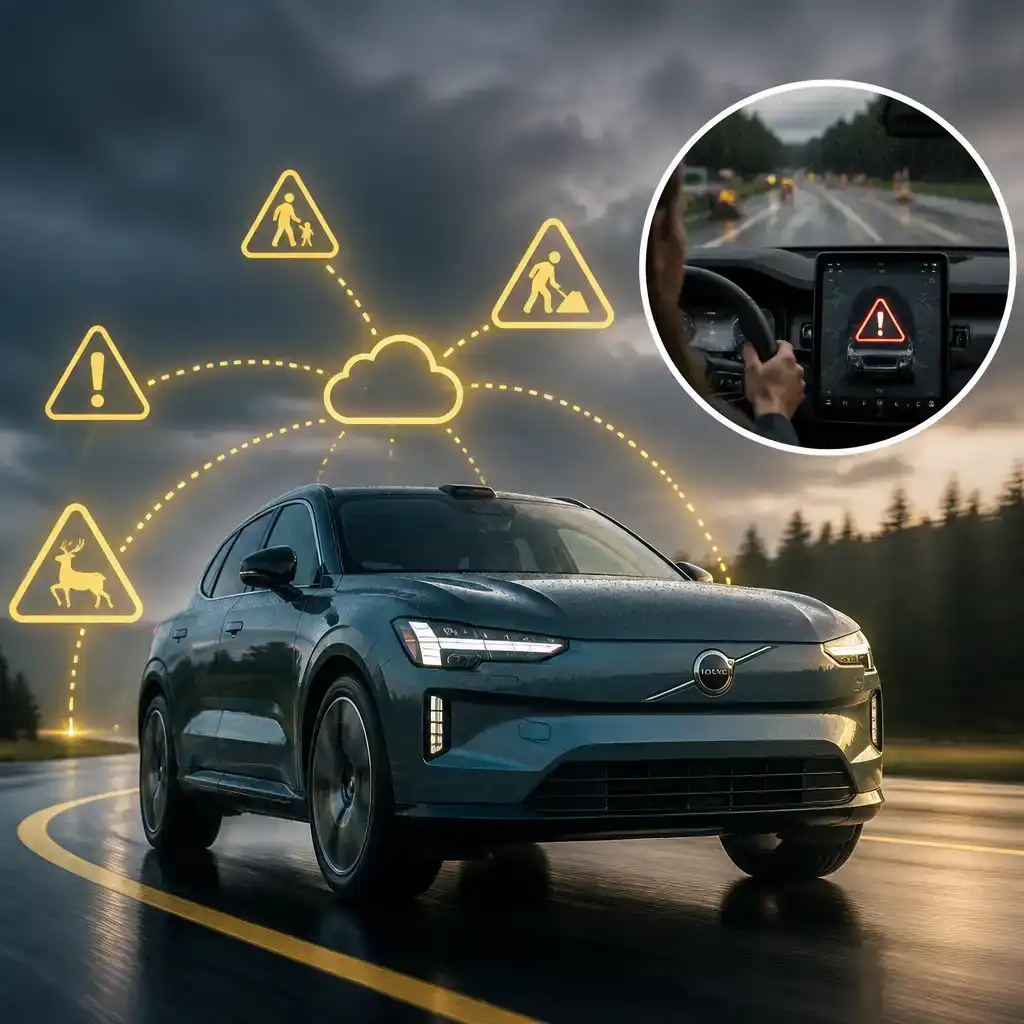
Rollout details are slightly less tidy. Motor1 and Autocar described the software as already delivered, while Volvo said the features “will be available” and noted that timing varies by model. Volvo's support pages had listed the same hazard categories by March 30, 2026, suggesting that some functionality, or at least its documentation, was already in place before the broader announcement.
Can the alerts reach cars from other brands?
Volvo says it shares safety information with traffic management centres and other vehicle manufacturers. In Europe, Autocar reported that the data can move through the Data for Road Safety network, meaning the warnings are not necessarily confined to vehicles wearing a Volvo badge.
That wider exchange matters because connected safety becomes more useful as more vehicles participate. A warning network with excellent technology but very few cars on a particular road is still a quiet network. Volvo has not disclosed regional fleet density, alert latency, detection accuracy or false-positive rates, so it is difficult to judge how consistent the coverage will be outside markets where its cars are common.
Motor1 reported that the smaller Volvo EX30 remains the main current model excluded from Volvo's older connected-alert network. Availability can also differ by model and market, adding another layer to what sounds, at first, like a simple software update.
Åsa Haglund, head of the Volvo Cars Safety Centre, said every car that shares “safety intelligence” can help other drivers prepare earlier. That is the central promise: one vehicle sees the problem, and others get a little more time to respond.
Why do animal and pedestrian warnings matter?
The hazards targeted are not minor edge cases. The Federal Highway Administration estimates that more than 1 million wildlife-vehicle collisions occur in the United States each year.
Pedestrian safety has also deteriorated sharply. The Insurance Institute for Highway Safety reported that US pedestrian deaths increased 72 percent from their 2009 low and accounted for 18 percent of crash fatalities in 2024. According to the National Highway Traffic Safety Administration, a pedestrian was killed every 74 minutes that year.
Earlier warnings could give drivers more time to slow down when an animal, cyclist or pedestrian is difficult to see. Their real-world value, however, will depend on how quickly the system identifies a danger, uploads it and reaches approaching vehicles. Volvo has not published those performance figures.
Cloud-based alerts also involve a participation trade-off. Drivers must allow their cars to share information, while the network needs enough opted-in vehicles to produce useful coverage. Privacy controls are necessary, but fewer participants can mean fewer warnings. Software has once again discovered that cooperation is helpful.
Volvo has used connected safety since 2016
This is an expansion rather than Volvo's first attempt at cars exchanging warnings. The Swedish manufacturer has used connected vehicle technology since 2016 through a cloud-based system developed with Ericsson.
That earlier system can warn drivers about slippery roads using information from steering, braking and acceleration sensors. It can also notify approaching cars when another Volvo activates its hazard lights, indicating that a vehicle may be stopped or positioned unexpectedly.
The newer categories broaden that approach from vehicle behaviour and road conditions to hazards spotted around the car. More powerful onboard computers in Volvo's latest electric vehicles handle the real-time processing, while cloud services distribute the resulting alerts.
Spatial Audio is also coming to the EX90
Volvo also announced a less urgent but more audible upgrade for the EX90. Apple CarPlay users will gain support for Spatial Audio, which Volvo says creates a “multi-dimensional and immersive sound experience” by placing music and vocals around the cabin.
There is a hardware condition attached. The feature requires the optional 25-speaker Bowers & Wilkins audio system, so it will not appear in every EX90. Cars may be learning to warn each other about wildlife, but premium audio remains safely behind the options list.