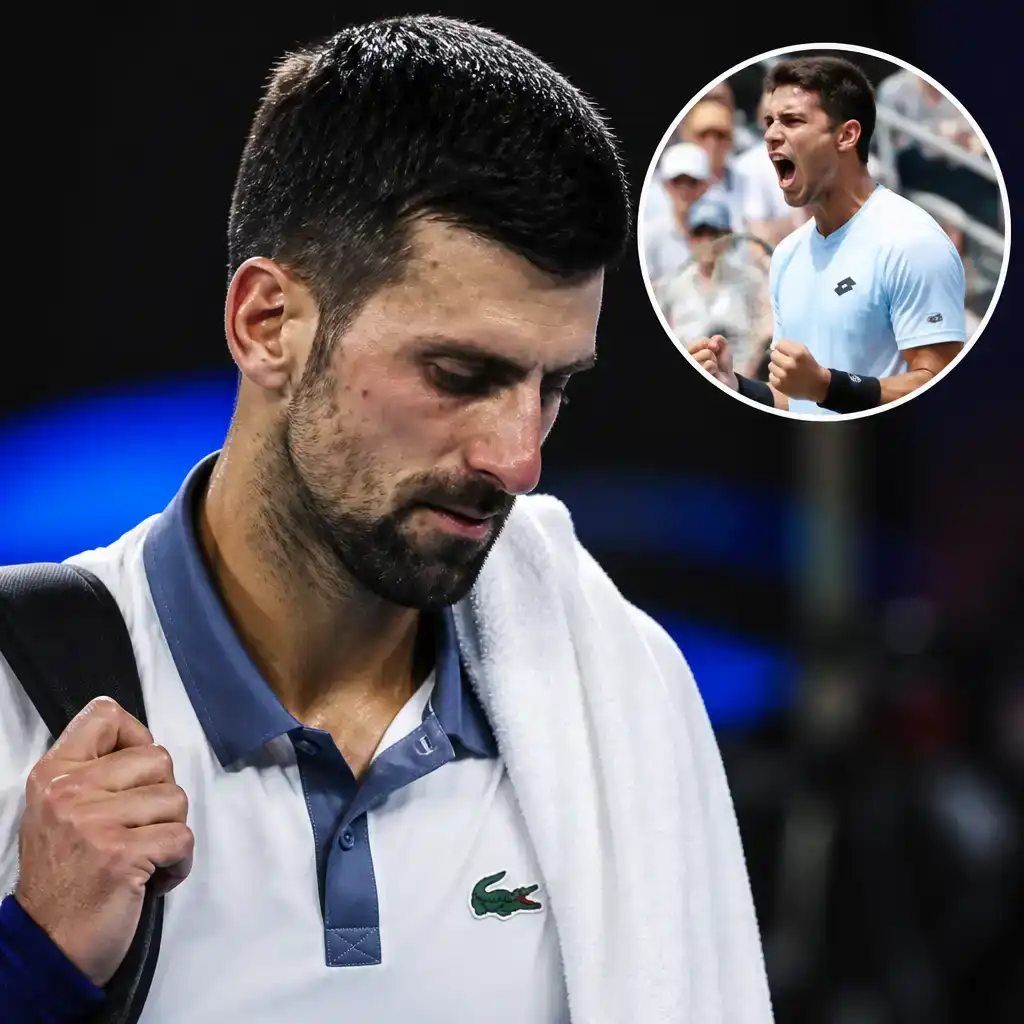
As conditions cooled under the roof, Djokovic recovered enough to win the second set. He became more animated in the third and punished a poor Navone service game to break for 5-4 before moving two sets to one ahead. For most of his career, this has been the point where the opponent discovers that the difficult part was merely the introduction.
This time, Djokovic’s body stopped cooperating. Cramps set in, his back and shoulder deteriorated, and Navone swept through the final two sets. The Argentine won 104 service points to Djokovic’s 94 and converted six of 17 break opportunities. Djokovic also produced 10 double faults.
Why is the recurring illness a bigger concern?
After the defeat, Djokovic said the problem had followed him through much of the season.
“It’s something that I have been carrying pretty much every match this year, vomiting, throwing up,” he said. “And then my whole body starts to collapse basically, cramping and pain. The back just gave up in the end and shoulder, and I couldn’t close it out.”
His official website described the decisive issue more narrowly as a back injury. Djokovic’s own post-match account suggested something broader, however, and he did not provide a diagnosis or recovery timetable.
Two weeks earlier, similar symptoms affected him during a surprise Cincinnati Open loss to Argentina’s Thiago Tirante. Djokovic said then that heat and humidity aggravated a longstanding health condition that had troubled him in oppressive weather for several years. After losing in New York, he called it a “serious issue.”
That distinction matters. Physical decline at 39 is hardly a medical mystery, but recurring vomiting followed by cramping and widespread pain cannot be explained simply by the number on a birthday cake. Until Djokovic and his team identify what is happening, every demanding match in warm conditions carries the same uncomfortable question.
How close did Djokovic come to stopping?
Djokovic later revealed that he considered retiring from the match and “pretty much despised every moment” on court because of his condition. He continued for five sets, helped in part by the support of the New York crowd.
“The crowd really touched my heart,” he said, while apologising for failing to produce the performance he wanted.
He managed a smile while congratulating Navone at the net, then appeared close to tears again as he left for the locker room. The reaction reflected more than a bad evening. Djokovic entered the tournament chasing a standalone record 25th Grand Slam singles title, which would move him beyond Margaret Court’s total of 24.
The draw also seemed to offer an opportunity. World number one Jannik Sinner was absent through injury, while defending champion Carlos Alcaraz arrived after a long recovery from a wrist problem. Djokovic had reached at least the semi-finals at six of the previous seven majors, so another deep run was hardly a sentimental fantasy.
Instead, his sequence of 78 consecutive Grand Slam appearances without a first-round loss ended. His previous opening defeat came against Paul Goldstein at the 2006 Australian Open.
How significant is Navone’s victory?
Navone arrived with limited evidence that such an upset was coming. He had won only one previous match at the US Open and held a 1-6 career record against top-10 opponents, according to L’Équipe. He had also never advanced beyond the second round in New York.
None of that made the victory accidental. Navone survived Djokovic’s early lead, remained focused while the stadium grew quiet and responded after falling behind by two sets to one. When Djokovic’s movement and serving deteriorated, Navone kept him working rather than waiting for a retirement.
Rankings published around the tournament placed Navone between No. 44 and No. 49, depending on the date used. Whatever the administrative variation, this was among the biggest victories of his career.
Djokovic was careful not to let his physical problems erase the winner’s role. Calling Navone “a nice guy and a fighter” was both accurate and necessary. Illness may explain why Djokovic faded, but Navone still had to complete five sets against the most successful men’s major champion in history. Tennis does not award the result for sympathetic circumstances, which is probably for the best.
What does the loss mean for Djokovic’s future?
The immediate damage extends beyond another missed chance at a 25th major. Djokovic had semifinal ranking points to defend in New York, and AS reported that losing them will push him outside the world’s top 10 for the first time since July 2018. The same report placed him 11th in the race to qualify for the ATP Finals.
A lower ranking creates practical problems:
- tougher opponents can appear earlier in major draws
- fewer protected seedings increase the risk of meeting Sinner or Alcaraz before the later rounds
- qualification for the season-ending ATP Finals becomes less secure
Those consequences can feed into each other. Harder early matches demand more physically, precisely when Djokovic is trying to manage a condition that worsens under stress, heat and humidity.
Retirement questions will inevitably follow, especially after he admitted considering stopping during the match. Earlier this month, however, Djokovic said in a documentary that he had placed no “expiry date” on his career and asked why he should discuss retirement while still proving he could win.
His position has not formally changed. After the Navone loss, he said his priority was finding out “what’s going on and how far I can go this way.” That is not a farewell announcement, but it is less defiant than his usual answer. For now, the central issue is not whether Djokovic still wants to compete. It is whether his body will let him do it on the terms he expects.