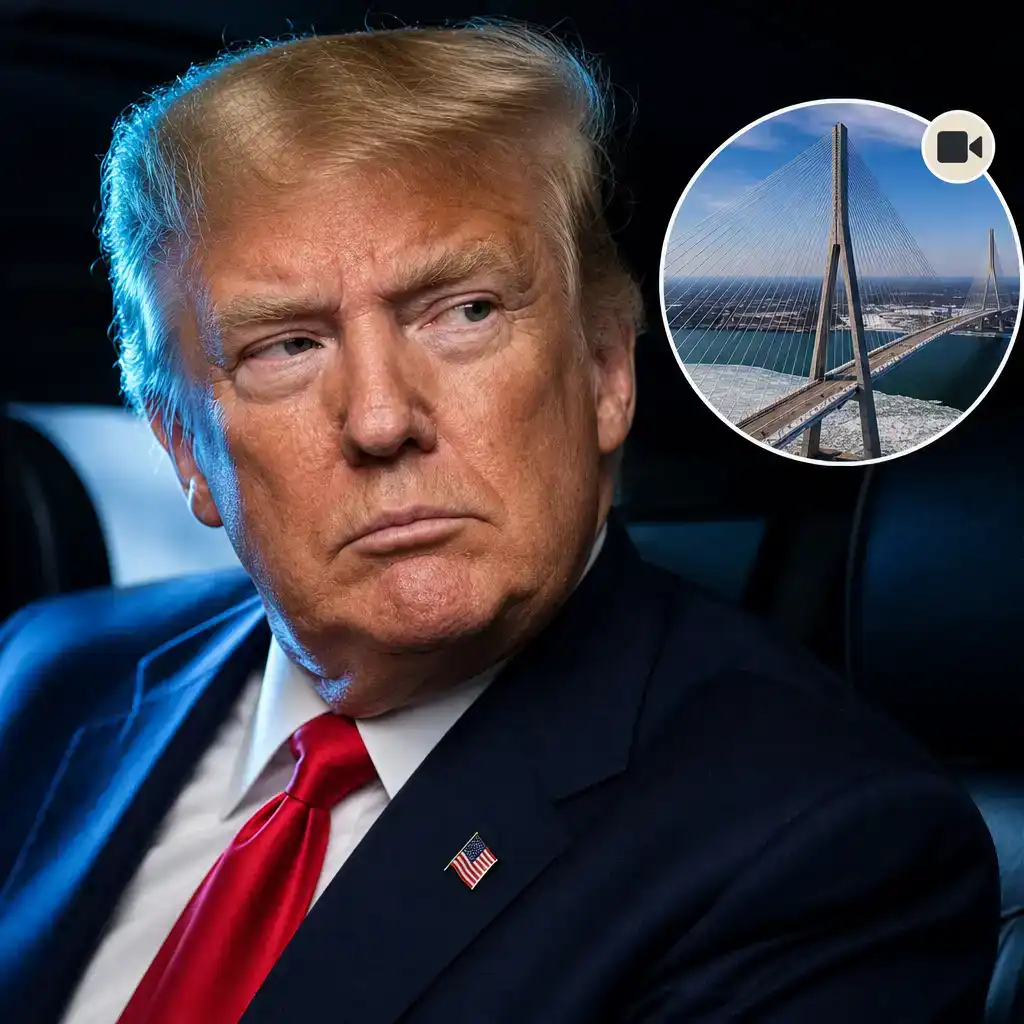
Windsor Mayor Drew Dilkens said the new bridge should give the trucking industry more certainty, although he described the present trade relationship between the countries as “regretful.” Republican Representative Lisa McClain has estimated that the crossing could save truckers $2.3 billion over 30 years.
Those practical gains explain why Canadian officials were determined to get the bridge open, even as the politics around it became steadily less practical.
How Canada ended up financing the project
Nearly 15 years ago, Canada agreed to finance the roughly $4.5 billion project in full to overcome political resistance in the United States and address the trade bottleneck. The bridge is jointly owned by Canada and Michigan, but Ottawa took responsibility for construction costs.
Under a 2012 agreement, Canada was expected to recover its investment through toll revenue before Michigan received a share. That arrangement remained in place as construction moved forward.
The project also faced sustained opposition from the Moroun family, whose Ambassador Bridge would gain a publicly backed competitor. Billionaire Matthew Moroun, a Trump donor, met with US Commerce Secretary Howard Lutnick shortly before Trump publicly intervened in the opening, according to The New York Times.
Early in 2026, shortly before a planned ribbon-cutting ceremony, Trump threatened to prevent the bridge from opening unless the United States received more authority and ownership. “We should own, perhaps, at least one half of this asset,” he said.
The final deal does not change ownership. It does, however, redirect a substantial portion of the toll proceeds.
What the new toll agreement actually says
In June, Prime Minister Mark Carney said Canada had accepted a US request to delay the opening while negotiations continued. The resulting agreement gives 50% of the bridge’s net revenue during its first 15 fiscal years to an economic development fund controlled solely by the US government.
The published terms define net revenue as total bridge revenue after operating costs. They do not say that Canada’s construction debt must be repaid before the revenue is divided.
That wording conflicts with Carney’s earlier description, which suggested revenue sharing would begin only after Canadian taxpayers had recovered the cost of the bridge. CBC, Global News and Bloomberg highlighted the discrepancy. Carney later acknowledged that he “should have been clearer.”
He has said the original Canada-Michigan repayment agreement remains intact and that the new arrangement with Washington operates “in parallel.” The written deal preserves the 2012 agreement, but the revenue formula leaves an important question for taxpayers: how quickly can Canada recover billions in construction spending if half of net toll revenue is being sent elsewhere for 15 years?
The agreement also gives Washington limited approval authority over certain toll changes. US approval may be required if increases exceed 10% and regional averages, or if tolls are cut below regional averages.
Why Carney is facing criticism at home
Trump celebrated the agreement as “MUCH BETTER” for the United States. In Canada, the response has been less enthusiastic.
Carney entered office promising a firm response to Washington, but his government has now made several moves critics describe as concessions. Canada scrapped a digital services tax opposed by major US technology companies and removed some retaliatory tariffs while trying to negotiate a broader trade agreement.
Conservative Member of Parliament Shuvaloy Majumdar said the bridge dispute showed Canada was negotiating “with weakness.” He argued that Canadians were tired of being treated as “a punching bag” by Trump and wanted their government to defend the country with equal resolve.
Ontario Premier Doug Ford took a different view, praising Carney for doing “an excellent job of getting this deal done.” Ford has nevertheless called for “tariff for tariff, dollar for dollar” retaliation if Trump proceeds with the threatened duties.
Former Canadian diplomat Colin Robertson described the toll arrangement as a concession but said it was necessary to protect cross-border supply chains. Businesses and communities on both sides, he noted, had been pressing for the bridge to open.
The bridge dispute is moving into US politics
The controversy has also become an issue in Michigan’s closely watched Senate race. Democratic candidate Mallory McMorrow has linked the delayed opening to the Moroun family’s donations to Trump and framed the episode as an anti-corruption issue.
“Open this damn bridge,” she said, accusing Trump of protecting a donor.
Trump, meanwhile, has said Canada has been “very, very tough on us.” His intervention transformed an infrastructure opening into another test of a strained bilateral relationship, one in which completed construction has not guaranteed political certainty.
The bridge may still begin carrying vehicles on July 27, giving manufacturers and drivers the additional capacity they have awaited for years. But the argument over its revenue, and the gap between Carney’s initial explanation and the written terms, will continue after the first trucks cross.