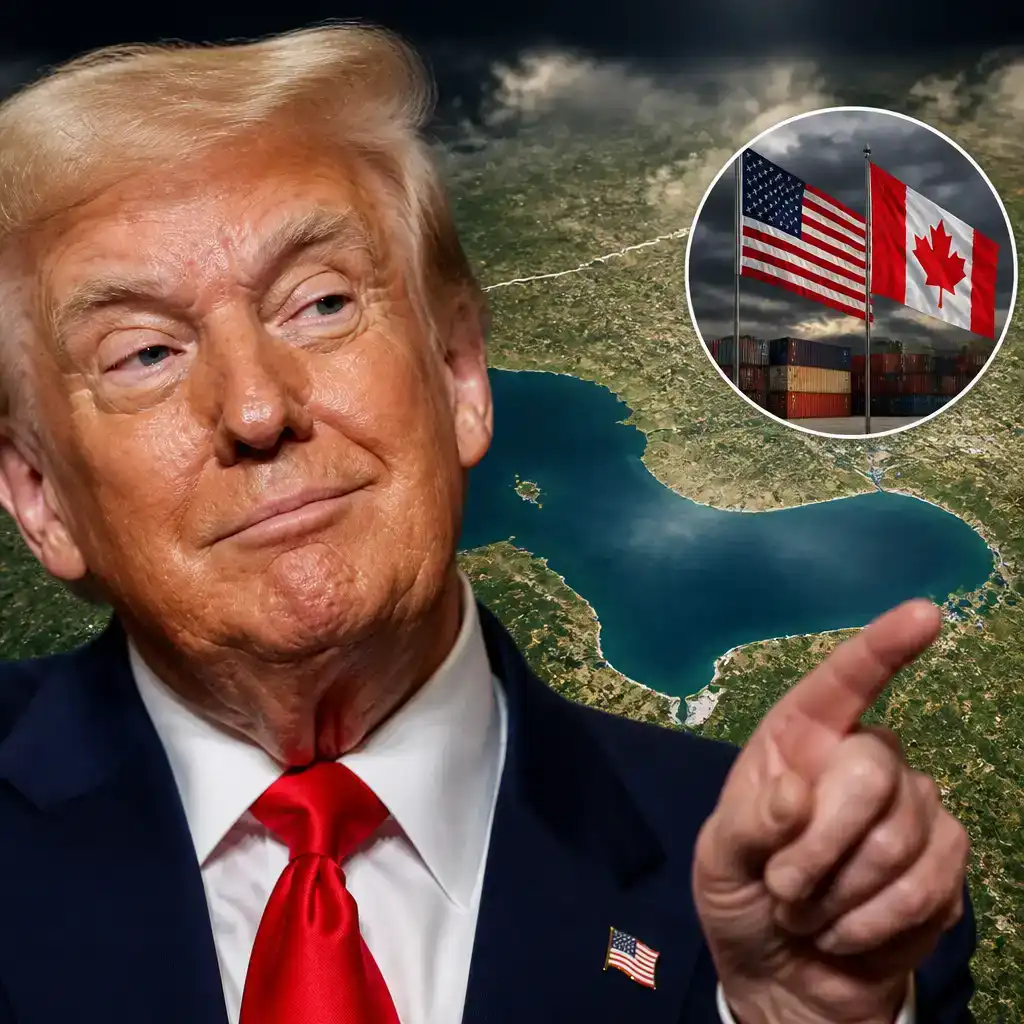
President Donald Trump has proposed renaming Lake Ontario Lake America, posting an altered regional map as trade relations between the United States and Canada deteriorate. The suggestion may be largely symbolic, but the tariffs accompanying it are very real.
Trump shared the proposal on Truth Social on August 25, then posted a map on which the lake’s existing name had been replaced. Some early accounts described a video of Trump personally crossing out Lake Ontario and writing in the new label. However, reporting from the Associated Press, ABC News, CBS News and The Washington Post described the material as an altered map or image, not footage of the president editing it himself.
A day later, Trump told conservative broadcaster Glenn Beck that people assumed he was joking about the change. “Maybe I wasn’t,” he said, pointing to his earlier designation of the Gulf of Mexico as the Gulf of America. Apparently, one major geographic renaming was not enough paperwork.
Can Trump actually rename Lake Ontario?
The lake sits across the international border, with shores in both Ontario and New York. That makes a unilateral name change considerably less straightforward than updating labels on US government maps.
According to the Associated Press, no single international organization controls the naming of international bodies of water. The United States could adopt a different name for domestic federal use, but that would not require Canada, international mapmakers or other governments to follow along.
The current name also has much deeper roots than either country. Ontario derives from the Huron word oniatarí:io, commonly translated as “lake of shining waters.” The name predates both modern Canada and the United States.
Ontario Premier Doug Ford was not especially troubled by the cartographic proposal. “It’s always going to be Lake Ontario here in Canada,” he told CBS News, adding that Trump could call it whatever he wanted on the American side.
That response dealt with the naming issue quickly. The trade dispute beneath it is proving rather more expensive.
Why are the United States and Canada trading tariffs?
The proposed rebrand followed the collapse of negotiations between Washington and Ottawa. The failed talks triggered 50% US tariffs on roughly $20 billion worth of Canadian goods, according to the Associated Press.
Canada announced matching tariffs covering about $20 billion in American products. CBS News reported that the Canadian measures are scheduled to take effect on September 8.
The two governments disagree over who disrupted the negotiations. Ford accused Washington of repeatedly changing its demands. Vice President JD Vance and US Trade Representative Jamieson Greer instead blamed Canada for introducing last-minute conditions.
Asked by CNN about Ford’s claim that the United States kept shifting its position, Trump replied that it “sounds like me.” The comment did not exactly reinforce his administration’s competing account.
Canadian Prime Minister Mark Carney has taken a firmer public line, saying Canada will not accept treatment as a subsidiary of the United States. The language reflects a broader concern in Ottawa that the dispute is no longer confined to individual products or negotiating details.
Who pays when cross-border trade slows?
The economic exposure extends well beyond Canada. Ontario is the largest export destination for more than a dozen US states, according to The Washington Post. Companies on both sides rely on supply chains that cross the border repeatedly, particularly in the automotive, energy and agricultural sectors.
That integration means tariffs can accumulate as components move between factories before a finished product reaches consumers. A levy presented as pressure on Canada can therefore raise costs for American manufacturers, farmers and buyers as well.
The dispute now has two very different dimensions:
- A symbolic proposal to replace the name of a centuries-old shared lake
- Reciprocal 50% tariffs affecting about $40 billion in combined trade
The first offers an eye-catching map and predictable outrage. The second threatens jobs, prices and commercial relationships built over decades.
For now, Canada still calls the water Lake Ontario, international naming practice gives Washington no power to compel otherwise, and the original name remains firmly attached to maps outside Trump’s social media account. The tariffs, unlike the new label, do not require anyone to recognize them before they take effect.