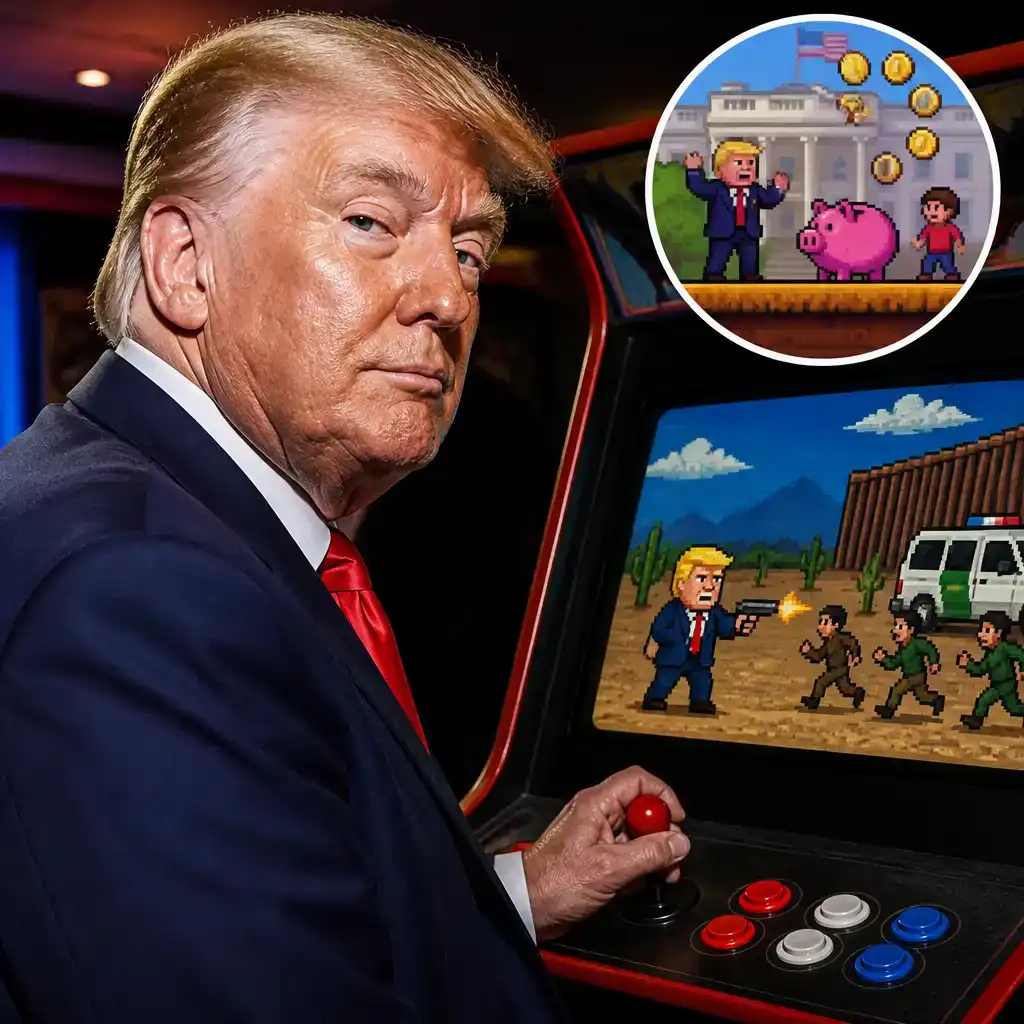
The White House arcade games have turned Donald Trump’s policy agenda into a set of retro diversions about border enforcement, legislation, food standards and savings accounts. The administration says the project tells the story of its policies. Critics see a government treating deportations and financial pressure as material for a lunch-break game.
Unveiled on Thursday, the arcade remains available on the White House website. It currently features five playable titles and advertises a sixth as “Coming Soon.” Apparently, five rounds of policy-themed nostalgia were not enough.
What are the five games?
Each title borrows familiar mechanics from an older commercial game while attaching them to one of President Trump’s priorities:
- Build the Wall is a falling-block game resembling Tetris. Players arrange sections of a border wall against what the official description calls a “coming horde.” Contrary to some early reports, this is not the game in which players chase small green figures.
- Rio Run uses a Snake-style format. AFP reported that players control border official Tom Homan while pursuing migrants along a fence. The Associated Press described the character more cautiously as resembling Trump.
- Supply Line recalls the arcade game Tapper. Players reject food that does not meet the standards of Health Secretary Robert F. Kennedy Jr.’s “Make America Healthy Again” programme.
- Flappy Bill borrows from Flappy Bird, with a bald eagle carrying legislation above the National Mall while avoiding obstacles.
- Trump Savings Tycoon asks players to catch falling cash and gold bars to fill children’s Trump Accounts.
The White House promoted the collection with the message: “CAN’T STOP WINNING. Build the wall. Deport. Fill a Trump Account.” An unnamed official told the Washington Examiner that the arcade was intended to “tell the story” of Trump’s agenda and draw a contrast with Democratic policies.
That makes the games more than a stray online novelty. They are part of a broader effort to package government policy as shareable entertainment, with simple controls, bright graphics and rather less room for complicated consequences.
Why are critics angry about the arcade?
The backlash has focused on both tone and timing. Senator Matt Lesser pointed to soaring household energy costs while mocking the administration’s choice of distraction.
“Heating oil is near an all-time high but hey you can play Border Czar Tom Homan in a video game,” Lesser wrote on X.
Border rights organisations were particularly critical of games that turn immigration enforcement into a scoring system. Amerika Garcia Grewal, co-director of the Frontera Federation in Eagle Pass, Texas, told AFP the project reduced real suffering to entertainment.
“Makes me sick. They’ve been playing games with people’s lives for years, now they’ve made a video game of what they’re doing,” she said. Grewal added that the designers “have lost touch with what it means to be human and care for others.”
Adriana Jasso, programme coordinator for AMIGOS San Diego Community, said the collection displayed a fundamental “lack of seriousness” from the administration. “The cruelty, the extremity of the administration … is no longer surprising,” she said.
The criticism is not simply that a government website contains games. Public agencies have used interactive tools for years. The objection is that deportation and border enforcement have been presented as uncomplicated contests with winners, losers and a score counter.
Rising costs make the timing more awkward
Trump has faced mounting criticism over the economic effects of the war on Iran and his domestic programme. The Strait of Hormuz has remained closed for nearly six months, disrupting global supplies of oil, natural gas and fertiliser.
Texas Public Radio reported that the resulting pressures pushed US inflation above the Federal Reserve’s 2 percent target. Higher energy and transport costs have added to the strain on household budgets, which helps explain why a digital arcade celebrating administration policy has not impressed everyone.
Other decisions have contributed to that pressure. The Supreme Court partly struck down Trump’s tariff policies earlier in 2026. Economists have also pointed to cuts in food assistance and the expiration of Affordable Care Act tax credits as additional costs for families.
The savings game does at least refer to a real and substantial federal programme. According to the US Department of the Treasury, more than 6.5 million families had registered for Trump Accounts by August, including over 1.5 million children eligible for a federal contribution.
The Internal Revenue Service says the $1,000 government payment is restricted to US-citizen children with Social Security numbers born between January 1, 2025, and December 31, 2028. The accounts generally cannot be accessed before the year a child turns 18. Catching animated gold bars is, unsurprisingly, the less administratively demanding version.
Did the White House borrow gaming brands?
Later coverage raised another issue: the arcade’s promotional material appears to imitate the visual and audio identity of established gaming companies.
Specialist outlet Automaton reported that promotional clips resemble the startup sequences used by Nintendo GameCube, Xbox 360 and PlayStation 2. The arcade also uses Sega-style branding and music associated with Sonic the Hedgehog, according to coverage of the launch.
Shacknews described the project as another example of the administration appropriating copyrighted entertainment imagery for political messaging. No confirmed public response had been reported from Sega, Nintendo, Sony, Microsoft or the Tetris Company.
Resembling classic game mechanics does not automatically establish copyright infringement. Specific music, branding and audiovisual sequences can raise different legal questions, however, particularly when they are closely copied. For now, the companies involved appear to be keeping their controllers down.
The White House has shown no sign of reconsidering the project. Its triumphant promotional message remains in place, the five games are still playable, and another title is waiting in the queue.