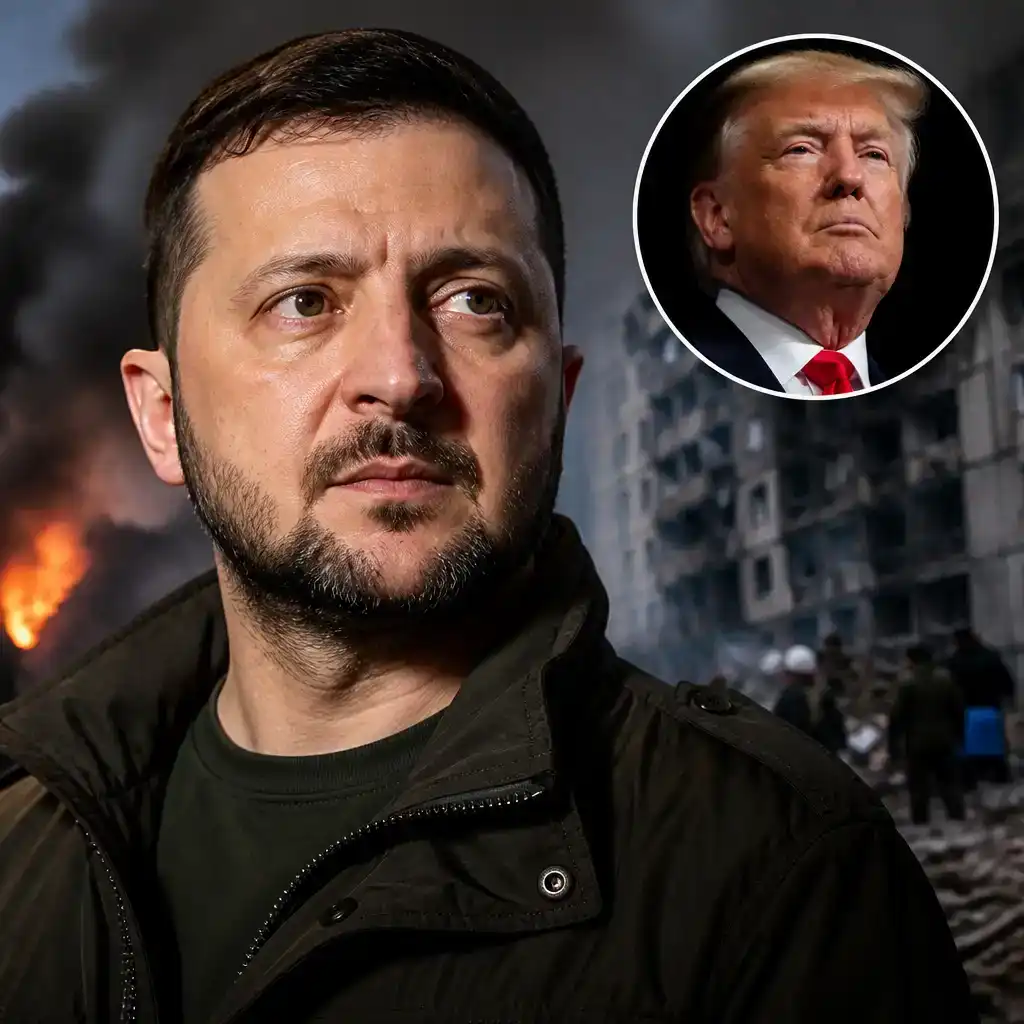
A Ukraine presidential election has suddenly become part of Donald Trump’s pressure campaign against Volodymyr Zelenskyy. The US president said on Saturday that it was “time for Ukraine to get a new president,” blaming Kyiv’s strikes on Russian oil refineries for squeezing global diesel supplies.
The demand is entangled with Trump’s fuel arrangement with Moscow. Axios reported that Zelenskyy ignored roughly six US requests to halt refinery attacks, according to an American official. Still, the diesel shortage has other causes. The Associated Press reported that supplies were also disrupted by the US-Israeli war against Iran, an inconvenient complication for the simpler blame-Zelenskyy version.
Trump can call for a change in Kyiv. He cannot schedule one. Ukrainian law, continued Russian attacks and the practical challenge of finding millions of voters scattered across military units, occupied territory and foreign countries remain stubbornly involved.
Can Ukraine legally vote during the war?
Zelenskyy’s five-year term formally expired in 2024, but that does not mean the presidency became vacant. Ukraine’s Constitution says the sitting president continues exercising authority until a successor takes office.
The restriction on presidential elections during martial law comes from Ukrainian statute rather than an explicit constitutional ban, according to an analysis by Ukraine’s National Institute for Strategic Studies. Martial law has remained in force throughout Russia’s full-scale invasion.
That distinction matters legally, but it does not solve the larger legitimacy problem. A wartime election would need to include soldiers at the front, refugees abroad, internally displaced citizens and people living under Russian occupation. Campaigning, monitoring polling stations and protecting voters would also require conditions rather less explosive than the current ones.
Zelenskyy responded to Trump by saying Ukraine could hold a vote if Russian President Vladimir Putin guaranteed a 60-day ceasefire. Kremlin spokesman Dmitry Peskov rejected that proposal and offered only a suspension of strikes on election day.
Russia has continued attacking Ukrainian energy facilities despite Trump’s announcement of an “energy ceasefire,” the Associated Press reported. Zelenskyy said Moscow had not stopped its assaults. Apparently, one quiet polling day is the Kremlin’s current idea of electoral infrastructure.
Why a ceasefire remains the central condition
European officials have backed Kyiv’s position that voting requires more than a date on the calendar. European Union foreign-policy chief Kaja Kallas said elections need a ceasefire and that Zelenskyy was prepared to hold them “as soon as possible” once one existed.
Ukrainian Foreign Minister Andrii Sybiha said Zelenskyy “leads our nation in a time of war.” French President Emmanuel Macron, meanwhile, accused Russia of continuing to reject a ceasefire while intensifying its attacks.
The dispute also reaches beyond electoral law. Axios reported that US envoys Steve Witkoff and Jared Kushner postponed a planned trip to Moscow while seeking clarity on whether Ukraine and European governments would accept a new American proposal.
Six bipartisan US senators urged Trump to reverse the Russian diesel agreement, warning against giving Putin a “financial lifeline.” Their intervention sharpened the central question around Trump’s demand: whether the election push is primarily about Ukrainian democracy or leverage for a fuel deal with Russia.
Many Ukrainians do want political renewal after years of war and repeated corruption scandals. That does not automatically translate into support for an immediate ballot held under bombardment. Nor does a politician’s trust rating tell anyone how an actual campaign would finish.
Valerii Zaluzhnyi leads the field of possible challengers
Former commander-in-chief Valerii Zaluzhnyi, now Ukraine’s ambassador to the United Kingdom, is widely viewed as Zelenskyy’s most formidable potential rival.
“At least since 2023, and especially since 2024, after his resignation, the most probable alternative to Zelenskyy, his most dangerous competitor who can defeat him in the election is Valerii Zaluzhnyi,” Volodymyr Fesenko, head of Kyiv’s Penta think tank, said.
A Rating Group survey conducted from October 3 to 5 found that 64 percent of Ukrainians trusted Zaluzhnyi, while 25 percent distrusted him. Those figures measure public trust, not voting intention, so they cannot be treated as an election forecast.
His popularity rests heavily on Ukraine’s early battlefield performance. Zaluzhnyi oversaw the defence of Kyiv in 2022 and counteroffensives that recovered about 40 percent of the territory Russia had occupied after launching its full-scale invasion.
Zelenskyy removed him by official decree on February 8, 2024, after the much-anticipated 2023 counteroffensive failed to produce a major breakthrough. He was later sent to London as ambassador.
The 53-year-old has kept his political views deliberately limited. He rarely gives interviews or appears on television, preferring occasional essays about military strategy, long-term security and Western guarantees. His positions on economic reconstruction, Ukraine’s demographic crisis and European Union membership remain much less developed in public. High trust and a thin policy platform can coexist quite comfortably until a campaign begins.
Could Zelenskyy still win another term?
Zelenskyy should not be treated as a departing president simply because Trump would prefer one. The former comedian won the 2019 election with 73 percent of the vote, the strongest result in Ukraine’s post-Soviet history.
The October survey found that 53 percent of Ukrainians trusted him and 40 percent did not. His administration has faced repeated corruption controversies, including scandals involving people in his political circle, but he retains substantial wartime support.
External attacks have sometimes strengthened him. After Zelenskyy’s combative Oval Office meeting with Trump in February 2025, his approval rating climbed to a wartime high of 67 percent. Another public attempt by Washington to remove him could produce a similar rally, although Ukrainian voters may eventually judge domestic appointments and governance more harshly than diplomatic arguments.
Kyiv analyst Igar Tyshkevych said Zelenskyy originally came to power promising to reset government and select the most competent officials rather than the most personally trusted. His appointment record may now be one of his larger political vulnerabilities.
Still, an election held quickly would favour candidates who already possess national recognition, campaign structures or military prestige. That places Zelenskyy and Zaluzhnyi well ahead of most of the names circulating around Kyiv.
Kyrylo Budanov offers another military option
Lieutenant General Kyrylo Budanov, 40, is the other prominent military figure with a plausible route into presidential politics. Zelenskyy appointed the former military intelligence chief to lead the presidential administration in January.
Budanov built his reputation through covert operations against Russia. He took part in a 2016 mission in Russian-annexed Crimea that sought to place explosives at a military airfield. Zelenskyy appointed him head of the Defence Ministry’s Main Directorate of Intelligence, known as GUR, in 2020.
Under Budanov, the agency expanded into an aggressive, technology-focused intelligence and special operations force. Ukrainian sea drones damaged Russia’s Black Sea Fleet and helped push many of its vessels away from occupied Crimea towards Novorossiysk.
The Rating Group survey found that 53 percent of Ukrainians trusted Budanov, equal to Zelenskyy’s figure, while 31 percent distrusted him. Again, that is not the same as saying 53 percent would vote for him.
Budanov’s appeal resembles Zaluzhnyi’s in one important respect: both are associated with military competence rather than traditional party politics. Yet neither has run a national civilian administration or presented a detailed domestic programme. Winning respect during a war is one task. Explaining taxes, pensions and reconstruction budgets is another.
Mykhailo Fedorov brings technology and political risk
At 35, Mykhailo Fedorov is the youngest major name under discussion. He became minister of digital transformation in 2019 and oversaw the launch of Diia, the government smartphone platform offering more than 100 public services.
Zelenskyy appointed Fedorov defence minister in January despite his lack of military experience. His responsibilities included logistics, procurement, budgets, anti-corruption reforms and negotiations over billions of dollars in Western assistance and loans.
Fedorov increased transparency in purchases of weapons, food and medical supplies. He also expanded Ukraine’s use of aerial drones against Russian supply routes, fuel depots, refineries and air-defence systems, while promoting ground robots for deliveries and casualty evacuation.
Those reforms reportedly created tension with commander-in-chief Oleksandr Syrsky, who pushed for Fedorov’s dismissal. Fedorov was replaced in July, prompting weeks of demonstrations by supporters. Rating Group polling showed his approval rising from 35 percent in June to 65 percent in July.
That surge did not last. After Fedorov said in August that Ukraine should hold a presidential election, his approval fell to 38 percent. The episode suggested that public interest in fresh leadership does not necessarily mean enthusiasm for voting before the security situation improves.
The remaining field has recognition problems
General Yevhenii Khmara, who replaced Fedorov as defence minister, ranked fifth among the figures measured. A career intelligence official with little previous public profile, he was trusted by 29 percent and distrusted by 16 percent.
His main obstacle was simpler: 43 percent of respondents did not know who he was. That leaves room to grow, but also requires introducing a defence minister to nearly half the electorate during a war.
Foreign Minister Andrii Sybiha and former President Petro Poroshenko each recorded 24 percent trust. Sybiha, a career diplomat, has helped secure support from Poland and Türkiye but lacks a broad domestic political base.
Poroshenko has the opposite problem. Everyone knows him, and many have already decided against him. The former president, who lost to Zelenskyy in 2019, was distrusted by 70 percent of respondents. His record includes a scandal involving overpriced military spare parts, which rather weakened the anti-corruption credentials that helped bring him to power in 2014.
Former Prime Minister Yulia Tymoshenko, another longstanding political figure, is under investigation for corruption. Tyshkevych argued that neither she nor Poroshenko has a realistic chance against the stronger wartime contenders.
For now, the most credible challengers come from Ukraine’s military and security establishment. But before voters can compare candidates, Russia would have to stop attacking long enough for the country to organise a credible ballot. That remains the part no opinion poll can arrange.