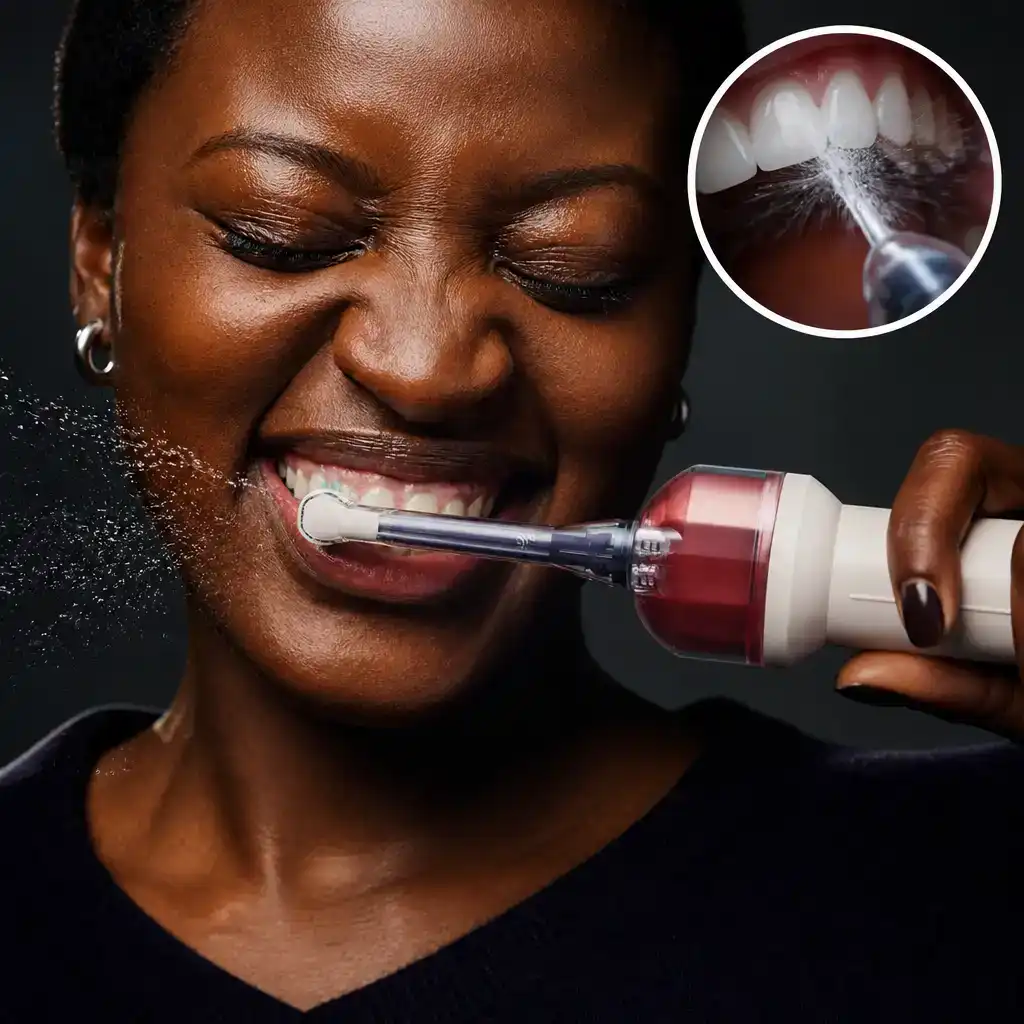
The idea, he told The Independent, came from the inconvenience of treating brushing, flossing and interdental cleaning as separate jobs: “Why can’t you do them both in one action?”
An early Allure test found the spray pleasant and generally reliable, including when the handle was held upside down. It briefly stopped activating behind the lower teeth when the area became too dark for the camera, showing that even AI-enabled dental equipment remains subject to the radical concept of needing enough light.
What does the brush do differently?
Each brush head combines soft outer bristles for the gumline with firmer inner bristles intended to remove stains. Dyson’s product page lists 245 oscillations per second. That differs from an early report describing nearly 1,000 oscillations per second, while The Independent cited 58,000 vibrations per minute, apparently measuring another aspect of the brush’s movement.
The oscillation angle changes continuously as the brush operates. An RFID tag in each head tracks use and prompts the owner to replace it after about three months. Dyson had not announced replacement-head pricing at launch, leaving buyers with at least one future expense still available as a surprise.
The handle contains a 12.5ml mouthwash reservoir. Rather than relying on a fixed intake tube, Dyson fitted the tank with an air bladder that expands as the liquid level falls. This reduces air pockets and keeps pressure steady regardless of how the brush is held.
A large refill dock recharges the device and replenishes the reservoir in around three seconds. The $499 package includes:
- A refill dock
- A travel case
- Two standard brush heads
- A charging cable
CameraJet works with conventional toothpaste and mouthwash. Dyson also plans to sell low-foaming mouth rinse and non-foaming toothpaste, both listed as coming soon at launch. Clearer formulations should give the camera a better view, though they also create an obvious route into Dyson’s own consumables.
Does Dyson’s toothbrush clean better?
Dyson says 661 engineers spent six years developing CameraJet. The project produced 38 patents, 16 million lines of code and an algorithm trained on 470,000 dental images. Those are substantial development figures, although engineering scale does not automatically answer whether the toothbrush works better than cheaper alternatives.
The company advertises 69 percent greater plaque removal in hard-to-reach areas, but that figure comes from a laboratory test rather than an independent clinical comparison with premium electric toothbrushes and string floss.
Allure reported results from a four-week clinical study comparing CameraJet with a manual toothbrush:
- Plaque levels fell by 19 percent with CameraJet and 12 percent with the manual brush
- Gum bleeding fell by 65 percent compared with 37 percent
- Some 74 percent of CameraJet users reached Dyson’s “healthy gums” threshold, compared with 6 percent in the manual-brush group
The size of that study is unclear. Dyson’s own product page says 71 people participated, while Allure reported 60. No explanation for the discrepancy was available. More importantly, the comparison involved a manual toothbrush, not a strong electric model paired with ordinary floss or an established water flosser.
Allure’s short hands-on session could confirm that the spray worked, but not that the complete system delivered better long-term results than those less expensive options. Independent, head-to-head clinical evidence remains limited for a health product carrying a laptop-level price.
Is a $499 toothbrush worth buying?
CameraJet addresses a real problem: many people brush regularly but skip interdental cleaning. Combining both tasks could improve consistency, and automatic targeting may appeal to users who dislike string floss or conventional water jets.
The camera also gives owners a way to inspect their mouth, while local image processing limits some of the privacy concerns created by placing yet another connected camera in the home. App connectivity is still part of the broader experience, and the system performs best when foam does not obstruct its view.
At $499, however, convenience is the main argument. CameraJet costs only somewhat more than some premium smart toothbrushes, but considerably more than a capable electric brush plus floss. Buyers are paying for the integration, the refill dock and the engineering required to make mouthwash fire at the correct gap before the brush moves elsewhere.
Whether that prevents enough missed flossing sessions to justify the price will depend on the user. The hardware is clever. The evidence that it beats a disciplined routine is not yet nearly as polished.