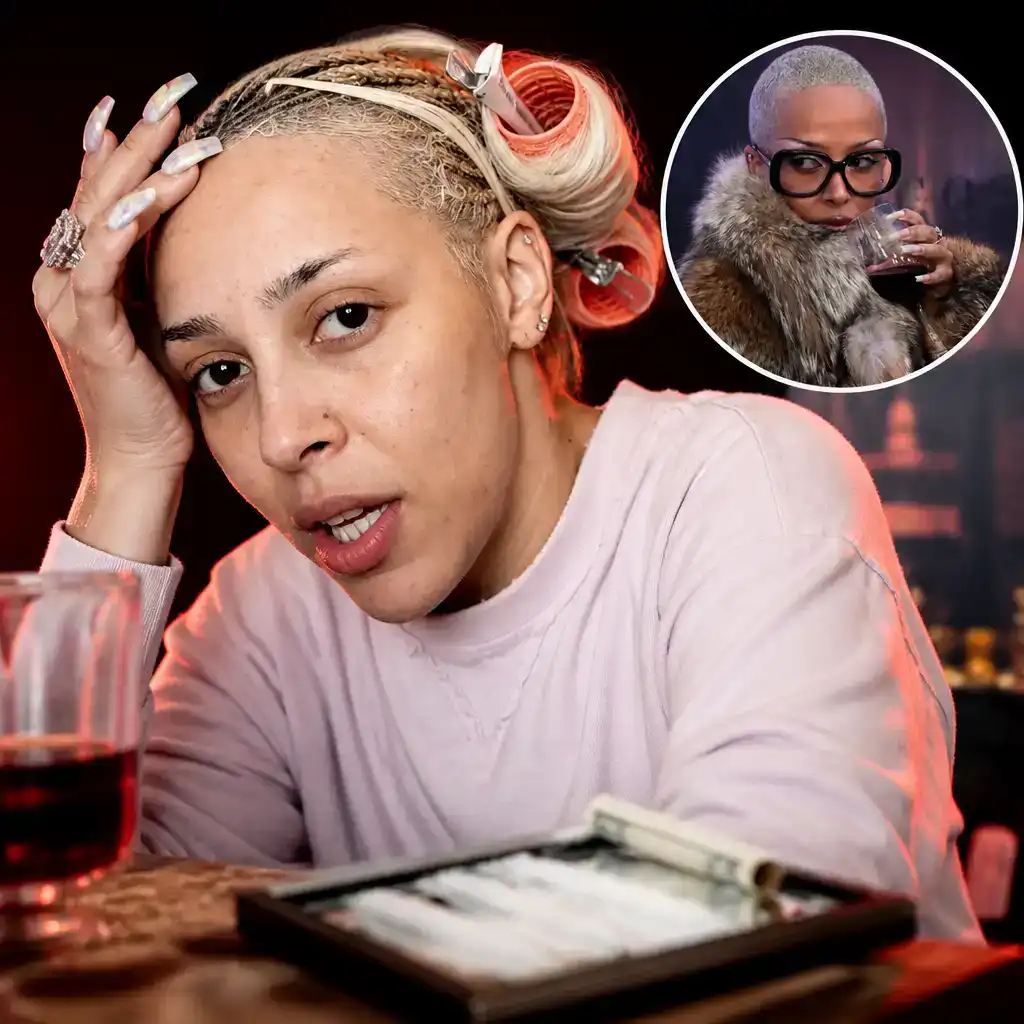
Doja added that she had never considered herself an alcoholic, although she acknowledged having serious problems with drinking. She identified marijuana as the only other drug she believed had caused sustained difficulties.
“I was never an alcoholic but I definitely had problems,” she said. “So if I can teach anybody anything, I will tell you that it’s not good to pair these two things together.”
Her account broadly matches a 2021 Billboard interview in which she described alcohol, cigarettes and marijuana as her principal addictions. She also offered a more general warning in the latest videos: “You’re not indestructible.” The internet, she added, is “everybody’s favorite place to project,” which may be its most reliable feature.
Did Doja Cat reverse her earlier cocaine denial?
The disclosure complicates what Doja previously said publicly. In February 2020, she denied taking cocaine after viewers interpreted her behavior during an Instagram Live broadcast as evidence of drug use, according to Capital.
Her new account confirms an earlier struggle but does not establish that she had used cocaine during that 2020 livestream. Since she placed the experience around eight years ago, both statements could technically refer to different periods. Still, the latest videos provide substantially more context than the earlier flat denial.
They also began with sarcasm. Doja mocked claims that she is demonic, belongs to the Illuminati, uses cocaine, or holds racist and extremist beliefs. Complex reported that she was rejecting allegations that she is racist, a white supremacist or a Nazi. Geo News instead treated part of the opening as a literal confession, apparently demonstrating the exact problem with online interpretation that the singer was discussing.
As of September 1, Doja had issued no further statement, and her representatives had not responded to requests for comment reported by TVA Nouvelles.
How does her mental health diagnosis fit in?
Doja linked her past behavior to what she described as undiagnosed mental illness and the pressure of social media. She said that combination can become “an extreme issue that I think a lot of us don’t understand,” particularly when people use hostile online commentary to confirm their own negative beliefs.
In March, she disclosed that she had been diagnosed with borderline personality disorder, commonly known as BPD. She said she had spent years pretending to enjoy things, hiding distress and presenting herself as though everything was fine.
“I’ll get it done. And it caught up with me, and I think it always does for people,” she said at the time. “I’m now struggling with BPD.”
She also said she had attended therapy for years to manage what she called an “agonizing condition.” The National Institute of Mental Health estimates that 1.4 percent of American adults have BPD and says substance-use disorders commonly occur alongside it.
Separate 2024 figures from the Substance Abuse and Mental Health Services Administration found that 1.5 percent of Americans aged 12 or older had used cocaine in the previous year, while 9.7 percent met the criteria for alcohol-use disorder.
Why did she address claims of racial self-hatred?
In the third TikTok, Doja responded to fans who have accused her of hating herself as a Black woman. She traced those feelings back to childhood and moving at around age 8 to Oak Park, a predominantly white community. Vogue has previously documented how that racial isolation affected her upbringing.
“I think I hated myself since I was, could have been like 8 years old,” she said. “And that was when I moved to my predominantly white neighborhood.”
The singer, who is biracial, connected those early experiences with later dependence on external approval. Her videos presented substance use, mental health, racial identity and online validation as overlapping parts of the same personal history rather than a tidy sequence of separate problems.
“I just felt like this TikTok was necessary and I need to get this shit off of my chest,” she said. “Today felt like the right day.”
If you or someone you care about is affected by substance-use or mental health concerns, contact the Substance Abuse and Mental Health Services Administration’s National Helpline at 1-800-662-HELP (4357).