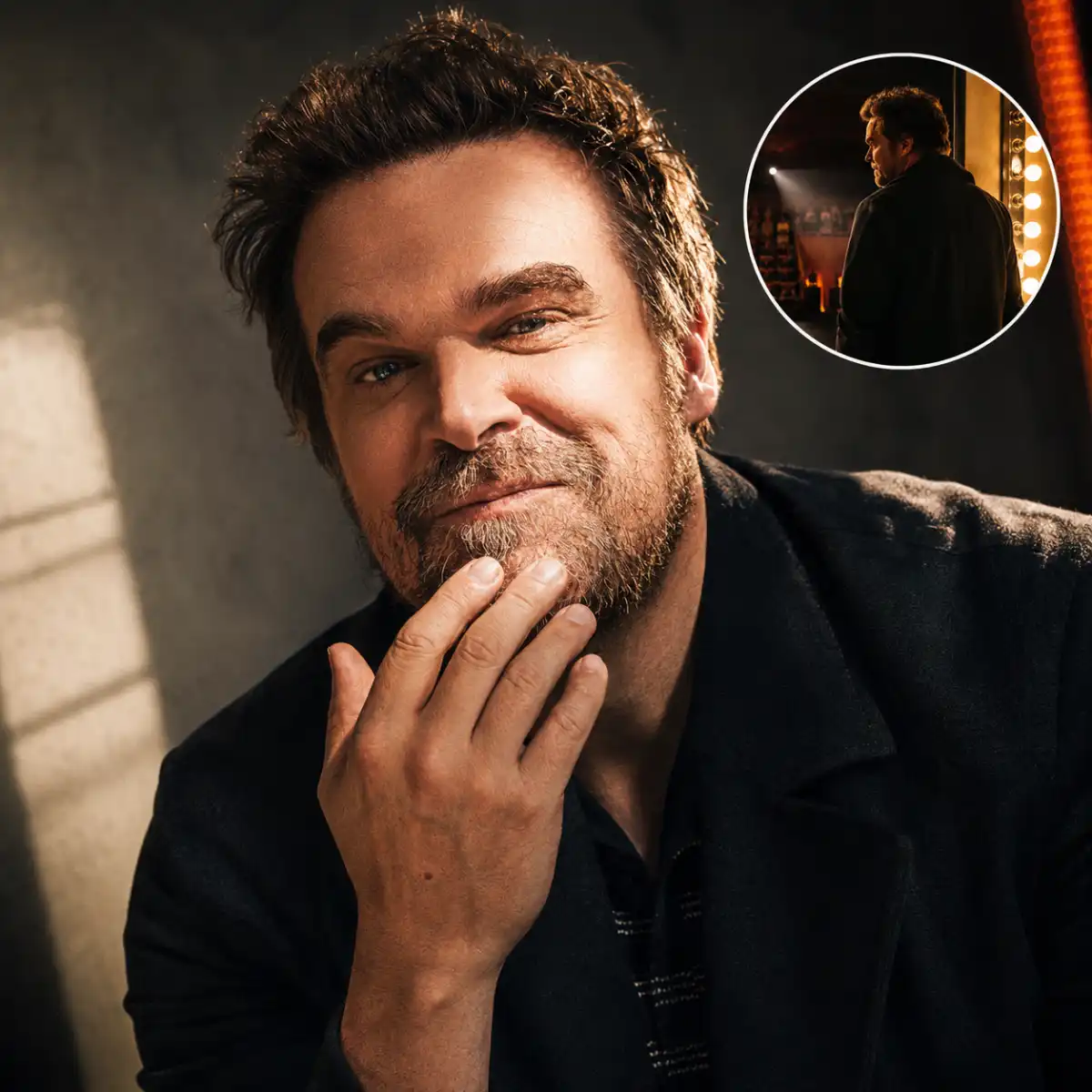
The belly also loosened him up. Floyd dances often in the series, and Harbour said he doubts he could have moved “as fun and as free” without it. Acting, apparently, sometimes requires a fake stomach. Method schools may update their brochures accordingly.
How Floyd Smernitch became Harbour’s next big role
DTF St. Louis aired this past spring on HBO, became a ratings success, and has put Harbour in contention for his first Emmy for the role after two previous nominations for Stranger Things.
The show begins as a murder mystery. Floyd appears to be the victim, while his best friend Clark, played by Jason Bateman, and Floyd’s wife Carol, played by Linda Cardellini, emerge as the obvious suspects. But the series, created by Patriot writer Steven Conrad, uses flashbacks to get at something more intimate and uncomfortable: suburban longing, shame, and the awkward ways people try to be loved.
The title comes from a fictional dating app used by Clark and Floyd. The show itself is much less cheeky than that sounds. It is melancholy, strange, and frequently tender, especially when Floyd stops guarding himself and dances with loose, almost childlike joy.
Conrad said Harbour arrived deep in the development process, and the character was built around what the actor could do. “Floyd is so immensely tender and generous, but he’s going down a dark road,” Conrad said. “You’ve got to be a certain kind of smart to be hurt as deeply as Floyd is hurt.”
That meant Harbour had to play him with emotional intelligence while also making him, in Conrad’s words, “a teddy bear.”
Why Stranger Things felt finished to him
For Harbour, DTF St. Louis offered a welcome turn away from the role that made him globally famous. Jim Hopper, the stern but loving police chief of Hawkins, Indiana, made him a pop culture fixture. It also narrowed the public’s view of him, as long-running hits tend to do. They give actors recognition, then quietly put them in a display case.
By the end of Stranger Things, Harbour said he was ready to leave.
“At a certain point, you kind of run out of story,” he said. “We had gone as far with these characters as we could, and we were starting to, in a subtle way, repeat beats.”
He had already spent years developing DTF St. Louis as a possible next chapter. Harbour said he was not deeply anxious about preserving a specific industry identity, but he understood that a post-Hopper moment mattered. The question, as he put it, was: “What’s the coolest thing I could make?”
For an actor whose earlier career was built on detailed, supporting character work, Floyd is both a return and an expansion. Harbour has worked for decades, but he has rarely had a part with this much emotional room.
What he says about Lily Allen’s West End Girl
The conversation around Harbour changed again in October 2025, one month before Stranger Things began airing its final season, when his ex-wife Lily Allen released West End Girl.
Allen and Harbour had married in Las Vegas in 2020. Before their breakup, they were treated online as a charmingly odd celebrity couple: he was the smiling actor from one of Netflix’s biggest shows, she was the sharp-tongued singer known for turning personal detail into music. Their 2023 Architectural Digest tour of their Brooklyn townhouse drew more than 9 million views.
Then West End Girl arrived.
Allen has said the album uses “artistic license,” and in one interview said, “I don’t think I could say it’s all true.” Still, the lyrics about extramarital behavior, alleged violations of an agreed arrangement, emotional manipulation, and a separate apartment referred to as the “Pussy Palace” sent the internet into its usual calm, evidence-based mode. Which is to say, it did not.
Harbour is now making his first public comments about the album.
“It was weird,” he said. “I do believe that it is the privilege of every artist to use their experience to create art, and so I respect her for doing that.”
He stopped short of rebutting Allen’s version in detail, saying he values privacy, including the privacy of people in his personal life.
“Stories are complex,” he said. “It wasn’t my experience.”
Why privacy matters to him now
Harbour’s response to West End Girl is careful, but not empty. He knows Allen has spent her career drawing from life, including on her 2006 debut album, which featured “Alfie,” a song about her brother Alfie Allen, later known for Game of Thrones.
Harbour’s own boundaries are different. Before Stranger Things, he was a respected working actor, not a household name. The shift into mass fame changed the cost of being known.
“I can’t really say that much more,” he said of Allen’s album, “because it’s my private life. In spite of the fact that a lot of people don’t allow me a private life, I value it.”
He connected his own way of processing experience to DTF St. Louis. Floyd is a man desperate to feel loved and capable of loving, even while trapped inside shame and self-loathing. Harbour said he wants to make work that helps people feel less alone.
“I want to make things that make people feel safer,” he said. “My particular talent is in allowing people to feel like they’re not alone.”
That line also explains why he keeps returning to vulnerable men, even when the surrounding plots involve monsters, murder, or superheroes.
How acting became his way into emotion
Harbour grew up in Westchester County, New York, in the 1980s and early 1990s. His parents worked in real estate, and he describes himself as a complicated child with “a lot of suppressed emotion” and confused feelings about the world.
In high school, he learned about subtext, the idea that people often say one thing while doing another. Onstage, he found that acting out those contradictions could earn laughter and applause.
“So this is the place where I can unlock the weirdest, most wonderful thing in the world, which is the human psyche,” he recalled thinking.
He later graduated from Dartmouth after spending summers doing regional theater in Maine. He said he had wanted to leave college and become an actor, but the community around him could not quite imagine that as a serious path.
“Being a lawyer was what I was going to do with my dramatic talents,” he said, with dry sarcasm.
As a young New York theater actor, Harbour also got sober. He said he had been unable to work reliably, looked terrible, and could not make auditions. A week after he stopped drinking, he booked a soap opera, his first paid acting job.
“It was sort of a sign,” he said. “Make your choice.”
The roles before Hopper
Before Hawkins turned him into a global face, Harbour built a career playing men who exposed other people’s delusions, hypocrisies, or emotional failures.
He received a 2005 Tony nomination for playing Nick in Who’s Afraid of Virginia Woolf?, Edward Albee’s brutal study of marriage as a contact sport conducted with words. In Brokeback Mountain, he briefly appeared as a man who picks up Jake Gyllenhaal’s Jack Twist while Jack is attempting, not very convincingly, to live straight. In Revolutionary Road, he played a neighbor watching Leonardo DiCaprio’s and Kate Winslet’s characters unravel under the pressure of suburban performance.
DTF St. Louis gives him a larger canvas for that same interest: what people are trying not to say.
The project began as an adaptation of a 2017 New Yorker article about an upstate New York murder trial. Over a long development process, it became an entirely new story. What remained was the fascination with people stripped of social polish, trying to connect and often doing it badly.
Jason Bateman described the characters as “a bunch of adult virgins walking around, saying and doing cringey things” because they have not learned to hide behind the usual adult falseness.
Bateman said Harbour’s vulnerability shaped the production. “He’s got this huge heart, and you can see in his eyes his ability to be soft and human,” he said.
What DTF St. Louis says about shame
Despite its crime-story frame, DTF St. Louis ultimately depends on the tenderness among Floyd, Clark, and Carol. The series repeatedly returns to childlike imagery, including scenes of Clark and Floyd sitting together on a swing set.
The ending reveals the mark Floyd left on both Carol and Clark. They genuinely loved him, even as Floyd lived with a punishing internal voice that connected desire to disgust.
Harbour described Floyd’s mindset plainly: “It doesn’t matter what my intentions are, how hard I work. At the end of the day, I’m fat, people think I’m disgusting and I ruin things with my desire.”
That is bleak, but it also explains why the character’s joyful movement matters. When Floyd dances, he briefly escapes the sentence he has passed on himself.
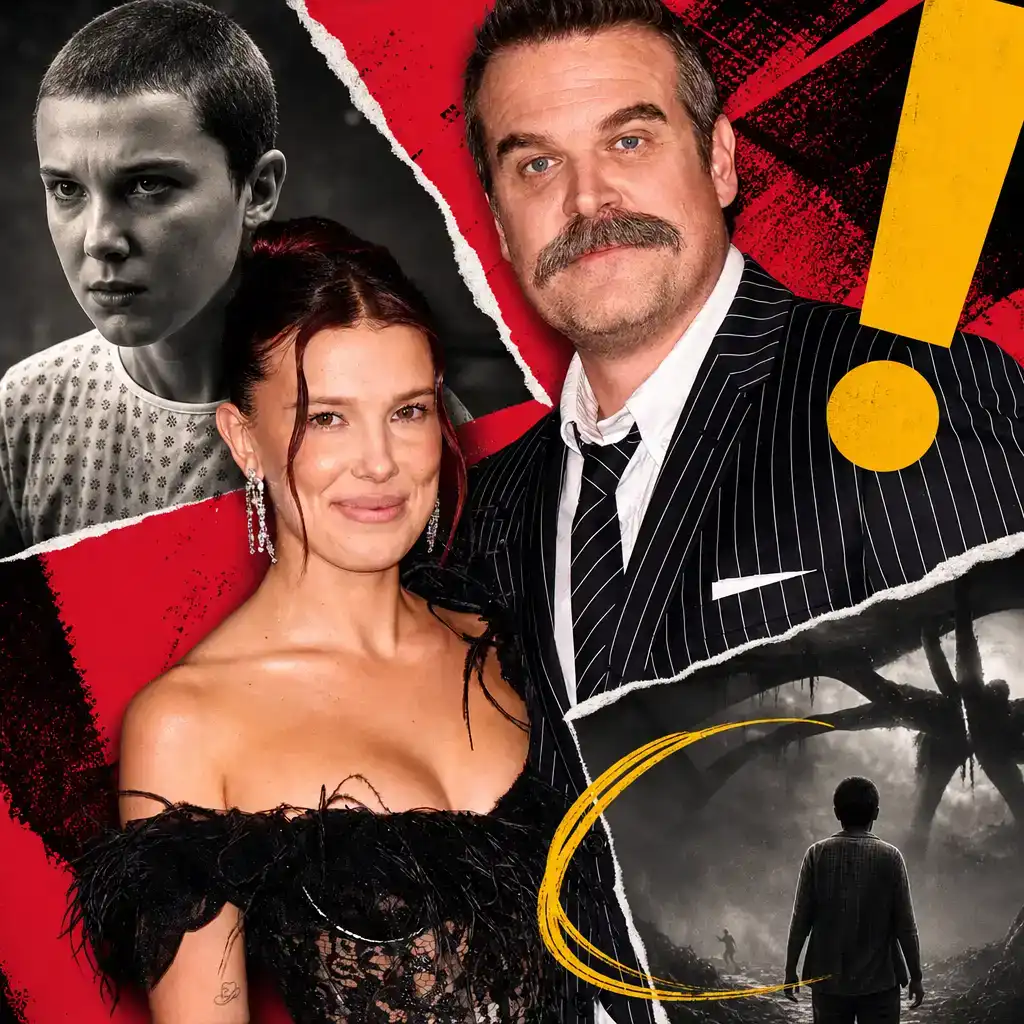
Harbour sees related emotional complexity in Hopper’s bond with Eleven, played by Millie Bobby Brown, on Stranger Things. Hopper is trying to protect an immensely powerful child, but the relationship is also about shared trauma.
“It’s like trying to heal shared trauma, which my therapist would say that we’re trying to do all the time, whether we acknowledge it or not,” he said. He called Hopper and Eleven “perfect interlocking puzzle pieces.”
How he reads the Stranger Things finale
The Stranger Things finale premiered on New Year’s Eve as a stand-alone episode. In it, Eleven sacrifices herself to save the world. Her friends grieve and speculate that she may have survived, though she has disappeared.
Harbour is not especially ambiguous about what he thinks happened.
He said he loves that Eleven dies at the end. From his perspective, the show’s logic always pointed there.
“A lot of people think maybe she’s in Spain or whatever,” he said. “But right from the very beginning of that series, we love this little girl, but you really can’t have a little girl in Hawkins, Indiana, with supernatural powers running around. She just cannot exist.”
For Hawkins to return to normal, the supernatural has to vanish. “Right from the beginning of the series,” he said, “you gotta kill her.”
Then came the practical caveat any streaming viewer will recognize: “Until Netflix needs to raise their subscription rate. Then, ladies and gentlemen: Eleven, the new series!”
It was a joke, but only barely. remove this sentence, or replace with: "Hollywood has made stranger decisions."
What he says happened during his breakdown
The end of Stranger Things was not light for Harbour. Around the December holidays, reports about odd public behavior in San Diego spread on Reddit and in tabloids. He also skipped celebrations for the series finale.
Asked whether he needed a break or some time away, Harbour cut through the softer wording.
“I had a breakdown,” he said, then laughed loudly.
He connected the episode to his long-discussed experience with bipolar disorder and broader mental health struggles.
“I do suffer from some confusing stuff,” he said. “It’s confusing as hell. I think a lot of people have a friend or a brother or a co-worker that deals with mental health stuff, and they’re probably pretty confused when that person gets depressed or gets manic or has an episode.”
Harbour said he worries about fans who do not understand what is going on with him, partly because he wishes he understood it better himself. He is also frustrated by the way public conversation about mental illness can flatten people into spectacle or condemnation.
“There’s a lot of irresponsible nonsense going on out there,” he said.
He cited Scottish disability-awareness campaigner John Davidson, who interrupted the BAFTA Awards this year by yelling racial slurs, as an example of a disturbing public incident involving a person with Tourette’s that many people struggled to discuss responsibly.
“We’re either going to acknowledge that mental illness is a thing or we’re not,” Harbour said. “We can stone everyone to death if you want!”
He said extreme stress can produce erratic behavior that is embarrassing and shame-inducing. “It’s not something I choose,” he said, “and I wouldn’t wish it on my worst enemy.”
The Millie Bobby Brown report and his response
Harbour said that stress also included what he described as false reporting. A week after West End Girl was released, the Daily Mail reported that Millie Bobby Brown had “filed a harassment and bullying claim” against Harbour before production began on the final season of Stranger Things.
Brown later told a reporter, “Of course I felt safe. I mean, we’ve worked together for 10 years.”
Harbour called the timing of the report “a weird thing” and said it “came out in a weird way.” He appeared cautious about saying too much, aware that any phrase could become another item in the public grinder.
“Straight up, Millie and I are working on several …” he said, before stopping himself from revealing future plans. “You’ll see more of me and Millie, 10 years wasn’t enough. There is a special bond there. I love her. She loves me.”
Brown also spoke warmly about their working relationship, saying that Harbour had been present through her growth from Season 1 to Season 5.
“Over time, our relationship became much more collaborative creatively,” she said by email. “When you work with someone for that many years, we could really push each other emotionally in scenes. Even though the series has ended, there’s still a lot of gratitude.”
Harbour framed whatever tension existed as a normal rupture and repair between people who had worked closely for a decade, complicated by the scale of a billion-dollar show and the many people surrounding it.
“It was completely normal,” he said, “and we adore each other and always have.”
What fame did to his sense of self
Harbour was not a child star suddenly thrown into global recognition. That makes his experience of fame different from his younger Stranger Things co-stars, but not necessarily easier.
He remembers the weekend the show first arrived on Netflix. He went into the East Village coffee shop he had visited for nine years, and the people who had served him all that time suddenly asked for his autograph.
The early perks were enjoyable: free ice cream, Knicks tickets, the ordinary bonuses of becoming a recognizable actor. He also had a high-profile public moment after Donald Trump was elected to his first term, when Stranger Things won best ensemble at the 2017 Screen Actors Guild Awards. Harbour delivered a fiery acceptance speech casting the show as a defense of outsiders and a rejection of bullies, while Winona Ryder’s astonished reactions beside him became their own internet event.
But the glow faded.
“I love affecting people, touching people, bringing people joy,” he said. “All that stuff is the reason you do it.”
The cost, he said, is becoming an object to strangers. Sometimes an object of joy. Sometimes an object of resentment.
Either way, object is the key word.
Why he keeps returning to art
Harbour says he is doing better now. He is trying to move past what he repeatedly calls weirdness, and to keep working despite the public noise around him.
“You can like me, not like me, yell about me, whatever I mean to you,” he said. “But I’m just going to try to put the best foot forward.”
He described art as a way to step outside ordinary chaos and find gratitude. He told a story about a Buddhist monk friend near San Diego who had to find peace within himself before being permitted to work for peace outside the monastery.
For Harbour, good work comes from a similar stillness.
“To me, art has a quality of gratitude in it,” he said, “where we are able to see the dramas, and also to have the moments where you go, Oh, yeah, it’s beautiful to be alive and to be able to sit on a swing set with another guy.”
The swing set image returns because DTF St. Louis uses it as a picture of trust. Harbour said the show feels like “two kids at recess playing freeze tag,” entering the unknown with another person and trusting they will not humiliate you.
To protect that feeling, he and Bateman kept some distance on set. Harbour said they did not want to overtalk their chemistry or make it too casual.
He is also wary of the modern appetite for behind-the-scenes access, including constant TikToks and set footage. Acting, in his view, can be delicate, and too much casualness can break the moment.
What comes next for Harbour
As Stranger Things ends, Harbour’s schedule is filling up.
He recently shot Evil Genius, Courteney Cox’s directorial debut, starring opposite Patricia Arquette in a story about conspirators in a real-life bombing spree. In December, he returns for Violent Night 2, again playing a murderous version of Santa Claus, following the 2022 action-comedy original.
Kristen Bell joins the sequel as Mrs. Claus, though she teased that it may be “a slightly different version than we’ve seen before.” He described Harbour as imposing and emotionally open.
“I find David to be very present and very tender,” Bell said. “He’s bringing this huge presence, but there is a porousness to it. He wants to interact. He’s not trying to pull off a solo endeavor. He’s trying to make a world.”
December also brings Avengers: Doomsday, Marvel’s Christmas-release megasequel and its first theatrical outing since The Fantastic Four: First Steps. Chris Evans and Robert Downey Jr. are returning to the Marvel Cinematic Universe, with Downey taking on Doctor Doom. Harbour, who played Red Guardian in Black Widow and Thunderbolts, is part of the performer’s next wave of Marvel co-stars.
He said he and Florence Pugh watched one major Marvel moment unfold during filming, describing it only as “the moment when said character does said thing that you’ve seen before.” He would not elaborate. Marvel secrecy remains one of the industry’s more durable religions.
What he wants audiences to see
Harbour does not seem especially interested in talking about acting when he could be acting. He cited Philip Seymour Hoffman’s reluctance to explain himself in interviews, saying Hoffman wanted audiences to see him as a character.
That is harder for Harbour now. After a year involving a high-profile divorce narrative, an album dissected online, tabloid reports, a mental health crisis, and the end of one of Netflix’s defining shows, some viewers will bring fixed ideas about him into the room.
He knows that. His hope is that the work can still take over.
“The challenge, and my hope, is that I just do such a fucking good job that you, even if you hate me or you love me, you lose yourself in that moment and you go, ‘I’m watching Floyd,’” Harbour said.
That, he said, is all he really wants to do. It pushes him toward sincerity, even when sincerity is not always rewarded in public life.
“I’m not trying to make myself look good or look heroic,” he said. “I’m just trying to tell you a story that I feel like might be valuable.”