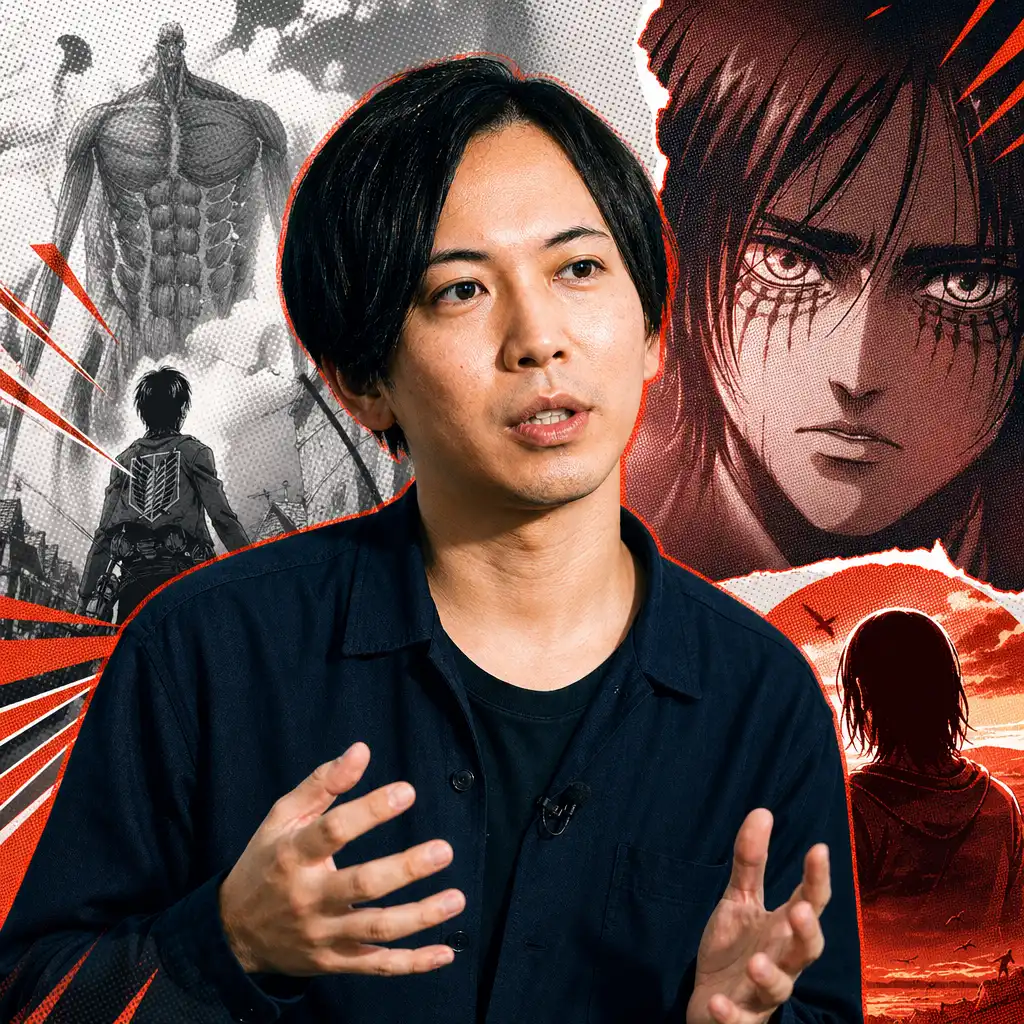
At the Hita City museum, which features original concept art, a large Titan statue, and creator commentary on selected scenes, Isayama reflects directly on Eren’s development from furious survivor to mass killer.
“Eren became a protagonist who committed mass slaughter on a scale rarely seen in other works of fiction,” Isayama says in the museum comment. “As for why I conceived such a story from the beginning, part of it was my desire to create a narrative with a major twist, where the victim becomes the perpetrator.”
He also links that idea to his younger self.
“But a large factor was also my own immaturity and foolishness at the time, when I was in my early twenties,” he continues. “That aspect became the core of Eren’s character, leading to the point where he confesses not as someone forced into wrongdoing by circumstances, but as someone who harbored a desire to do harm.”
That is a sharp reading of the character from the person who created him. Eren was not simply written as a hero cornered by history, at least not in Isayama’s retrospective framing. He was designed to expose something uglier: a victim who becomes the perpetrator and admits that part of him wanted destruction.
The problem was how much readers loved him
Isayama’s regret is not that Eren became humanity’s enemy. It is that, by the time the ending arrived, Eren no longer existed only as a character on Isayama’s page.
“However, Attack on Titan had long since ceased to be mine alone, and Eren became a character loved by many readers,” Isayama says. “In the end, without fully committing to portraying him as a detestable figure, I found myself depicting him with a certain closeness and sympathy. As a result, I feel there remains a sense of insincerity in the story’s conclusion, at least in my own assessment.”
That gets to the heart of why the finale remains such a live subject among fans. Eren’s final arc asks the audience to process him as both a character they followed for years and someone responsible for catastrophic violence. Isayama now appears to be saying he did not push that discomfort as far as he thinks he should have.
For a creator, that is a difficult line to admit. For an audience, it explains why the ending could feel emotionally generous to Eren even while the plot condemned what he did. The story wanted horror, tragedy, and character intimacy at the same time. That is a complicated recipe, and not the kind that leaves every reader calmly nodding at the final page.
Why the comment matters now
The Attack on Titan ending was already one of modern manga and anime’s most debated conclusions. Eren’s shift from defender of humanity to architect of mass death was not a late improvisation, according to Isayama’s museum commentary. The twist was built into the concept: the victim becomes the aggressor.
What has changed is the creator’s own assessment of how he executed it. If Isayama were telling the story today, Eren may still have reached the same endpoint, but the framing might have been colder, harsher, and less protective of him.
That does not rewrite the manga or the anime. It does, however, give fans a clearer view of the tension behind the finale: Isayama wanted Eren to become detestable, but found himself writing a character he still understood, and perhaps still cared for, too closely.
For a series built on cycles of violence, inherited trauma, and the cost of choosing enemies, that confession lands with real weight. Even after the final chapter, Attack on Titan is still arguing with itself. Quietly, that may be one reason it has lasted.