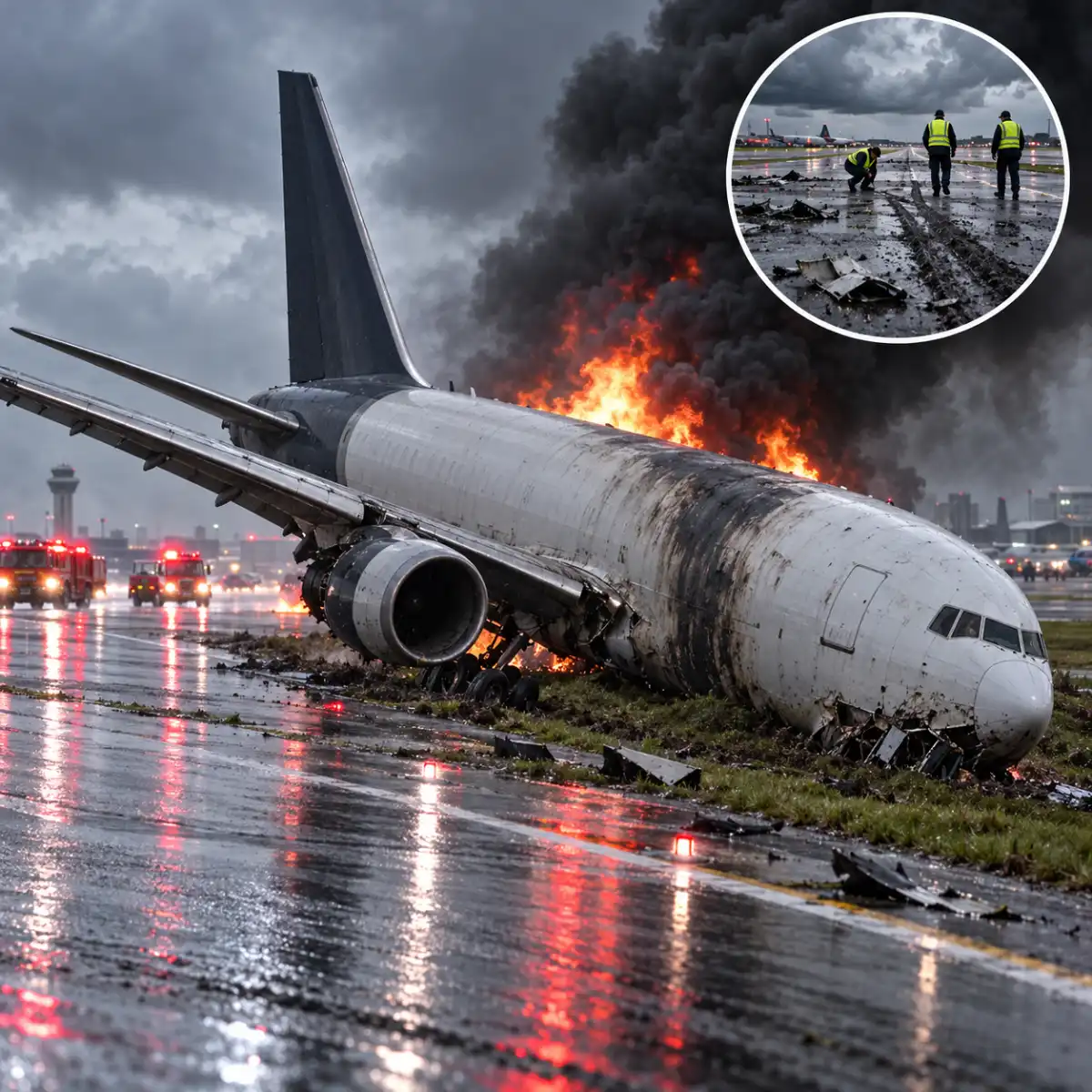
Amazon initially described the incident as happening “while attempting to land,” while the FAA said it occurred “after landing.” That difference does not establish whether the aircraft had fully completed touchdown or exactly when control was lost. Investigators will determine the sequence using flight data, cockpit recordings, air traffic communications and physical evidence.
Amazon later said it was “heartbroken” and offered sympathies to the victims’ families. Its first statement said the company was working with local authorities and that its priority was the safety and care of everyone involved.
Who operated the Amazon-branded aircraft?
Although the jet carried Amazon branding, North Carolina-based cargo airline 21 Air operated the flight for Amazon Air. The arrangement reflects Amazon’s broader reliance on contracted carriers rather than a single airline operating every aircraft in its logistics network.
Flightradar24 identified the plane as a 32-year-old Boeing 767-300. It was originally built as a passenger aircraft and converted for cargo service in 2015, according to the Associated Press.
The aircraft’s age does not by itself explain the crash. Commercial jets can remain in service for decades when properly inspected and maintained. Still, investigators are expected to review the plane’s maintenance history, cargo conversion records and operational oversight, along with the crew’s actions and the aircraft’s mechanical condition. Old aircraft are not automatically unsafe, but they do generate a substantial filing cabinet.
The National Transportation Safety Board dispatched a team led by Chair Jennifer Homendy. No credible report has identified a mechanical failure, crew error or other cause.
Did weather or the landing distance play a role?
Thunderstorms were reported near Miami International Airport, with gusts reaching 30 mph. The Associated Press stressed that investigators had not determined whether weather contributed to the accident.
Aviation expert Steve Arroyo said the normal touchdown zone extends through the first 3,000 feet of a runway. He raised two central questions: whether the aircraft landed inside that zone and, if it did not, why the crew did not abandon the approach and go around.
Former Transportation Department inspector general Mary Schiavo said video appeared to show the aircraft remaining airborne over the runway for an extended period. That could have reduced the distance available for braking. She also said a tailwind might have worsened the problem.
Those observations are preliminary assessments based on footage, not official findings. Video can show where an aircraft was, but not necessarily what the crew saw, what the instruments indicated or whether a system malfunctioned at a critical moment.
Why is Miami’s runway protection under scrutiny?
Miami International Airport does not have an engineered-material arresting system, equipment designed to stop an aircraft that runs beyond the end of a runway. The Federal Aviation Administration says such systems operate at more than 120 airports and have helped save at least 497 lives.
That absence does not prove an arresting system would have prevented the deaths in Miami. The aircraft crossed a road and struck vehicles, and investigators will need to reconstruct its speed, path and stopping distance before assessing whether additional infrastructure could have changed the outcome.
Still, the crash is likely to renew scrutiny of runway-end protections at a major airport handling heavy passenger and cargo traffic. The practical question is not simply whether Miami met existing requirements, but whether the available safeguards matched the consequences of a large jet leaving the pavement.
How badly were airport operations disrupted?
Flights were initially grounded as emergency crews worked at the scene. NBC 6 later reported that two of Miami International Airport’s four runways had reopened.
By late Sunday, FlightAware had recorded:
- More than 160 cancellations
- Nearly 325 delays
Further disruption remained possible while authorities secured the site and investigators began examining the wreckage. The airport’s recovery will happen faster than the investigation, which is normal. Reopening runways takes hours. Establishing why a wide-body cargo jet crossed a road and hit vehicles generally requires considerably more patience.