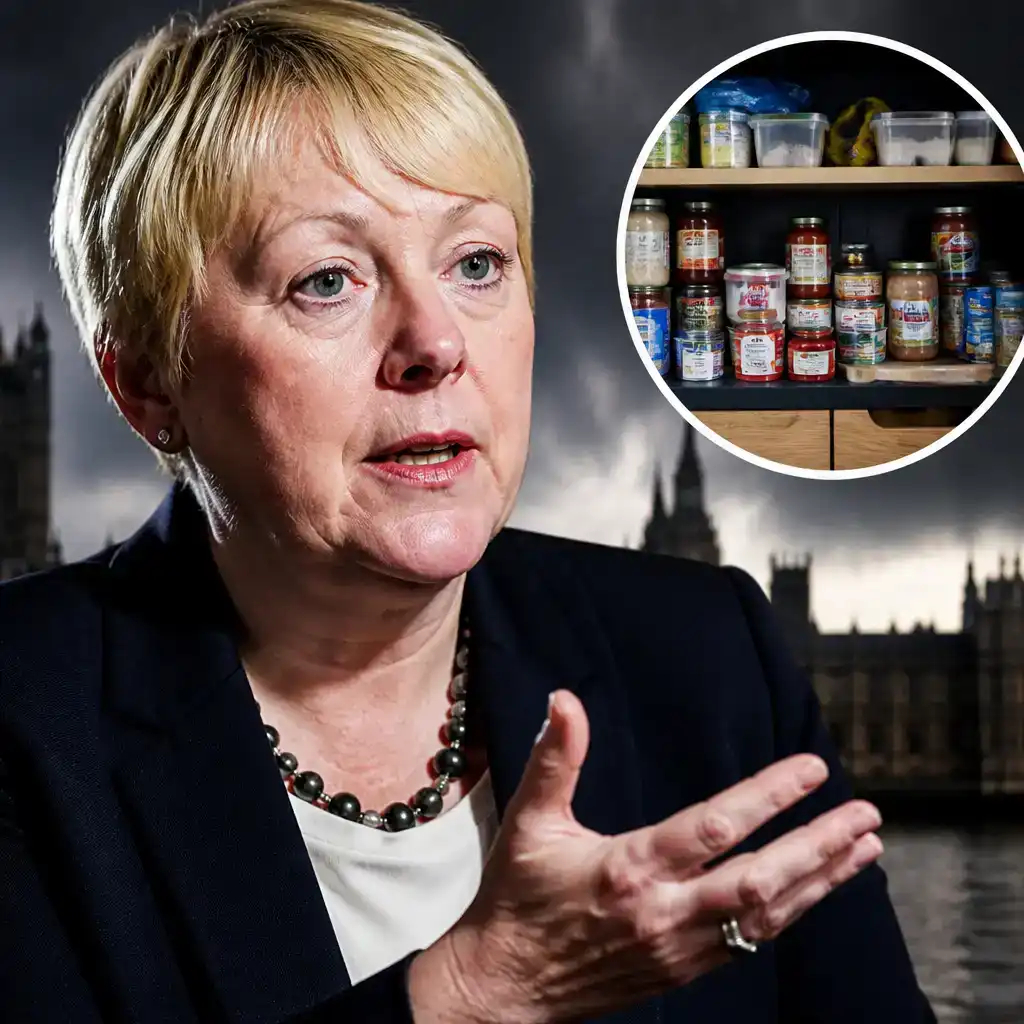
Households should stock up on food for several days as an exceptionally powerful El Niño develops over the Pacific, Environment Secretary Dame Angela Eagle has warned. The advice is intended to help families manage during storms or supply disruptions before emergency services can reach them, rather than encourage a national competition to empty every supermarket shelf.
Her warning coincides with a National Audit Office report finding that Britain’s food system faces increasingly complex threats, including extreme weather, cyber-attacks, disease outbreaks and dependence on imports. The watchdog’s less comforting conclusion is that the government has relied too heavily on private companies to keep everything functioning when disruption arrives.
How serious could this El Niño become?
Eagle told The Guardian that the developing event could be the largest El Niño ever recorded, bringing drier summers, wetter winters and more severe storms to the UK. She said its effects would be more damaging in parts of Asia, particularly through flooding, but argued that British households should still prepare.
“If you’ve got a store of a bit of food that can keep you going for a while before the emergency services can get to you, you’re going to be a lot better off than if you haven’t,” she said.
The Met Office supports the warning that this could be an exceptional event, although its language is more measured. It forecasts Pacific temperature anomalies above 3C and says the El Niño will probably be the largest since the 19th century. Proxy climate evidence cited by The Guardian suggests it could be the strongest in 1,000 years.
Met Office forecaster Adam Scaife said he had “never seen an El Niño signal this intense.” United Nations secretary general António Guterres described the phenomenon as being “supersized before our eyes”, while World Meteorological Organization chief Celeste Saulo warned of a “massive blow” to communities and economies.
Still, the Met Office says the consequences for Britain are indirect and probabilistic. A wetter, stormier autumn and early winter are more likely, not guaranteed. That is a notable difference from Eagle’s firmer claim that extreme storms “will” result. Weather, regrettably, has not agreed to follow ministerial wording.
Why is Britain’s food supply vulnerable?
The National Audit Office said disruption could come from plant and human diseases, hostile cyber activity, severe weather and longer-term climate change. Any of these could raise prices, reduce availability and leave poorer or otherwise vulnerable households struggling to buy essentials.
The scale of the system makes even limited disruption expensive. UK households spent £148 billion on food in 2025, while domestic production accounted for only about 60% of consumption by value. British farming also relies on imported products including fertiliser and animal feed, so home-grown food is not entirely insulated from problems overseas.
The wider agri-food sector supports 4.1 million jobs. Recent history has already shown how quickly pressure moves through the system: food inflation reached 19.2% in March 2023, placing a particularly heavy burden on households with little spare income.
During the Covid pandemic, the Department for Environment, Food and Rural Affairs spent £200 million delivering 4.7 million food boxes. The department expanded its food resilience team from 6.5 to 16.5 full-time-equivalent staff in May 2026. Even so, the audit office found that no food assets are currently listed in the government’s critical-infrastructure database.
The last national exercise to substantially test the consequences of catastrophic food disruption took place in 2023.
Has government left too much to supermarkets?
The audit office concluded that the Department for Environment, Food and Rural Affairs had not done enough in recent years to improve supply-chain resilience. It also said officials were too dependent on businesses to manage emergencies voluntarily.
Phil Pluck, chief executive of the Cold Chain Federation, which represents companies transporting temperature-controlled food, said Britain was “pretty close to crisis”. He told the BBC that Russian cyber-hackers were targeting weak points in the food distribution system.
Pluck said El Niño, international shipping disruption and the continuing threat of pandemics meant the country could not “just rely on the private sector coming through every single time”. Asked whether households should keep extra supplies, he replied: “Yes, we should.”
Food companies and supermarkets have maintained supplies through several major disruptions, but the National Audit Office’s concern is that commercial resilience is not the same as a national emergency plan. Businesses are designed to sell food efficiently. They are not automatically equipped or required to provide a public safety net during a prolonged crisis.
Defra said it was working with farmers and industry to strengthen the UK’s resilience and would consider the watchdog’s recommendations. A spokesperson said food businesses and supermarkets had continued feeding the country through significant disruption, while the government worked towards a more resilient, productive and sustainable food system.
What should households keep at home?
The government has not yet published its full updated list. Eagle referred to enough food for “a few days”, while ministers announced in July that future guidance would cover small but important preparations for shortages of food, water and other essentials caused by extreme weather or cyber-attacks.
The message is sensible preparation, not panic buying. A household emergency supply would generally need to reflect individual dietary and medical requirements, available storage space and whether food can be eaten without electricity or cooking facilities.
The National Audit Office found that UK households are less prepared for emergencies than those in Finland, Sweden and several European Union countries. It recommended that ministers learn from those systems and communicate more clearly about what people should have available.
A multi-year public information campaign is expected later in 2026, with the broader national emergency strategy due by the end of the year. Pluck said the government would begin telling households to keep sensible reserves in the autumn.
Who pays for household preparedness?
Asking families to hold several days of food raises an awkward question: what happens when they cannot afford to buy extra? The same households most exposed to rising prices are also least able to maintain emergency reserves.
The audit office warned that supply disruptions would hit vulnerable people hardest. Moving part of the cost of national preparedness into kitchen cupboards risks treating financial capacity as resilience. A household with limited income cannot necessarily buy duplicate supplies merely because the state has produced an advice leaflet.
The report therefore leaves ministers with broader choices beyond public guidance. They could place stronger resilience requirements on food businesses, identify essential food infrastructure formally, improve national testing or consider public reserves of critical products. For now, the government’s approach still depends heavily on voluntary industry planning and individual households doing what they can.
Keeping a modest supply may help people through several difficult days. It does not replace a functioning national strategy for protecting food imports, transport, cold storage and distribution from storms, cyber-attacks or disease. El Niño has made that distinction harder for ministers to ignore.