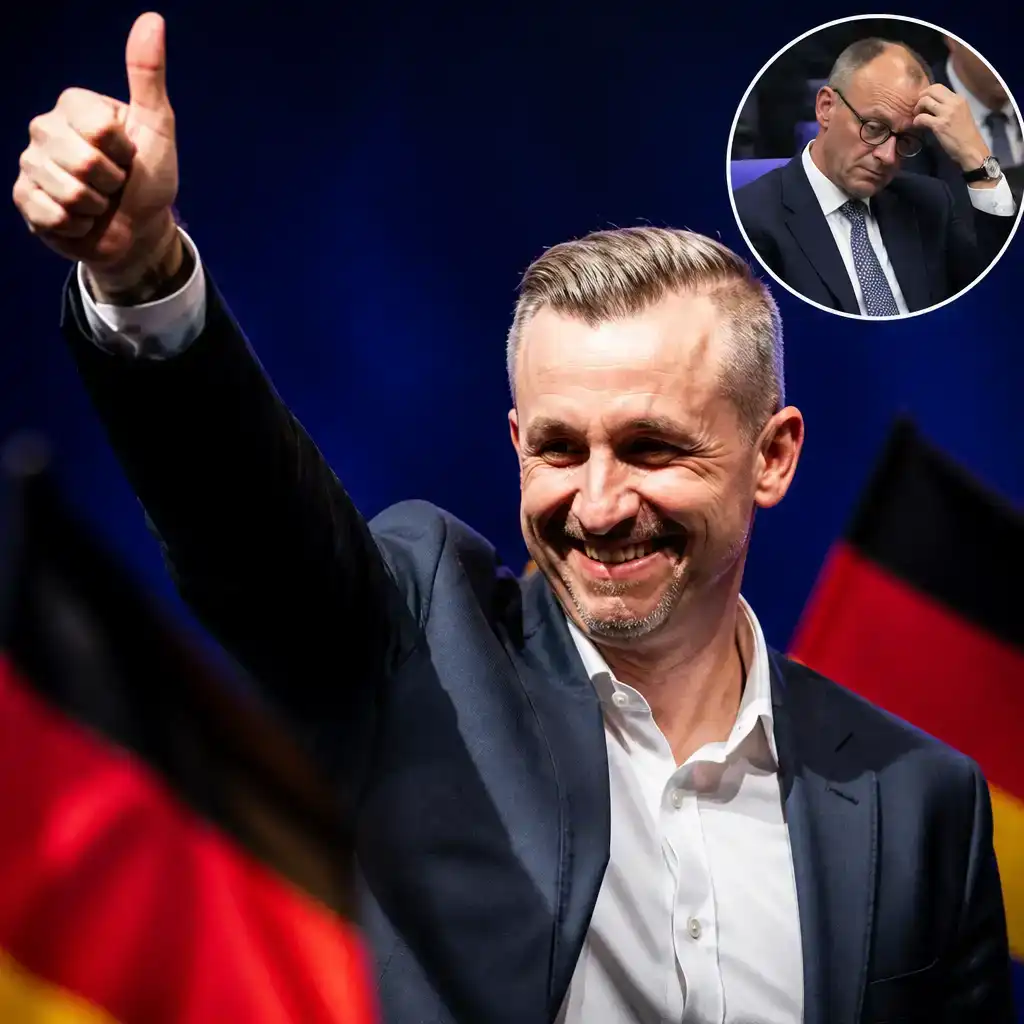
Reporting on BSW’s position has been inconsistent. The Associated Press reported that its candidate, Thomas Schulze, was prepared to help elect an AfD premier. Tagesschau reported that BSW leaders Claudia Wittig and Amira Mohamed Ali would support neither Siegmund nor CDU candidate Sven Schulze and instead proposed a nonpartisan head of government.
Siegmund rejected both minority rule and the nonpartisan proposal, suggesting another election might be necessary. “We have made history in this country,” he said. Sven Schulze offered the more restrained response: “That is democracy.”
Why the result is a serious problem for Friedrich Merz
The state vote landed on an already unpopular federal government. An ARD survey found that 87% of Saxony-Anhalt voters were dissatisfied with the administration in Berlin. Merz had promised to reduce the AfD’s appeal. Instead, an INSA national poll cited by Reuters placed the party first nationwide on 28%, eight points ahead of the CDU.
That does not make a state election a perfect model for Germany as a whole. Eastern Germany has long been the AfD’s strongest territory, and regional campaigns turn on local personalities as well as national frustration. Even so, a 43.8% result is difficult to file under “regional peculiarity” and move along.
The defeat also produced immediate casualties. Free Democratic Party state leader Lydia Hüskens resigned after the FDP again failed to enter parliament.
For Merz, the larger danger is political paralysis. Germany is the European Union’s largest economy and a central player in policy on Ukraine, trade with China, defence and relations with US President Donald Trump. A weakened chancellor consumed by domestic survival has less authority abroad, which is not ideal when Europe’s list of manageable problems remains impressively short.
What would an AfD-led government try to change?
Migration dominated much of the wider discussion, but the AfD’s state programme reaches into education, policing, culture and energy policy. Its proposals include:
- Separate classes for refugee children
- Daily display of German flags at schools
- Citizen patrols
- Expanded teaching of Russian
- A ban on new wind farms
The programme shows why the result is about more than anger over immigration. It offers a broader attempt to reshape public institutions and ideas of national identity. The party campaigned under the slogan “Anything is Possible!” and promised to make Germans proud of their country again.
That language carries unusual weight in a country where the Nazi era still shapes political debate. German authorities have described parts of the AfD as anti-democratic, while several regional branches, including the one in Saxony-Anhalt, have been classified as far-right extremist.
The party rejects labels such as “extreme right” and presents itself as an excluded challenger to an entrenched political establishment. Until now, it has largely been untested in government. Saxony-Anhalt’s voters have brought that prospect much closer, though not close enough to avoid a complicated parliamentary negotiation first.
Why nationalist leaders outside Germany celebrated
Donald Trump quickly shared the exit poll on Truth Social. Elon Musk added “Well done!”, prompting Siegmund to invite “strong and constructive cooperation.” The AfD’s attacks on mainstream media, judges and immigration policy resemble parts of the Make America Great Again political strategy, including its promise to restore national greatness.
European nationalist parties use similar themes, although they differ substantially in policy and tone. France’s National Rally previously expelled the AfD from its European Parliament grouping for being too radical. That is a notable distinction in this particular political neighbourhood.
Spain’s Vox leader Santiago Abascal called the result “a great hope for Germany and for Europe.” Russian Direct Investment Fund chief executive Kirill Dmitriev described it as historic, said Germany’s government had been discredited and claimed Merz had been humiliated.
Polish Prime Minister Donald Tusk responded rather less warmly: “In Poland, only idiots or traitors could rejoice” at the result. France’s Europe Minister Benjamin Haddad called it “a serious moment in Europe,” pointing to the significance of a far-right party winning a German regional election.
What does Saxony-Anhalt mean for Europe?
The result arrives before a busy period of elections across the European Union, including expected ballots in France, Italy, Spain and Poland. Brussels is watching for further gains by parties that combine opposition to immigration with nationalist and Eurosceptic policies.
The concern is practical as much as ideological. European governments are trying to maintain sanctions against Russia, support Ukraine, strengthen NATO’s eastern members, respond to Trump’s trade policies and protect industries from heavily subsidised Chinese competition. Nationalist parties often resist coordinated European action or question military and financial commitments abroad.
Voters, meanwhile, are balancing those external threats against immediate concerns including strained health services, weak economic security, immigration and public safety. Supporting a challenger does not automatically mean every voter accepts its most radical positions. It does show that established parties have failed to persuade a growing share of the public that they can fix the problems in front of them.
Saxony-Anhalt therefore delivered both a mandate and a constitutional puzzle. The AfD has the largest bloc but not a majority. Its opponents have enough seats to stop it, but only through combinations many spent years telling voters were unthinkable. The next test is not whether the result was historic. It is whether anyone can turn it into a functioning government.