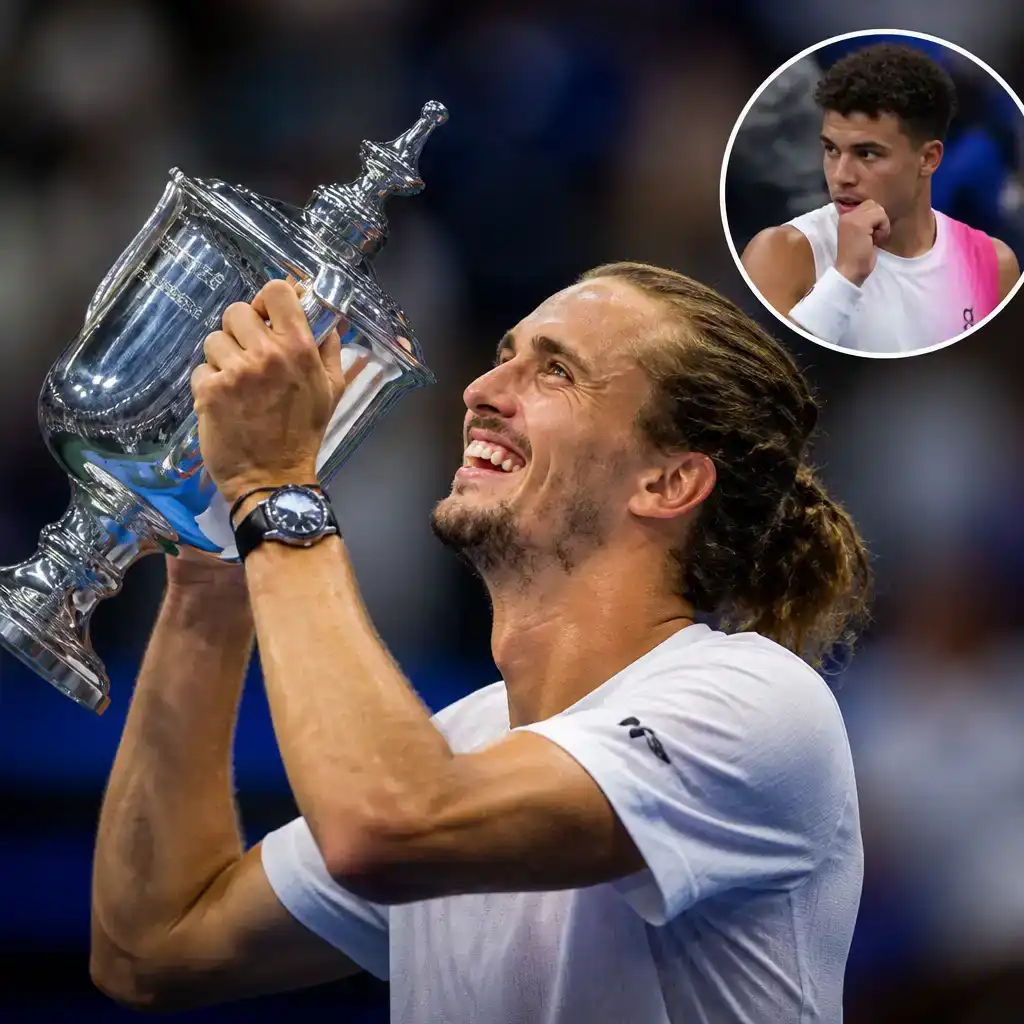
That lead carried uncomfortable historical baggage. Zverev had been two sets up in the 2020 US Open final before losing to Dominic Thiem. This time, he handled the important points with considerably less drama.
Shelton finally put sustained pressure on Zverev’s serve in the third set. He converted his third break opportunity and gave the 24,000 spectators reason to believe that the American drought might be ending.
Why Shelton’s comeback did not last
The momentum disappeared almost as quickly as it had arrived. Shelton opened the fourth set with a poor service game, allowing Zverev to re-establish control before the crowd could properly settle into its comeback routine.
From there, the top seed dictated play again. Shelton struggled to unleash his damaging forehand at the moments when it mattered most, while Zverev remained patient and continued exposing the American’s backhand.
The ending even briefly confused the champion. Shelton sent a return long on championship point, but Zverev did not immediately realise the match was over. Only after his team pointed out the score did he break into a broad, slightly surprised smile.
It was a restrained finish to a season that has dramatically changed how his career will be judged. Zverev entered 2026 having lost all three of his previous major finals. At 29, the possibility that one of the leading players of his generation might finish without a Grand Slam singles title had become difficult to ignore.
He removed that burden by winning the French Open. Three months later, he added the trophy in New York.
How injuries opened the draw for Zverev
Zverev’s breakthrough season came with help from circumstances elsewhere in the men’s game. Jannik Sinner and Carlos Alcaraz had shared every major title between them in 2024 and 2025, but injuries disrupted both players in 2026.
Alcaraz missed the French Open and Wimbledon, while Sinner was ruled out of the US Open. Zverev took full advantage of the reduced field, which is generally what elite athletes are expected to do when their leading rivals are unavailable.
His form at Flushing Meadows was not immediately convincing. Zverev scraped through the early rounds in several late-night matches and did not face a top-20 opponent until meeting Shelton in the final. Over the fortnight, however, his level steadily improved.
The match-up also suited him. Zverev had won all five of his previous meetings with Shelton, and his ability to absorb power, serve reliably and extend rallies again proved decisive.
Speaking to a team led by his father, Alexander Zverev Sr., and his brother, Mischa Zverev, the champion reflected on the long wait.
“We went 30 years without winning a Grand Slam title and now won two in the span of three months,” he said.
“I think God has seen how hard we have worked, how hard we have suffered and how much pain we went through.
“I think 2026 is the outcome of all the years that happened before.”
What Shelton’s run means for American tennis
The defeat will sting, but Shelton leaves New York with clear evidence that he can contend for the sport’s biggest prizes. The 23-year-old arrived with confidence after winning the Canadian Open in August, though his Grand Slam season had previously failed to match expectations.
A first-round loss at Wimbledon to Finnish qualifier Otto Virtanen was particularly damaging. Shelton called it “one of the toughest losses” of his career and treated it as a warning before the North American hard-court swing.
His response was impressive. The American number one reached his first major final through a demanding draw featuring several powerful opponents, including three former top-10 players and seven-time Grand Slam champion Carlos Alcaraz.
Shelton had never beaten a top-three player before defeating Alcaraz in an exhausting quarter-final that finished at 3:34am. Alcaraz was playing his first tournament in almost five months, but the victory still represented the biggest result of Shelton’s career.
Against Zverev, he could not repeat it.
What Shelton still needs to improve
Shelton’s recent progress has come from better defensive movement and a more dependable backhand. Those improvements helped him survive difficult matches throughout the tournament, but the final exposed the gap that remains against the leading players.
His forehand can overwhelm almost anyone when he has time to attack. Against Zverev, too many opportunities ended with errors, particularly on points that might have changed the direction of the match.
“I’m excited with the progress that I feel that I’ve made, but this one stings 100%,” Shelton said.
“I made too many errors when I had the ball there on my strings.”
Shelton came close to ending a 23-year wait for an American successor to Andy Roddick, who won the US Open in 2003. Instead, Zverev quieted Arthur Ashe Stadium and completed a remarkable transformation from serial finalist to multiple major champion.