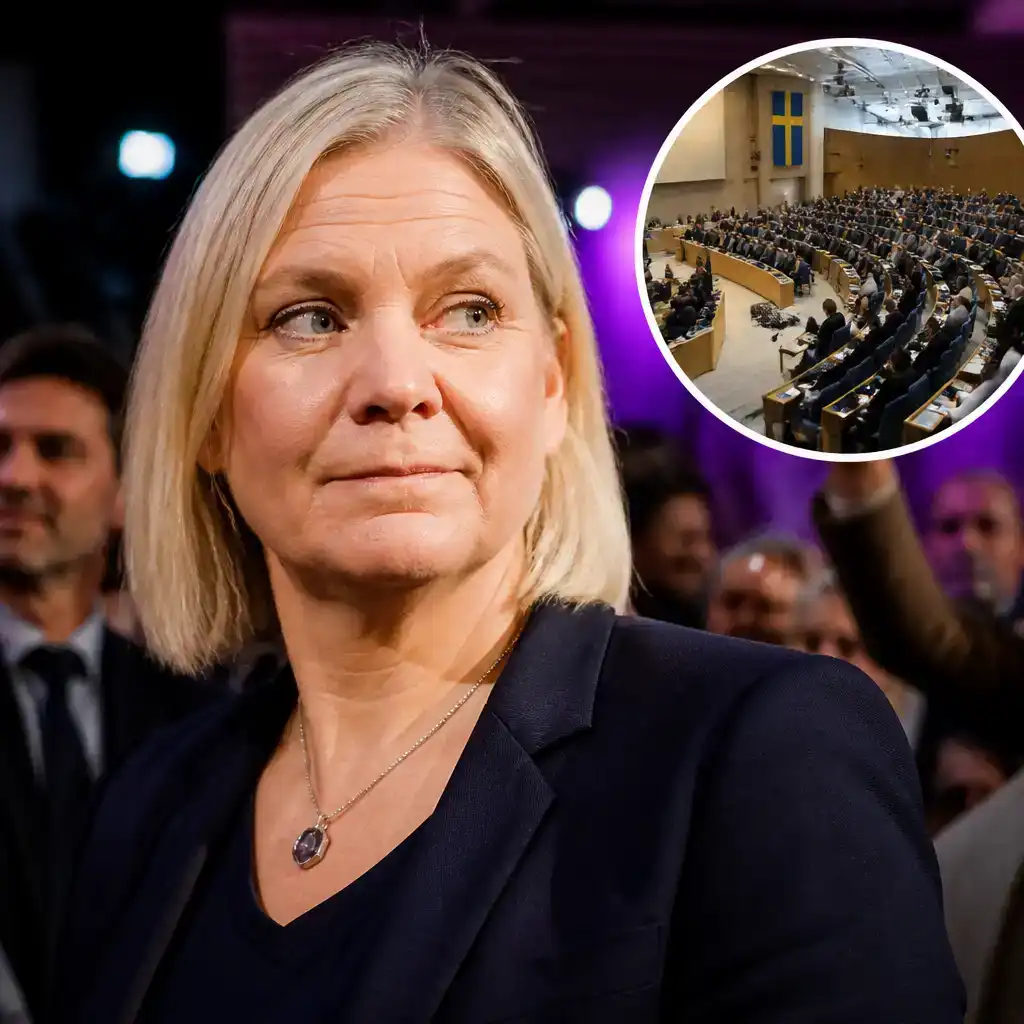
Sweden election results remained too close to call early Monday, with the left-wing bloc narrowly ahead and a potentially decisive batch of ballots still waiting to be counted. With 95% of votes reported, the Social Democrat-led grouping held 176 seats in the Riksdag, compared with 173 for the right-wing alliance.
No major media outlet had declared a winner. For a country choosing its next government, the answer was still the political equivalent of “please check again on Wednesday.”
Why the result is still uncertain
Prime Minister Ulf Kristersson told supporters early Monday that neither side could yet claim control.
“The voters have had their say, but we still don't have a final result. Which government will lead Sweden in the coming years is still an open question,” he said.
Counting will resume on Wednesday, when officials add early votes submitted too late for the initial tally and overseas ballots that did not arrive before election day.
The number of votes still outstanding has not been confirmed. In the 2022 election, however, more than 220,000 ballots were included during the later count. A similar total could alter the outcome this time because only around 28,000 votes currently separate the two blocs.
Sweden elects its parliament through proportional representation, distributing 349 mandates, or seats, according to each party's share of the vote. Parties must receive at least 4% nationally to enter the Riksdag. The projected 176 seats would give the left a majority, but the margin leaves little room for comfort.
What Magdalena Andersson said about the lead
Magdalena Andersson, leader of the opposition Social Democrats, urged supporters on Sunday night to wait for the final count. She also made clear what the current numbers would mean if they survive Wednesday's additions.
“If the current results hold, Sweden will have a new government,” Andersson said.
After voting earlier on Sunday, she framed the election as a choice between a government led by her and one heavily influenced by the Sweden Democrats.
“Should we have a government entirely dominated by the Sweden Democrats, something that has never happened in Sweden before? Or should we have a government led by me, which will steer Sweden in a new spirit of co-operation?” she asked.
The Social Democrats have dominated Swedish politics for much of the period since the end of the Second World War. Their leading position has not prevented a difficult result, though. Early figures put the party on 28%, which would be its weakest performance in more than a century.
How Sweden's political blocs performed
Swedish politics is largely divided between two four-party blocs, making coalitions and minority governments common. Straightforward parliamentary arithmetic is apparently considered optional.
The left-wing grouping includes:
- The Social Democrats
- The Left Party
- The Green Party
- The Centre Party
Although the Social Democrats lost support, the other three parties in the bloc increased their vote shares, helping put the group narrowly ahead overall.
The Sweden Democrats also appeared to be losing ground. The hard-right party, founded by Nazi sympathisers in the 1980s, spent years isolated by other political groups. That changed after the 2022 election, when it became Sweden's second-largest party following a campaign focused heavily on violent crime and immigration.
Monday's early count suggested the Sweden Democrats were heading for their first decline in support since entering the Riksdag in 2010. Even so, the party remains central to the right-wing bloc and to the question of whether Kristersson can remain prime minister.
What Kristersson's alliance is arguing
Kristersson said after voting in his home municipality of Strängnäs that voters wanted his alliance to continue governing.
“I think there is a genuine enthusiasm for us being able to continue our important work,” he said.
The election campaign centred on national security, gang crime and welfare spending. Those issues shaped a close contest in which both the largest left-wing party and the most prominent hard-right party lost support, while smaller parties gained ground.
Turnout fell to about 80%, roughly four percentage points lower than in the 2022 election. That still represents substantial participation, although fewer voters showed up for an election decided by a margin narrow enough to make every uncounted envelope rather conspicuous.
The next meaningful stage arrives Wednesday. Until officials process the remaining early and overseas ballots, both blocs have reason to remain hopeful and very little reason to start assigning cabinet offices.