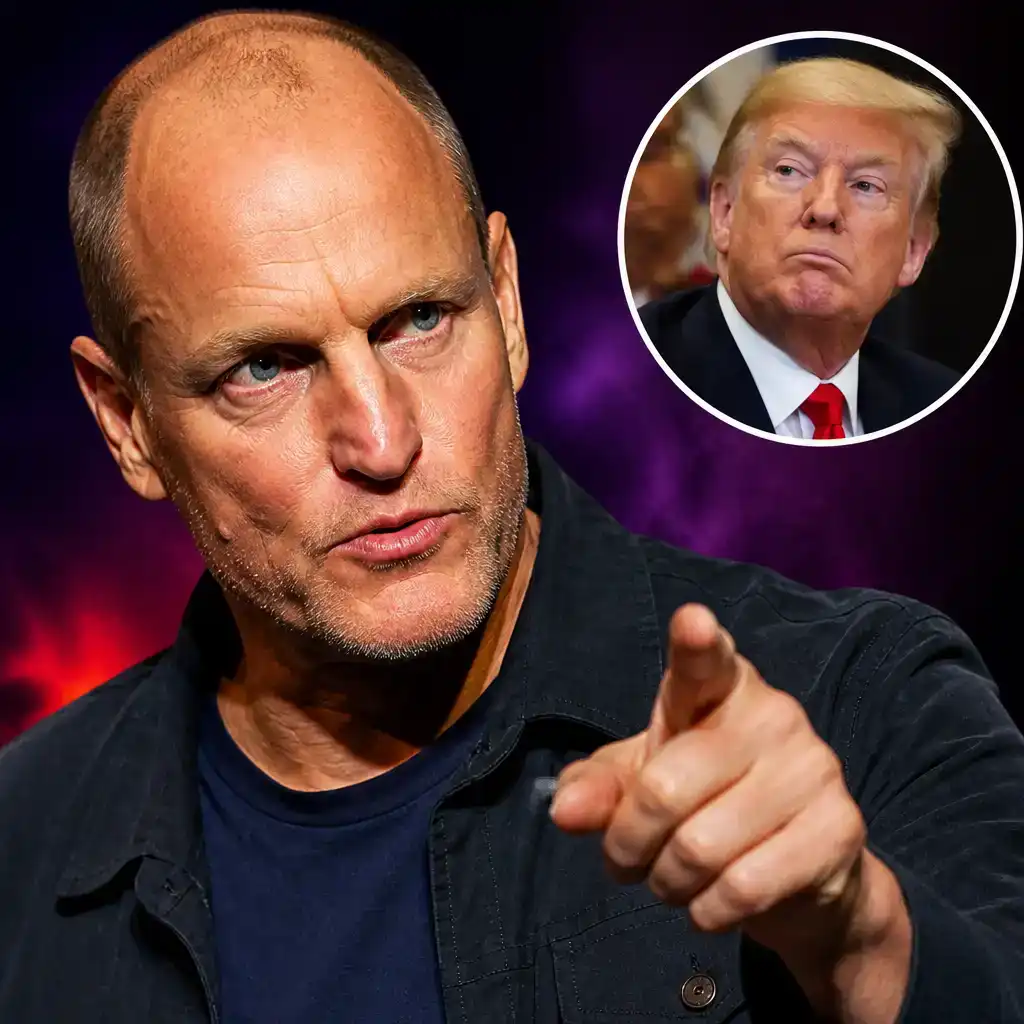
Woody Harrelson has never been particularly difficult to read politically, but his latest comments about Donald Trump leave almost no room for interpretation.
Discussing the US president, the actor said he wished there were a way to “get rid” of Trump and replace him with “a great president,” while accusing him of helping bring bigotry and racism back to the surface in America.
Harrelson's frustration appears to go beyond a disagreement over individual policies. He described the direction of the country under Trump as something closer to regression, saying it felt as though the US was “going backwards.”
Harrelson says Trump has “unearthed” racism and bigotry
Harrelson argued that Trump's presidency had “unearthed” bigotry and racism in the United States, presenting the president as a figure who had helped expose — and, in his assessment, worsen — divisions that were already present in American society.
His language was characteristically direct. Rather than carefully circling around his opinion of the president, Harrelson made clear that he would prefer to see somebody else in the White House.
He said he wished there were a way to “get rid” of Trump and replace him with “a great president.” The remarks were an expression of Harrelson's political view; the material available does not indicate that he was proposing any specific mechanism for removing Trump from office.
That distinction matters, particularly when political rhetoric is condensed into headlines. What is clear from Harrelson's comments is the intensity of his opposition to Trump and his belief that the country has moved in the wrong direction.
His opinion of Trump goes back much further
Harrelson's criticism also comes with an unusual piece of personal history: he has previously recalled spending an evening in Trump's company long before the latter occupied the White House.
The actor has said he attended a dinner in the early 2000s with Trump, Melania Trump and Jesse Ventura. His recollection of the future president was not especially flattering.
Harrelson described Trump's control of the conversation that evening as a “monologue monopoly” — a compact phrase suggesting that sharing the floor was not exactly the evening's defining feature.
The encounter gives Harrelson's more recent comments an additional dimension. His dislike of Trump's public persona is not based solely on watching him as a political figure from a distance; Harrelson has also described experiencing that personality at close quarters years earlier.
The “monologue monopoly” clearly left an impression
The dinner story has endured because it fits neatly with the criticism Harrelson is making now. In both cases, his description of Trump is of an overpowering figure: first dominating a dinner conversation, later becoming a political force Harrelson believes has pushed the country backwards.
That does not make Harrelson's assessment an objective judgment of Trump's presidency. It remains the actor's interpretation, shaped by his political views and his own experience of meeting Trump.
Still, there is remarkably little ambiguity about what that interpretation is.
In my view, the most revealing part of Harrelson's comments is not that a Hollywood actor dislikes Donald Trump — celebrity criticism of political leaders is hardly rare — but that his impression appears remarkably consistent across very different periods of Trump's public life. The dinner anecdote cannot prove anything about a presidency, but it does help explain why Harrelson's criticism sounds personal as well as political.
Years later, Harrelson's verdict has only hardened
The early-2000s dinner and Harrelson's latest political criticism belong to very different moments, but together they offer a fairly coherent picture of how the actor sees Trump.
Years ago, Harrelson remembered a man who monopolised the conversation. Now he is describing a president whose influence, in his view, has encouraged some of the country's ugliest divisions to re-emerge.
There is no evidence in the supplied material that Harrelson expects his comments to have any practical effect on Trump's presidency. They are instead a blunt statement of where he stands — and an unusually emphatic one.
His assessment of that dinner guest from the early 2000s was hardly glowing. After everything that followed, the review has not improved.