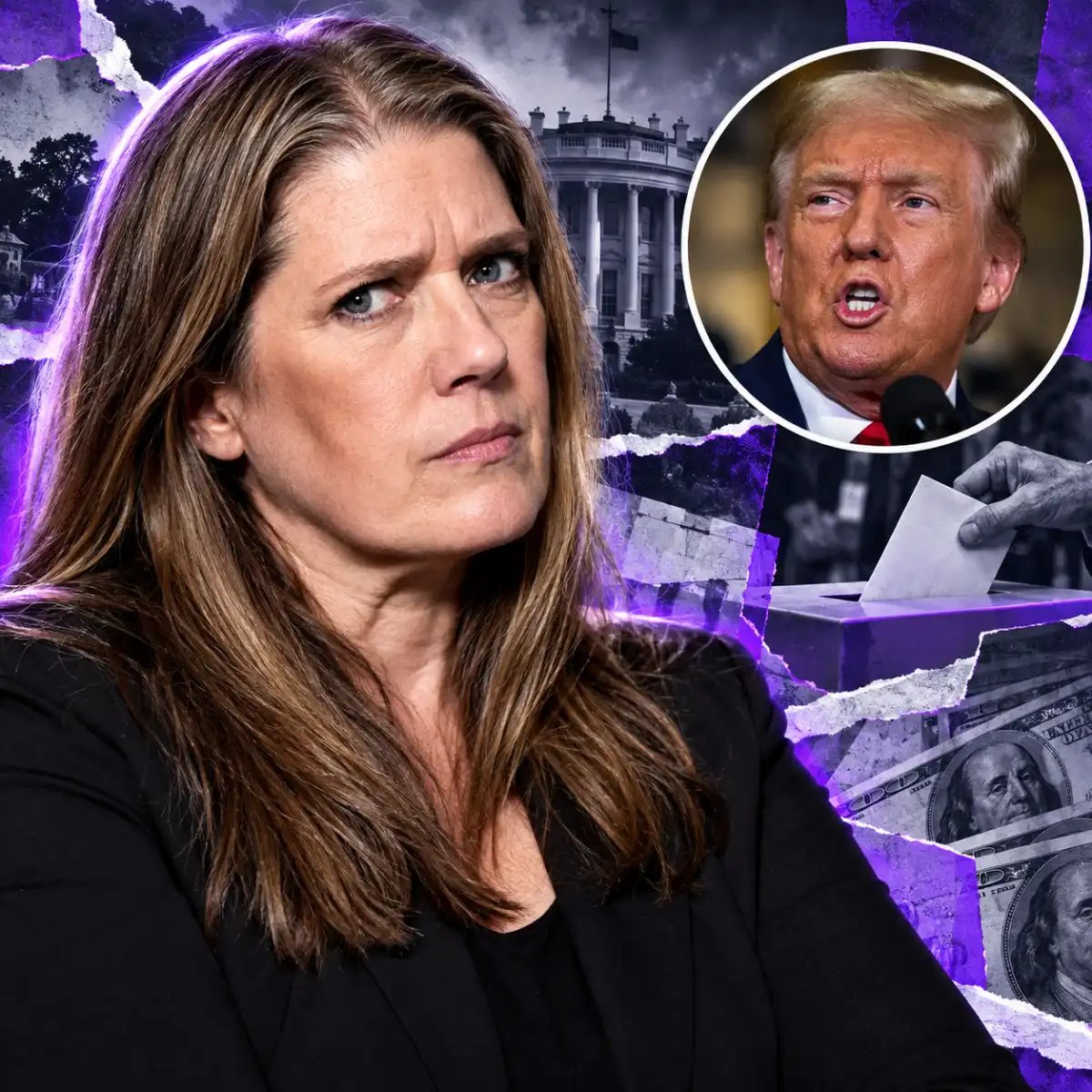
Mary Trump has launched a blistering attack on her uncle Donald Trump's election messaging, accusing him of hypocrisy, dismissing his latest financial promises and warning voters against becoming exhausted by his political tactics.
In a recent blog post ahead of an upcoming election, the president's niece described his campaign rhetoric as "insanity" and challenged two particularly striking elements of his messaging: his opposition to mail-in voting and a proposal involving $5,000 payments to voters.
Her criticism goes beyond another family disagreement. Mary argues that the political problems facing the United States are largely the consequence of decisions made by her uncle and supported by the Republican Party.
Mary Trump calls out her uncle's mail-in voting hypocrisy
One of Mary's central complaints concerns Donald Trump's long-running attacks on mail-in ballots, a voting method he has repeatedly criticised despite using it himself.
For Mary, that contradiction illustrates a broader problem with his political messaging: the standards he promotes publicly do not necessarily appear to apply to his own behaviour.
The distinction is difficult to ignore. If voting by mail is sufficiently reliable for the president himself, his continued opposition to the practice raises an obvious question about the consistency of his argument.
Mary's criticism focuses on that apparent double standard rather than offering a detailed assessment of election security or voting procedures.
It is also a particularly accessible political argument. Voters do not need an extensive understanding of electoral administration to recognise the tension between condemning a practice and personally participating in it.
The $5,000 check proposal faces another uncomfortable question
Mary also targeted a proposal that would provide voters with $5,000 checks if Republicans secured an electoral victory.
She dismissed the idea as "another promise of a check that will never come", making clear that she does not believe the proposed payments will materialise.
Her objection is fundamentally about credibility. Rather than treating the proposal as a guaranteed financial benefit, she portrays it as another political promise designed to appeal to voters without sufficient reason to trust that it will be delivered.
The information available does not establish the proposal's precise eligibility requirements, funding arrangements or implementation timetable. Nor does it demonstrate that the payments are impossible.
That distinction matters. Mary's prediction that voters will never receive the money is her assessment, not an established outcome.
Still, her criticism highlights a legitimate question for any politician proposing direct payments: what concrete mechanism would turn an election pledge into money reaching people's bank accounts?
Until those details are clear, the political appeal of a $5,000 check and the practical likelihood of receiving one remain separate issues.
Mary Trump blames Donald and Republicans for America's problems
Mary's strongest accusation concerns responsibility for the country's broader difficulties.
"Almost everything that is going wrong in this country right now is the direct result of actions Donald has taken, supported by the entirety of the Republican Party", she wrote.
It is a sweeping condemnation, directed not simply at her uncle's individual decisions but at the political organisation that has supported him.
By including the Republican Party in her criticism, Mary frames the issues she identifies as the product of collective political choices rather than the actions of one person operating alone.
Her statement is also considerably broader than the specific examples she provides. The material available does not independently establish that Trump's decisions caused almost every problem currently facing the United States.
That remains Mary's political judgement, and readers should distinguish it from a documented assessment of individual policies and their consequences.
Nevertheless, the force of her argument is unmistakable. She wants voters to hold both Donald Trump and his Republican allies accountable for the decisions they have supported.
Why Mary Trump is warning voters against political exhaustion
Beyond the accusations of hypocrisy and unreliable promises, Mary's message contains another concern: that voters could become so accustomed to Trump's rhetoric that they eventually stop challenging it.
Her warning against becoming worn down by his tactics suggests she sees political fatigue as a danger in its own right.
Repeated controversies can create an unusual challenge for political critics. An argument that might once have provoked intense scrutiny can begin to sound familiar simply because similar disputes have occurred before.
Mary's response is to keep drawing attention to the contradictions she considers important, particularly when they concern election procedures and promises made directly to voters.
In my view, her strongest argument is the criticism of mail-in voting. The contrast between Trump's public opposition and his personal use of the method is specific, understandable and open to scrutiny. Her broader claim that he is responsible for almost everything going wrong in America is much harder to substantiate from the evidence presented. The more persuasive criticism is the one that identifies a concrete inconsistency rather than assigning sweeping responsibility.
That does not make her concerns about political exhaustion irrelevant. It suggests that criticism is most effective when voters can examine the underlying facts rather than being asked to accept an expansive political judgement.
What Trump's latest election promises will have to prove
Mary Trump's intervention leaves two distinct questions hanging over her uncle's election messaging.
The first concerns consistency: how does he reconcile his criticism of mail-in voting with his own participation in it?
The second concerns delivery: what evidence can Republicans provide that the proposed $5,000 payments would actually reach eligible voters?
The supplied account does not include a response from Donald Trump or Republican representatives to Mary's latest remarks, so their positions on these particular criticisms cannot be established here.
For now, Mary's message is that voters should resist treating familiar political contradictions as unremarkable simply because they have heard them before.
And while disagreements within the Trump family are hardly the central issue facing American voters, this particular dispute raises a question with implications well beyond one household: whether election promises and political arguments are being judged by the same standards as the actions behind them.