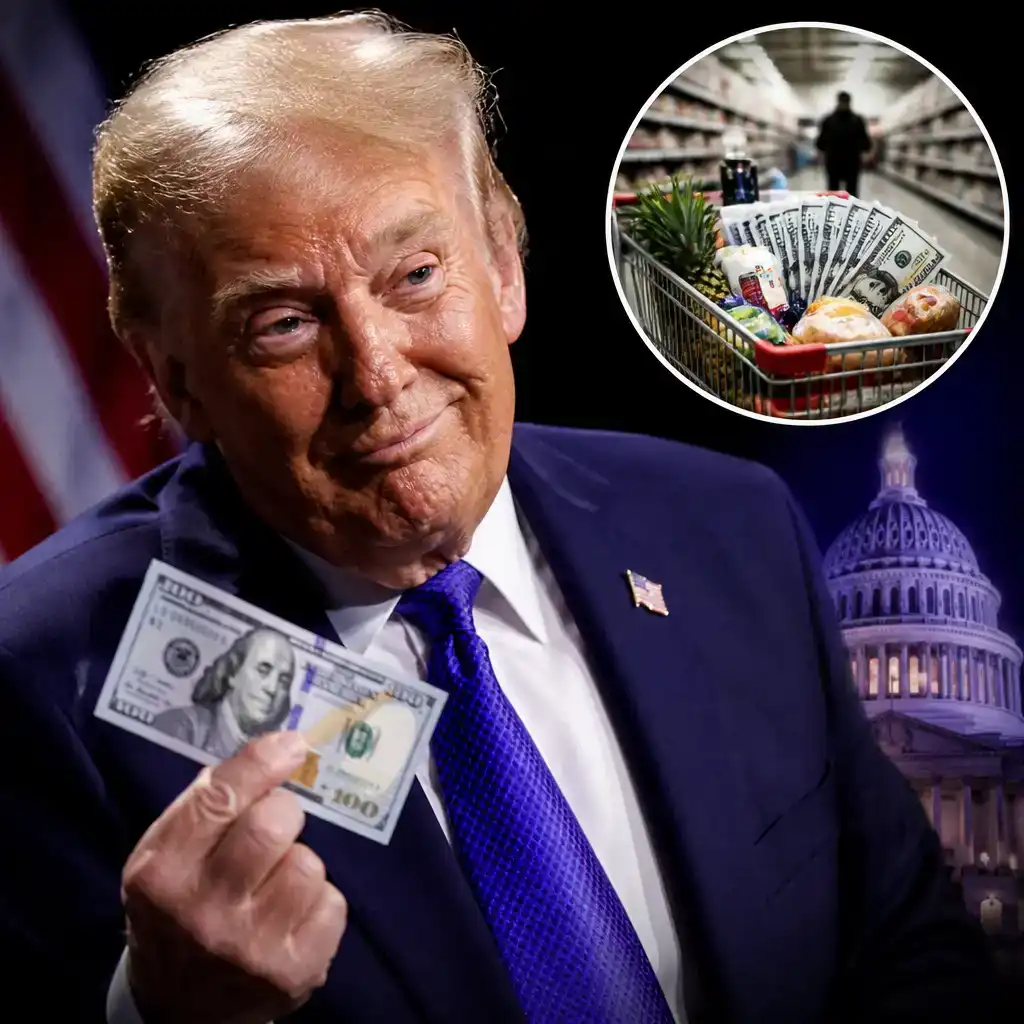
That total creates an immediate problem for the administration’s suggested funding source. Vice-President JD Vance linked the proposal to revenue collected through Trump’s tariffs, describing the payment on Fox News as “fundamentally a dividend for American workers.”
“We’re taking in an extraordinary amount of revenue because the president of the United States is actually standing up to both foreign companies but also foreign countries,” Vance said.
The available figures are rather less extraordinary. The New York Times, citing the Penn Wharton Budget Model, reported that Trump’s tariffs generated nearly $300 billion before refunds. After the Supreme Court invalidated much of the programme, net revenue fell to about $132.5 billion.
A universal dividend would therefore cost more than ten times that post-refund amount. Replacement tariffs were expected to raise about $105 billion annually, Axios reported in July. Treasury figures also showed negative net customs receipts of $25.6 billion in June because refunds exceeded collections. Tariffs may bring in money, but not currently enough to make this arithmetic cooperative.
Would every adult actually receive $5,000?
Trump’s language in Dallas was broad and uncomplicated: “every adult citizen.” Vance later introduced a complication, suggesting to the Associated Press that wealthy Americans might not qualify.
That raises several unanswered questions:
- Whether the payment would be universal or limited by income
- What income threshold would apply
- Whether citizenship, tax-filing status or residency would determine eligibility
- How the domestic-spending condition could be enforced
- When payments would arrive after the election
The White House has not publicly resolved the difference between Trump’s universal promise and Vance’s possible means test. A narrower programme would cost less, although the administration has not produced estimates for any version of it.
Trump previously proposed $2,000 tariff-funded cheques. TD Economics estimated that even a payment of that size could significantly increase consumer spending while adding inflationary pressure and potentially affecting Federal Reserve policy. A universal $5,000 payment would be substantially larger, particularly at a time when households are already dealing with higher everyday costs.
Can a president send the money without Congress?
Not by announcement alone. Congress controls federal spending, and previous pandemic-era relief cheques required legislation.
Marc Goldwein of the Committee for a Responsible Federal Budget told the Associated Press that Trump could not distribute the money without congressional authorisation. The president did not say during his speech whether he would ask lawmakers to approve the programme, even though his condition for launching it is Republican control of both chambers.
The campaign context has also prompted questions about election law. Federal law prohibits payments intended to influence voting, but legal specialists have drawn a distinction between directly paying individuals to vote a certain way and making a broad campaign promise about future government policy.
John Day, a New Mexico lawyer, told the Associated Press that the proposal appeared lawful because it was offered to all adult citizens as a campaign policy rather than as an individual payment for a particular vote. An election-law expert cited by The New York Times similarly said the promise would likely fall under the First Amendment’s free-speech protections.
So the larger obstacle is probably not whether Trump may promise the money. Politicians have considerable freedom to promise things. The harder part is persuading Congress to fund them.
Why did Trump make the pledge now?
The offer arrived as Republicans face voter concern over prices and the economic effects of the war with Iran. The conflict began in February after the United States and Israel attacked Iran. Tehran retaliated against US bases and allies in the Gulf and largely closed the Strait of Hormuz, the route that previously carried about one-fifth of the world’s oil and liquefied natural gas.
The disruption has driven volatility in global energy markets and increased pressure on Trump from within his own party to end the conflict. Before his Dallas speech, the president warned supporters that the war would continue beyond the midterms and that oil prices would not fall before then. He repeated that message at the convention, arguing that temporary economic pain was necessary to stop Tehran from developing nuclear weapons.
Against that background, the dividend offered a much simpler message: vote Republican and receive more spending power. The convention audience responded enthusiastically.
Trump also insisted the money remain in the domestic economy. “We don’t want you going to Canada to spend the money,” he said. “We don’t want you going to China, to Germany. You got to spend the money in the United States of America.” The mechanism for checking anyone’s shopping itinerary remains unavailable.
What have Democrats and Trump allies said?
Democrats dismissed the proposal as an election-year promise unsupported by legislation or funding. Democratic National Committee Rapid Response Director Kendall Witmer called it another “empty promise” and argued that families were instead facing elevated grocery, petrol and healthcare costs.
Criticism also came from inside Trump’s political coalition. Venture capitalist and Trump ally Joe Lonsdale said he wanted Republicans to win the midterms but strongly opposed what he described as “bread and circus bribes.”
Vance rejected the idea that the payment was controversial, presenting it as a return of tariff proceeds to workers. Yet his suggestion that higher-income adults could be excluded leaves the administration defending a proposal that currently has two different eligibility rules and no legislative text.
Election-linked economic incentives are not entirely new. During the Covid-19 pandemic, Democrats campaigning in Georgia promoted $2,000 relief payments if their party won control of the Senate. Those payments still required congressional action.
Trump’s proposal now depends on several events occurring in sequence: Republicans must retain both chambers, Congress must approve an enormous expenditure, the administration must identify a credible funding source, and officials must devise a system ensuring the money is spent domestically. The applause was the easy stage.