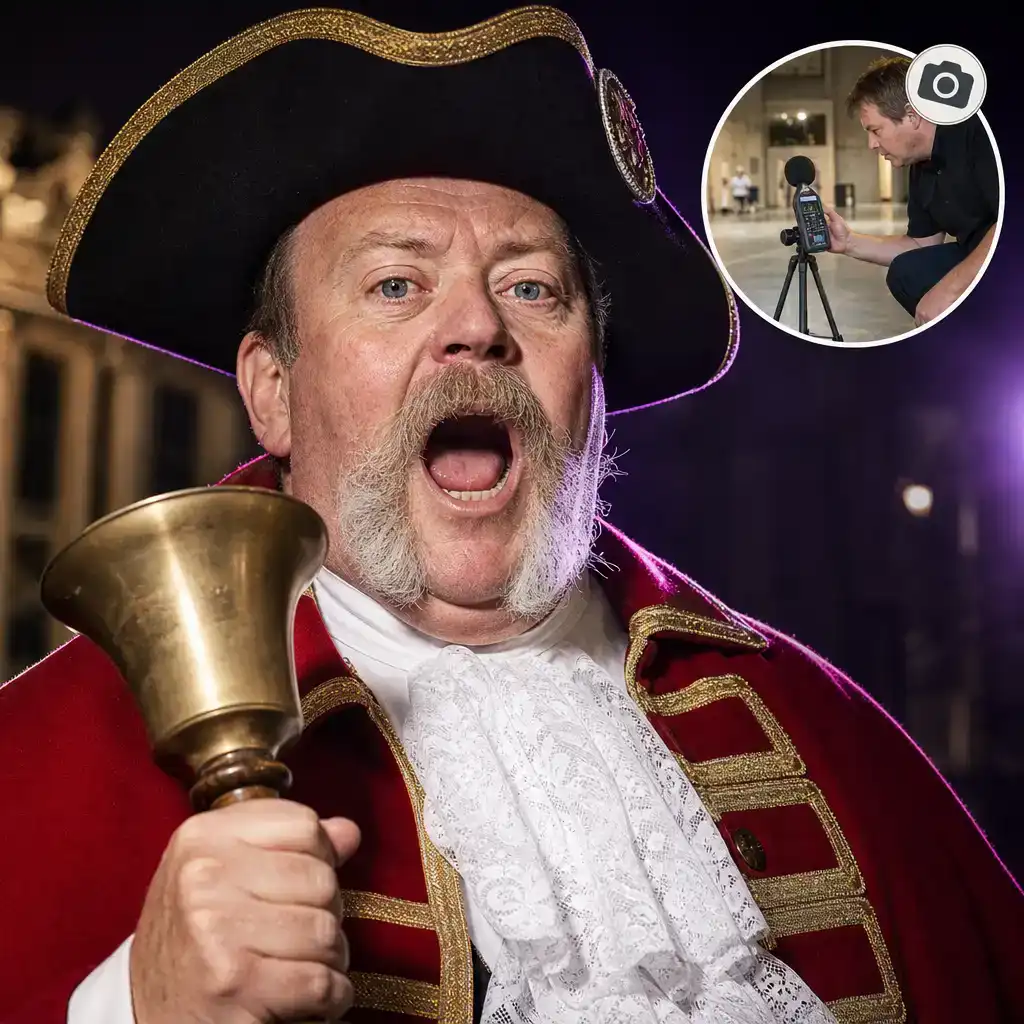
That process matters because Guinness, in its usual spirit of turning unlikely human abilities into audited achievement, does not simply accept that someone was loud because several people looked startled.
The word “now” beat a record from 1994
McGrail-Bateup’s 122.4-decibel shout surpassed a mark that had stood for three decades. In 1994, schoolteacher Annalisa Flanagan set a 121.7-decibel record in Belfast, Northern Ireland, by shouting the word “quiet.”
Guinness has also listed that earlier record under the name Annalisa Wray. McGrail-Bateup has been careful to frame his title as the male record, with Flanagan’s achievement still standing as the loudest female shout.
The word used in the attempt was not chosen at random. Guinness reported that McGrail-Bateup and his daughter tested several options before landing on “now,” which they found worked better than “quiet.”
It was effective, but not exactly gentle on the vocal cords. He repeated the attempt enough times to strain his voice, which feels like the least surprising medical outcome in this story.
From “quiet kid” to official town crier
The record has brought global attention to a voice people in his community already knew well. McGrail-Bateup appears at civic gatherings, school fetes, car shows and community events under the ceremonial name “Lord Joseph.”
He was appointed Canberra’s official town crier in 2017 and later became involved in competitive town crying through the Ancient and Honourable Guild of Australian Town Criers.
Town crying is a ceremonial role now, but its roots are practical. Before microphones, public address systems and phones that somehow still fail at basic calls, town criers needed to project clearly in open public spaces. Volume was not a party trick. It was the job description.
McGrail-Bateup had already tested that skill in competition. In 2024, he won a guild contest for the loudest “Oyez, Oyez, Oyez,” reaching 98 decibels with the traditional call used by town criers before a proclamation.
Why 122.4 decibels is not just a fun number
The record is entertaining, but the sound level is also serious. Noise at or above 120 decibels falls into a range health authorities consider hazardous.
The U.S. Centers for Disease Control and Prevention has warned that noise-induced hearing loss can happen after exposure to extremely loud sounds, including a one-time exposure at or above 120 decibels. NIOSH guidance also treats repeated exposure above 85 dBA as hazardous.
In other words: do not try this in the kitchen just because the video looks fun. It was measured in a controlled setting with professionals involved, which is the least glamorous but most important part of the achievement.
This is not his first Guinness moment
McGrail-Bateup has been in the Guinness orbit before. In 2019, he set a record for the fastest time to shoot 10 arrows into a 40-centimetre target from 18 metres, completing the challenge in 1 minute and 0.03 seconds.
That archery record has since been broken. McGrail-Bateup appears relaxed about that part of record life, telling the Associated Press that “records are meant to be broken.”
For now, though, he holds one of the Guinness catalogue’s harder-to-ignore titles. A ceremonial voice trained for local announcements has become a world record measured in decibels, and McGrail-Bateup has proved that being heard can still take you surprisingly far.