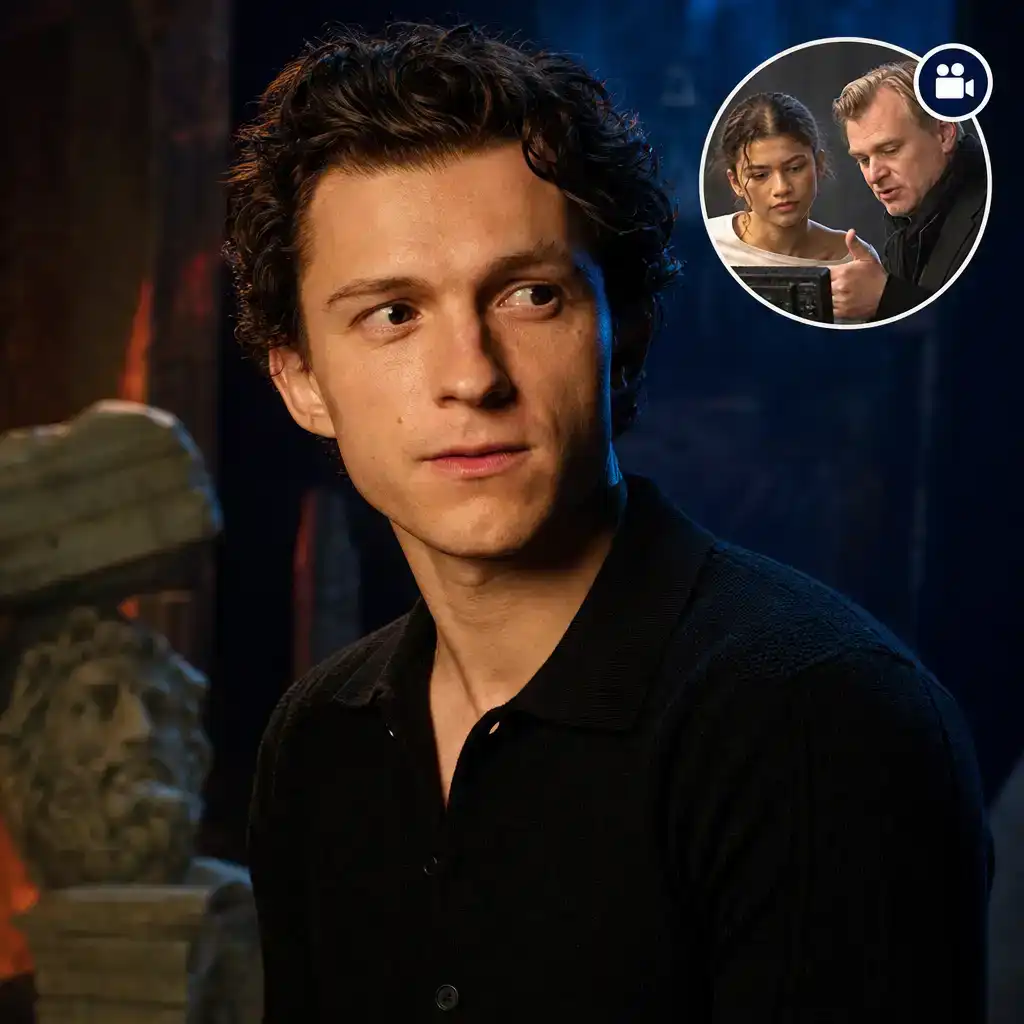
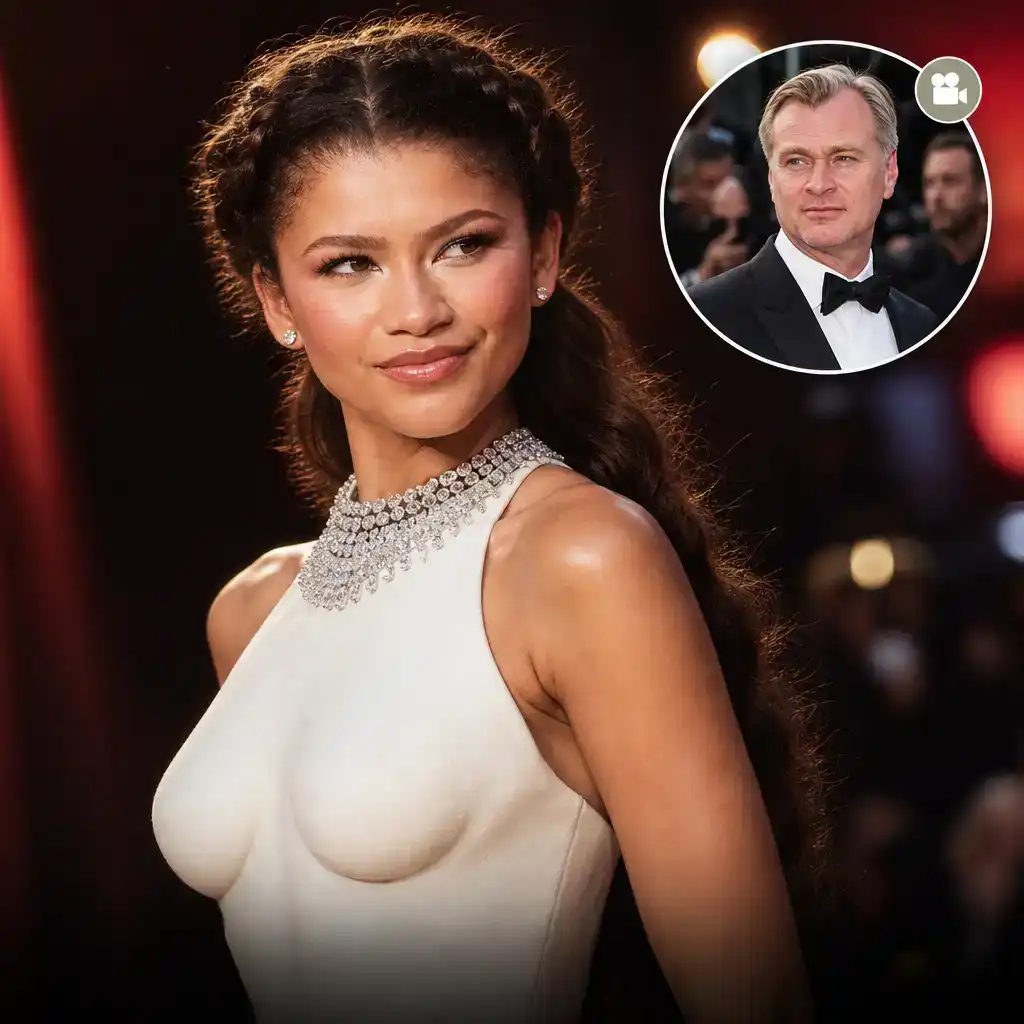
Holland is now married to Zendaya, though discussion of their wedding was off limits. On screen, however, there is an unusual wrinkle: Zendaya appears in the film as the goddess Athena, but the pair do not share scenes, unlike in their Spider-Man work together.
Holland says he read the script with her, “which I don’t know if I was supposed to”. When he met Nolan the next day, the director “asked me if I would be OK with him asking Zee to play Athena”. Holland says he went home and was able to tell her himself: “It was a very special moment.”
Her reaction was not exactly theatrical, at least at first. “The little corners of her mouth went up. She had this little smile and then we both started jumping around the kitchen.”
How Nolan assembled the film’s central family
The film’s main cast gives Nolan a fairly deep bench. Matt Damon plays Odysseus, who spends 10 years fighting at Troy and another 10 trying to return home. Damon says Nolan’s offer required very little negotiation.
When the director called, Damon recalls, Nolan said: “I’d like to offer you the lead role.” Damon answered yes immediately. Nolan then asked, “Don’t you want to hear what it is?” Damon replied, “Sure.” The pitch was brief: “It’s a two-word pitch. The Odyssey.”
Hathaway plays Penelope, Odysseus’s wife and Telemachus’s mother. She recently announced her pregnancy, and says the film made her think about motherhood across roughly 3,000 years.
“It was really interesting to kind of translate what the world that I live in and what my idea of being a loving mother is to 3,000 years ago,” Hathaway says.
“There’s no such thing as gentle parenting in ancient Greece! The stakes were really, really high. And there was sometimes a need for her to scare him in order to keep him safe. It just made me grateful that I feel like I have more avenues available to me now.
“But I also, you know, I don’t know what it is to raise a teenage boy. My kids are still very young, at least they feel young.”
What the film says about masculinity and training
The Odyssey also touches a current conversation about masculinity, though Holland avoids turning that into a speech with bullet points and a closing slogan. His read is broader and more useful.
“Maybe what you can learn from this movie about masculinity is that it comes in all shapes and sizes and there is no version of it that’s perfect,” he says.
For the role, Holland also learned a practical skill: “I did a lot of swordfighting, which I loved.” Whether that training has much application away from a Nolan set is less clear, unless daily life takes a sharp turn.
He jokes that he does not keep a sword at home, for obvious reasons, but adds that if someone broke in, “I have a cricket bat actually, and I can wield that in a sword-like fashion”.
For all the A-list status around him, Holland presents himself as grounded. “I just live my life the way my parents raised me,” he says, adding that he tries not to “take anything for granted”. That is sensible advice, although it does not usually come with Imax cameras and bronze Trojan horses.
Why working with Christopher Nolan raised the stakes
Unlike Damon and Hathaway, Holland had never worked with Christopher Nolan before. For many actors, that phone call is a career marker, and Holland does not pretend otherwise.
“Before you’ve worked with him and before you’ve got that call, you think about it a lot and you yearn for that opportunity and then you get the opportunity and that comes with a lot of pressure,” he says.
Holland’s path here has been unusually public: Billy Elliot on the London stage at 12, then Spider-Man, then global recognition. Nolan calls him “one of the great actors of his generation,” praise that lands differently from a director whose past collaborators list is not exactly short on Oscar winners.
Holland says Nolan “is spoilt for riches with the list of actors that he’s worked with”. Asked whether that made the job daunting, he answers simply: “Absolutely.” His approach was to treat the opportunity as already earned and then get to work: “I’ve got what I wanted and now it’s time to show him what I can do.”
Nolan had his own pressure to manage. His previous film, Oppenheimer, won seven Oscars and made around a billion dollars worldwide. That is a useful commercial result, though not exactly a relaxing one.
How Nolan followed Oppenheimer without looking back
Nolan says he coped with the weight of Oppenheimer by keeping reminders out of view. While he was writing The Odyssey, his son walked into his office and noticed the Oscar statuettes had disappeared.
“I said to him very seriously, I’m trying to write a new project and if I’ve got Oscars sitting on the shelf, think about how daunting that would be,” Nolan says.
“You can’t really think about what’s come before,” he adds.
That approach fits the scale of the new film. Nolan has again emphasized physical production: real ships, real seas and a real Trojan horse on a real beach. The Odyssey is also the first feature film shot entirely on Imax film. Nolan’s preference for celluloid is not new, but here it becomes part of the film’s identity.
“If you want naturalism, if you want to show somebody the way the world looks, celluloid film is the way to do it,” he says.
The result is built for the biggest possible screen. The film is being sold as an Imax experience, which is not subtle, but then neither is a mythological war story involving gods, monsters and an extremely consequential wooden, or in this case bronze, horse.
Why the casting debate followed the film early
Before release, the film also attracted criticism over casting. Elon Musk posted on X about the choices, including Lupita Nyong’o as Helen of Troy. He shared a post by a right-wing blogger accusing Nolan of changing characters for awards-season or diversity-related reasons.
Others accused Musk and the blogger of racism, and pointed out that Helen is a mythological figure, described as the daughter of Zeus and born from a swan’s egg. Historical realism is a flexible tool when the source material has that sentence in it.
In the film, Helen’s story is handled with a twist. Nolan does not treat Homer as distant homework. He rejects the idea that he is sneaking high art into cinemas by dressing it like blockbuster spectacle.
“When you go to Homer, it’s a very crowd-pleasing story. It’s popcorn stuff. I mean that’s the joy of it and that’s why it’s endured for this long,” Nolan says.
His aim, he adds, is to “bring something fresh to the audience”.
“When Hollywood makes a mistake, it’s always the same mistake, which is to forget how much people want something new, how much they want something they haven’t seen before.”
What Nolan changed in the Trojan horse
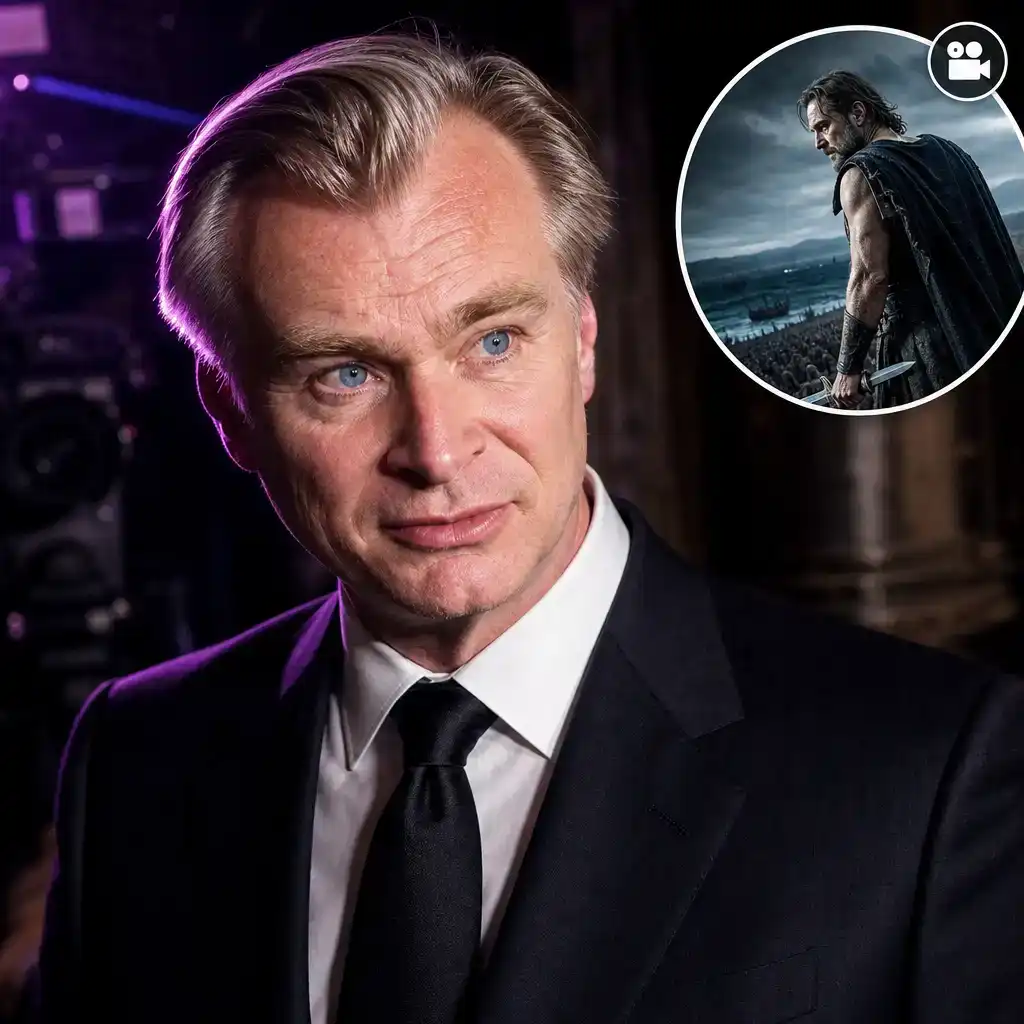
One of Nolan’s clearest changes is the Trojan horse itself. In this version, the trick devised by Odysseus does not roll into Troy on wheels. It is reimagined as a vast bronze creature, packed with men inside.
Nolan says the image had been sitting in his head for about two decades, dating back to a period when he was briefly attached to direct Troy for Warner Brothers.
That kind of long-held visual idea is typical of Nolan’s process: practical, large-scale and engineered to make the audience feel the weight of the object rather than merely observe it. There is spectacle, certainly, but the film also invites bigger questions about war, obligation and the rules people claim to live by.
One phrase in the film, the “Law of Zeus,” points toward the idea of treating others as you would want to be treated. The story may be ancient, but that idea has not exactly gone out of circulation.
Damon resists reducing the film to a single lesson. “It’s more that something like this should be a conversation, that’s what a piece of art is there for,” he says. “It’s not for us to say, here’s the message, it’s not a lecture. It’s something to be discussed.”
The Odyssey opens in cinemas on Friday 17 July.