Warning: Major spoilers for The Odyssey follow.
Nolan's The Odyssey changes are not limited to trimming an ancient poem for a modern runtime. Christopher Nolan has reworked the story's gods, marriages, violence and final destination, turning Odysseus' homecoming into a broader warning about war and civilizations repeating their failures.
That approach has produced both a major theatrical success and a lively argument among classicists. Some scholars believe Nolan sacrificed essential relationships and divine forces for spectacle. Others see the film as the latest legitimate retelling of a work that has never had one uncontested interpretation.
The audience, meanwhile, is showing up. According to the Associated Press, the film earned $87 million domestically in its second weekend, the strongest second frame of Nolan's career. Its estimated worldwide total reached $639.6 million, including $286.3 million in North America and $353.3 million internationally. That is substantial, though still well short of the earlier suggestion that it was already heading past $1 billion.
Why are scholars challenging Nolan's adaptation?
Emily Wilson, whose 2017 English translation reportedly helped inspire Nolan, has objected to several of his choices. She argued that reducing Zeus and Poseidon weakens the poem's divine framework and called the film's combined anti-war and anti-cowardice message “incoherent.”
The Los Angeles Times made a similar observation about the gods, noting that Poseidon is largely reduced to rumors while Zeus is represented through thunderclaps.
Wilson was also critical of Anne Hathaway's Penelope, saying the diminished role threatened “any possibility of believing in this marriage.” She disliked the treatment of Odysseus' dog, Argos, too, describing those scenes as an appeal to modern sentimentality. Her broader conclusion was that Nolan tried to include nearly everything while losing themes central to the poem.
Other responses have been more generous. Variety called the film a “grand, gutsy vision” attentive to scholarly detail, although it also found Penelope and other family relationships vaguely drawn and the drama emotionally distant. RogerEbert.com praised Nolan's handling of fate and chance, adding that the 172-minute film feels shorter than its considerable runtime.
Homer scholar Joel Christensen said academics had a “really robust debate” over the adaptation. Marilyn Slatkin offered a more flexible view, describing Nolan's screenplay as the “newest song” in a long tradition of retelling the epic.
Are Athena and the other gods real in the film?
Nolan refuses to settle whether Zendaya's Athena is literally the goddess from Homer's poem or a manifestation of Odysseus' guilt after the Trojan War. He told Time that explaining Memento taught him not to close off an audience's interpretation, so Athena's identity remains deliberately uncertain.
His wider approach is to present divine power as people in the ancient world might have perceived it.
“We view the gods the way that people at the time might have viewed them,” Nolan said. “So they're seeing evidence of the gods in nature. They're seeking and finding gods and the influence of gods in the people around them.”
That choice shifts the story's emotional burden. In Homer, gods intervene directly, protect favored mortals and alter events. Nolan's characters must instead interpret weather, coincidence, fear and other people as possible signs of divine intent. The uncertainty makes Odysseus' guilt more immediate, but it also explains why readers attached to Poseidon's anger or Athena's guidance may feel that important machinery has been removed.
The gods are not exactly absent. They are simply denied the courtesy of clear identification.
Why does Helen of Troy have a scar?
One of Nolan's starkest departures concerns Lupita Nyong'o's Helen and Jon Bernthal's Menelaus. Greek mythology traditionally has Menelaus forgive Helen after bringing her back to Sparta. Nolan imagines their reunion as something far more poisonous, suggesting that Menelaus deliberately scarred her face.
When Tom Holland's Telemachus visits, Menelaus forces Helen to reveal the scar and calls her “the face that launched 1,000 ships, or maybe just 500.” The humiliation gives the audience an immediate picture of a marriage defined by resentment, control and damage left by the war.
Nolan said the poem did not fully confront what Helen's return with Menelaus would mean or how their relationship could continue. He concluded that it would be an “acidic, awful marriage.”
“There's a lot of s**t that's happened in that relationship, and we have a very brief moment of time with them in this story,” he said. “I was looking for a shorthand way to communicate the aftermath of the war and how it's been traumatic for the entire world.”
The scar therefore does more than revise Helen's mythology. It makes her body evidence of the conflict's aftermath, while Menelaus becomes an example of a victorious soldier who has carried violence into his own home.
What happened to the poem's violent final chapter?
Nolan also reconsidered the punishment that follows Odysseus' return to Ithaca. In Homer, Odysseus kills Penelope's suitors and orders the execution of disloyal maidservants. Nolan described parts of the poem's conclusion as “so grim and so misogynistic” that he felt he had to leave some material out.
He did not want to erase what that violence says about men and warfare, however. The film redistributes those concerns across its treatment of trauma, power and revenge rather than reproducing every killing from the poem. Circe and the transformation of Odysseus' soldiers into pigs are also substantially reimagined, although Nolan has not reduced the change to a single stated explanation.
There is an additional complication: the ending of The Odyssey was never as fixed as it can appear in a classroom edition. In Book 24, the relatives of the dead suitors seek retaliation. Zeus and Athena intervene, stop the cycle and impose peace. Classical scholarship from Cambridge notes that the authenticity of this final section has been disputed since antiquity.
That history places Nolan's revision inside an old argument rather than making it a simple rejection of one universally accepted conclusion. Readers and scholars have long debated where the poem properly ends and how much divine intervention is required to restore order.
What does Nolan's new ending mean?
The film ends with Matt Damon's Odysseus and Hathaway's Penelope sailing away while considering how later civilizations will repeat the same mistakes. Homer instead leaves Odysseus restored as king, with divine intervention preventing further bloodshed.
Nolan said he wanted “to strike the right balance between pessimism and optimism,” combining pessimism about what may have caused the Bronze Age collapse with hope that constructive forces will eventually return.
The final image, the burning head of Odysseus' wooden horse, ties his personal victory at Troy to a much larger historical decline. Within the film's argument, the deception that ended the war also helped begin the destruction of the world that produced it. The sequence still permits ambiguity, including whether the departure is real or imagined, but Nolan's comments frame it primarily as a genuine closing movement rather than merely Odysseus' dying vision.
Emotionally, the change gives Odysseus and Penelope an escape that Homer's version does not. It also asks whether coming home is enough when violence has changed both the traveler and the society awaiting him.
How much has the spectacle driven its success?
The debate is unfolding around a film with a reported $250 million production budget and unusually strong premium-format demand. The Odyssey opened with $264.1 million worldwide, received an A CinemaScore and delivered a record $52 million global IMAX debut.
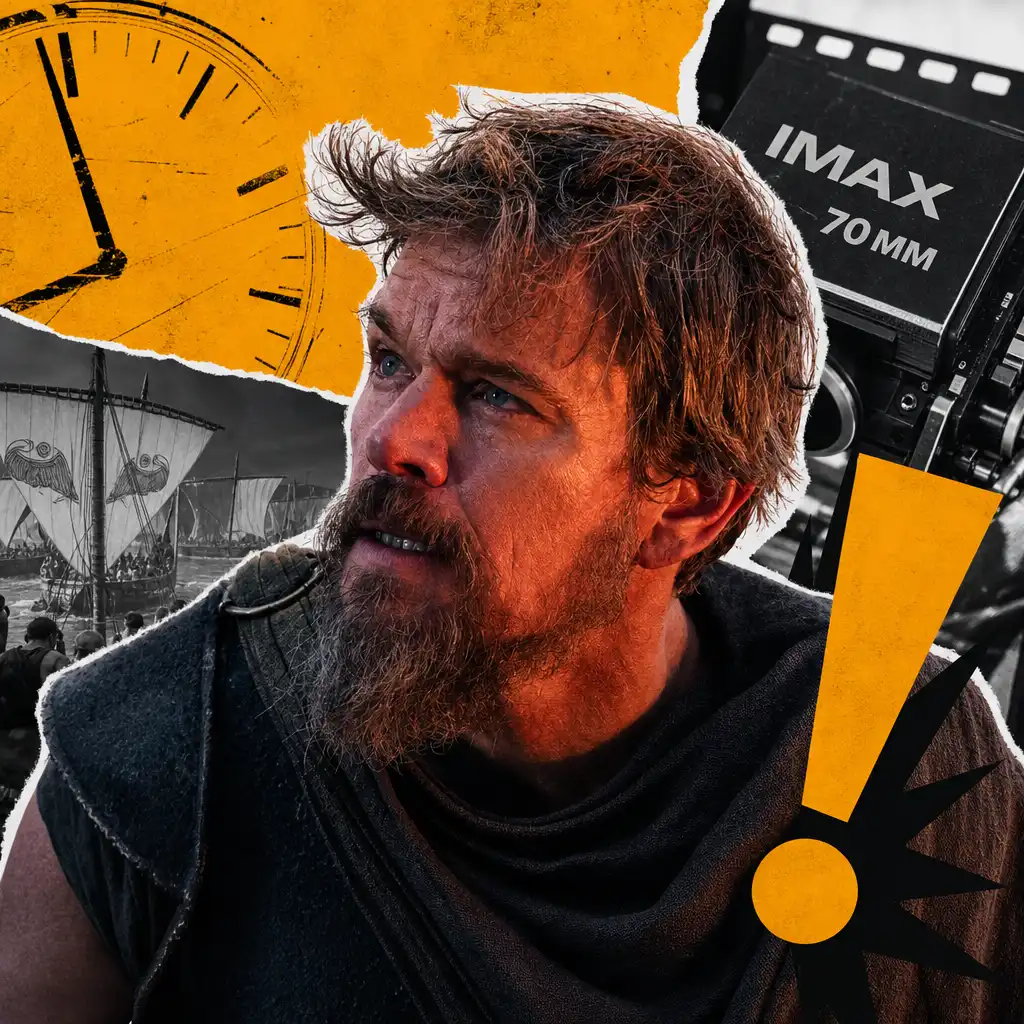
IMAX says it is the first theatrical feature filmed entirely with IMAX 70mm cameras. Axios reported that only 25 theaters in the United States can project the complete format, prompting some viewers to travel to compatible venues. IMAX chief Rich Gelfond called the turnout evidence of the “excitement and enthusiasm” surrounding Nolan's epic.
Universal Pictures also said the movie achieved the best second-weekend hold for any film that opened above $100 million. Those numbers suggest audiences are responding not only to the source material but to the promise of a large-scale theatrical event.
The adaptation has attracted a separate casting dispute, with conservative critics objecting to Elliot Page's involvement. Whoopi Goldberg answered that criticism directly: “Then don't go see it. Why do you care who's cast in it?”
Nolan's film can be both an emotional blockbuster and a fundamental revision of Homer. Its success does not settle the scholarly objections, and those objections do not cancel the craft or audience response. They clarify what is at stake whenever an ancient story is reshaped for a new crowd: not whether it changes, but what the changes ask viewers to value.