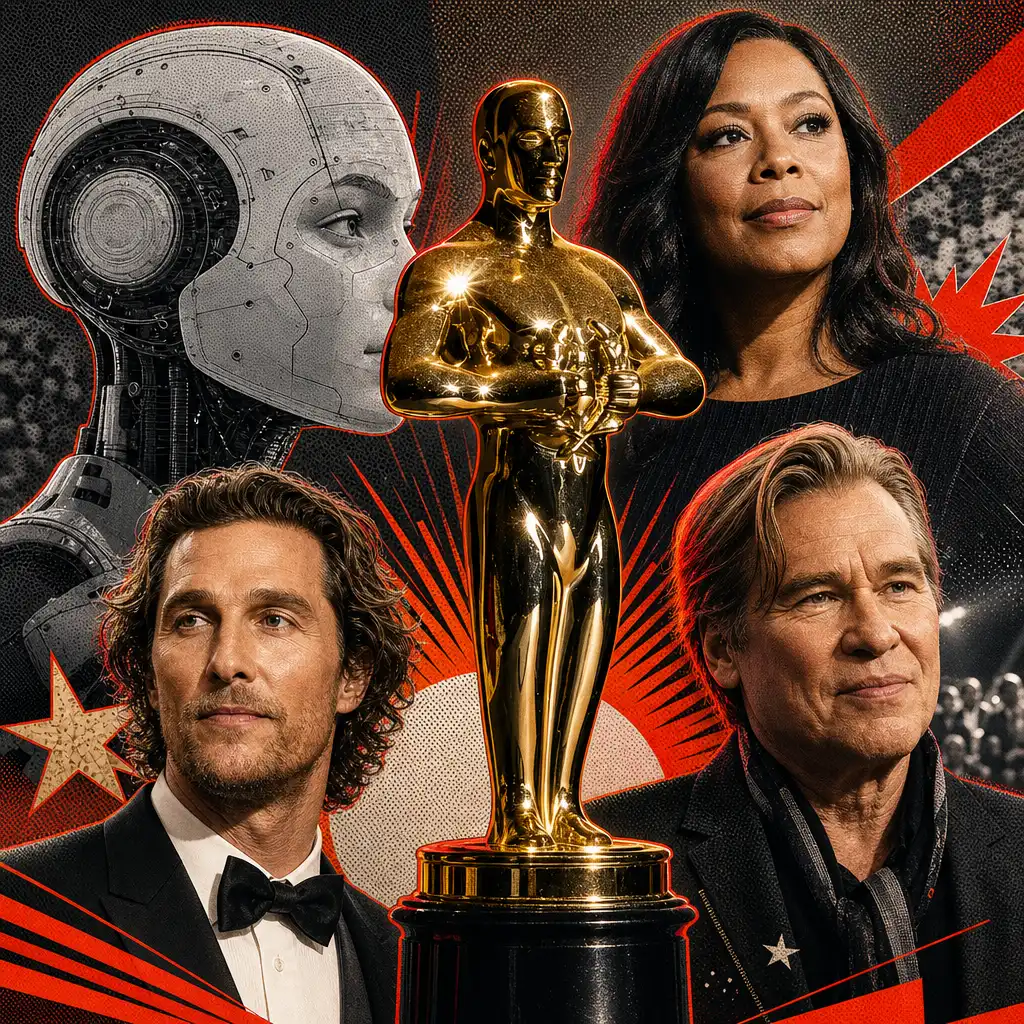
The Academy of Motion Picture Arts and Sciences has made its latest rules update, and the message is not subtle: awards are for people. That may once have settled the matter of Rin Tin Tin. In 2026, it is very clearly about AI.
According to The Hollywood Reporter, the Academy’s newly announced regulations tighten the connection between eligibility, legal credits, and human authorship across the filmmaking process. The rules do not pretend AI is going away. They do, however, make clear that Oscar recognition is meant to attach to credited human work, not a generated substitute wearing the shape of cinema.
That matters beyond Hollywood. Gaming awards, which have often been less consistent about putting actual creators in the spotlight, are approaching the same problem with far less clarity.
What the Oscars changed
On Friday, the Academy released new rules covering Oscar eligibility and the nomination process. Some of the changes are procedural, but still significant.
Performers can now receive multiple nominations in the same category, a possibility that has long existed for writers, directors, and other disciplines. The Academy also revised rules around international films, moving away from the old one-film-per-country structure and reducing the role of each film’s national governing body. That shift matters for politically sensitive work, where official selection bodies can create obvious conflicts.
The AI rules are the part drawing the loudest industry interest. The Academy is now emphasizing that nominations must line up with legal credits and consented human performances. That takes aim at two current anxieties at once: generated “actors” and digital recreations of performers who did not, or could not, meaningfully consent.
The Academy also reserves the right to examine how much AI was used in the making of a film. That is not a magic shield against every synthetic shortcut in production, but it is a meaningful standard from the institution that still defines mainstream awards legitimacy.
Hollywood’s AI flirtation is no longer theoretical
The timing is not accidental. Major studios and tech companies are making their AI ambitions harder to miss. Some filmmakers, including Darren Aronofsky and Steven Soderbergh, have spoken with interest about the technology. Others in the industry see it as a direct threat to jobs, authorship, and performance rights.
AI firms have also shown a particular fascination with Hollywood likenesses, including the use of star images in glossy, jittery action-style demonstrations. The Academy’s rules may not stop those experiments, but they do make one thing clearer: a generated personality such as Tilly Norwood is not being invited to rehearse an acceptance speech.
The Academy is also shutting the door on a more quietly uncomfortable possibility: posthumous CGI recreations of actors being treated as award-worthy performances in their own right. If a performance is going to be honored, the performer needs to be a consenting human being. Radical stuff, apparently.
The music industry has already wobbled
The Oscars are not the first major awards body to face this. The Grammys initially took a firmer stance against AI-created works in 2023, but the boundaries have appeared to soften since then.
That is the pattern many creators worry about: a hard public line at first, followed by exceptions, technicalities, and language broad enough to satisfy companies that want the benefits without the bad headlines.
Games are especially exposed to that drift.
Games awards have a creator problem already
AI had a comparatively quiet presence at the most recent Game Awards, but the ceremony’s older problem remained intact: human creators often get less room than the marketing calendar.
Only a limited number of winners are given time to speak. Even major award recipients can be hurried offstage. The show presents itself as gaming’s answer to the Oscars, but it is also widely understood as a showcase for trailers, mobile announcements, expansions, and corporate platform-building.
That does not make it meaningless. The Game Awards can move attention, sales, and prestige. But if the biggest night in games struggles to make room for the people who make games, it is not hard to see why AI rules could become an afterthought.
BAFTA’s AI panel sparked a consent issue of its own
The BAFTAs occupy a different space. They do not have the same mass-market profile as Geoff Keighley’s production, but they carry institutional weight, particularly because the games awards sit alongside the British Academy’s film and television honors.
On Friday, Sorry We’re Closed co-creator C.Bedford said a photo of them had been used to promote a BAFTA event about generative AI in games, despite their lack of involvement.
Bedford wrote: “I have no association with it what so ever and want to make it clear that I am NOT participating in this event nor will be attending it.”
They added that the event they had actually attended in 2024 was titled “Masterclass: Social Mobility and the Games Industry.” Bedford continued: “I was unaware that my photo would be used in this way. I have no interested in the use of generative AI, or AI content. It’s frustrating to have this association created without my knowledge or consent.”
It was a sharp illustration of the very issue sitting underneath the AI debate: consent is not a decorative extra.
BAFTA asks about AI. The Indie Game Awards went further
BAFTA’s submission rules mention AI in certain categories, requiring entrants to declare its use. Disclosure is useful, but it is not the same as a ban. A game can declare AI use without necessarily being ruled out.
The Indie Game Awards have taken a much harder position. Last year, the IGAs retracted nominations for Clair Obscur: Expedition 33 over AI usage, shortly after the game swept the non-indie Game Awards.
“The Indie Game Awards have a hard stance on the use of gen AI throughout the nomination process and during the ceremony itself,” the group said in a statement.
That is the kind of clarity game awards bodies will increasingly be pressed to provide, especially as AI-generated assets become more common in production pipelines. Sometimes they appear proudly. Other times, they seem to arrive by accident and are only noticed once players start comparing textures, icons, or background art.
AI assets appearing in Crimson Desert, for instance, are unlikely to seriously damage its awards-season chances under the current landscape. That is the point. Without clear rules, the consequences are mostly vibes.
The real fight is about what awards are for
The industry incentives are obvious. Game companies have spent years cutting staff, sometimes by the hundreds, while also searching for tools that promise faster production and lower labor costs. AI is attractive to executives for exactly the reasons many developers distrust it.
Awards shows are where the industry tells the public what it values. If those shows honor work built on undisclosed generative systems, or treat AI usage as a minor footnote, they help normalize it. If they demand disclosure, consent, and human credit, they create pressure in the other direction.
The public mood is not exactly warm toward paying for AI-created work, even among people who use the tools themselves. Audiences understand the difference between technology assisting artists and technology replacing them. Awards bodies should be able to manage that distinction too.
The Oscars have not solved AI in entertainment. No awards rulebook can do that. But the Academy has at least acknowledged that authorship, consent, and human craft are central to what it exists to celebrate.
Gaming awards should make the same decision before the stage lights are already on.