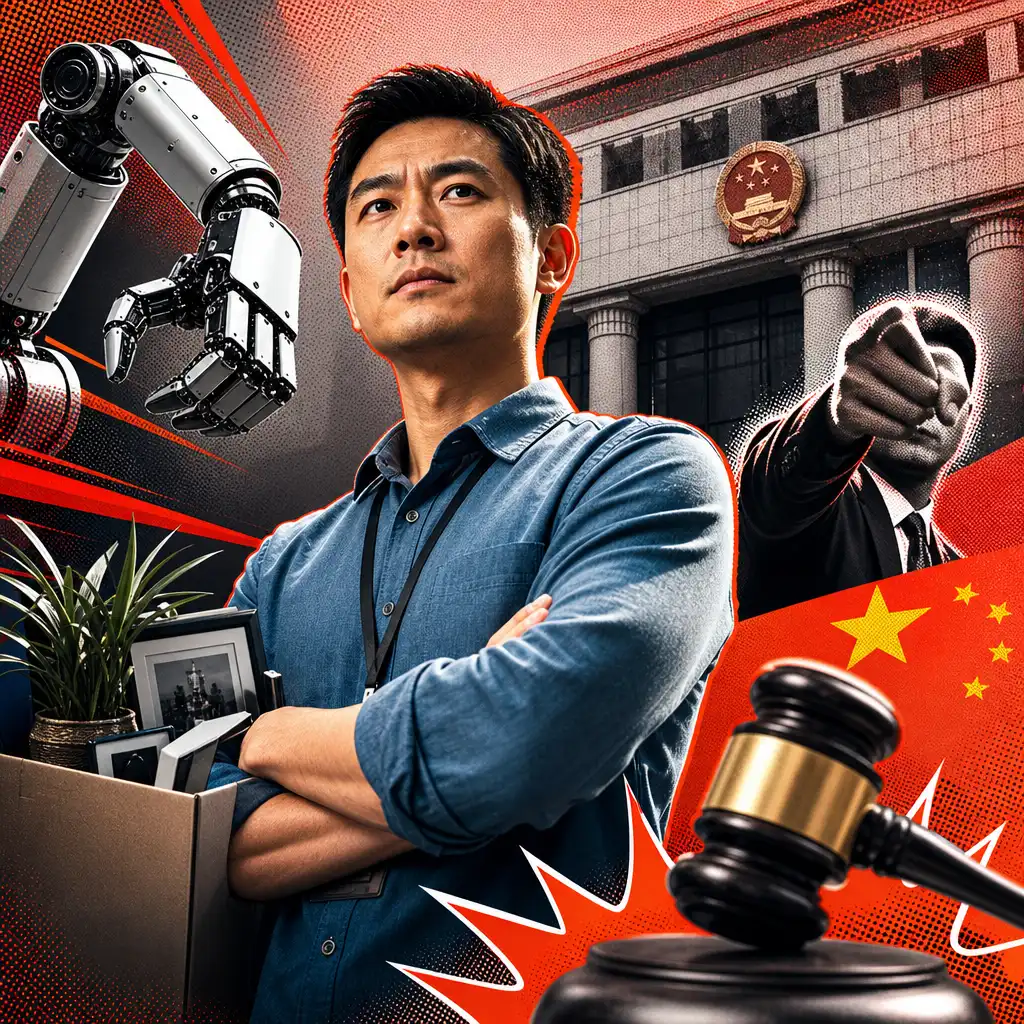
A court in China has drawn a firm line around one of the biggest workplace questions of the AI era: adopting automation is not, by itself, a legal excuse to fire someone.
The Hangzhou Intermediate People’s Court upheld earlier rulings that a tech company unlawfully dismissed a worker after trying to replace his job with an AI large language model, according to China.org. The case matters because it turns a broad anxiety about AI and jobs into something much more concrete: a contract, a salary, a rejected demotion, and a court saying no.
What happened to the worker
The employee, identified as Zhou, joined the company in November 2022 as a quality assurance supervisor. He earned 25,000 yuan a month, around $3,660 USD.
His job involved reviewing AI-generated outputs and filtering sensitive or illegal content. In other words, he was doing the kind of human oversight many companies still claim is essential when deploying AI systems.
The company later offered Zhou a lower-level position with a 40% salary cut. He refused. The firm then terminated his contract, citing reduced staffing needs and the effect of AI on his role.
Zhou challenged the dismissal through arbitration, which ruled in his favor and found the firing unlawful. The company appealed, but both lower courts and the Hangzhou Intermediate People’s Court rejected its case.
The court rejected the AI argument
The court found that replacing a worker with AI did not qualify as a “major change in objective circumstances” under China’s Labor Contract Law.
“The termination grounds cited by the company did not fall under negative circumstances such as business downsizing or operational difficulties, nor did they meet the legal condition that made it ‘impossible to continue the employment contract,’” the court stated.
Judges also said the alternative role offered to Zhou was unreasonable because of the significant salary reduction. A job offer is not much of a safety net if it arrives with a 40% pay cut attached.
The company’s AI adoption was described as a “voluntary move to stay competitive.” Because of that, the court found the company had effectively shifted the risks of technological change onto its employee, making the dismissal unlawful.
Why the ruling matters
Legal experts said the decision reinforces that employers cannot use AI adoption as a shortcut for terminating contracts. They added that “companies should not use AI adoption as a pretext for layoffs or as a means to sidestep their obligations” to social responsibilities.
The case was published alongside other labor examples ahead of International Workers’ Day, at a time when China is facing growing scrutiny over how AI tools are reshaping employment.
The ruling does not stop companies from adopting AI. It does, however, signal that if a business chooses automation to stay competitive, it may still have to honor existing labor protections. That distinction is likely to become more important as more employers test how far AI can go inside the workplace.