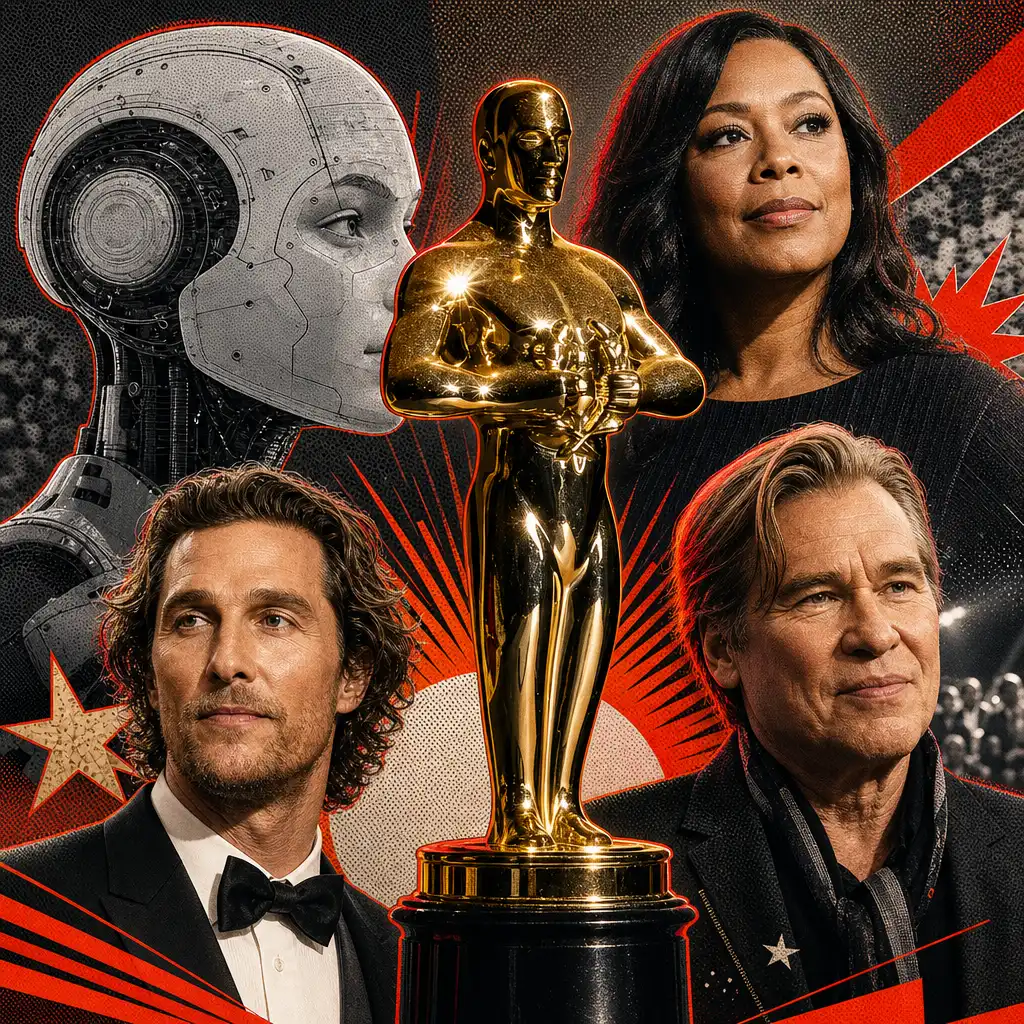
The Oscars are drawing a line around artificial intelligence, but not banning it outright. In new eligibility rules approved on May 1, 2026, the Academy of Motion Picture Arts and Sciences made clear that films using generative AI or other digital tools can still compete, while stressing that awards recognition will continue to prioritize human creative work.
The update is part of the Academy’s eligibility review for the 2027 Oscars, the process that determines which films and performances can be submitted, nominated, and ultimately awarded.
What the new rule says
In guidance posted through the Academy’s official press materials, the organization said AI use will not automatically count for or against a film.
“With regard to Generative Artificial Intelligence and other digital tools used in the making of the film, the tools neither help nor harm the chances of achieving a nomination. The Academy and each branch will judge the achievement, taking into account the degree to which a human was at the heart of the creative authorship when choosing which movie to award.”
That wording matters. The Academy is not treating AI as a disqualifier, but it is telling studios, filmmakers, and awards strategists that the human contribution will be central when voters assess achievement.
Human authorship is the priority
Academy president Lynette Howell Taylor told the Associated Press that the organization’s position is built around one principle: people must remain the core creative force.
“Humans have to be at the center of the creative process,” Taylor said.
“As AI continues to evolve, our conversations around AI will do so along with that. But for the academy, we are always going to put human authorship at the center of our awards eligibility process,” she added.
Taylor also said acting eligibility will be limited to roles “demonstrably performed by humans with their consent.” The Academy will assess AI-related questions in films on a “case-by-case basis,” rather than setting one blanket rule for every possible use.
“We, like everybody in our industry and world, will be assessing this every year,” she said.
In other words, the Oscars are preparing for AI to become a recurring eligibility issue, not a one-season headache.
The Val Kilmer question remains unanswered
The Associated Press also asked about the current discussion around Val Kilmer’s posthumous AI double in the 2026 film As Deep as the Grave. The Academy did not comment on that specific case, and it remains unclear whether the film will be considered by the organization.
That silence is notable because it points to the difficult territory ahead: posthumous performances, consent, digital doubles, and the boundary between technical recreation and human performance. Hollywood loves a grey area almost as much as it loves a campaign lunch.
Screenplays face a clearer standard
The Academy’s stance on writing is more direct. Screenplays “must be human-authored” to be eligible for Oscar consideration.
That leaves less room for interpretation than the broader rule covering visual effects, editing, performances, and other digital tools. AI may assist in parts of production, but when it comes to the credited creative authorship of a screenplay, the Academy is requiring a human writer at the center.
Why this matters
The new rules arrive as the film industry continues to wrestle with how generative AI should be used, credited, and regulated. The Academy’s position does not shut the door on AI in filmmaking. Instead, it says AI cannot be treated as a shortcut to awards prestige, and it cannot replace the human labor the Oscars are designed to recognize.
That puts the Academy at a different point on the spectrum from pro-AI Hollywood figures such as Matthew McConaughey, who has predicted that AI will “infiltrate” the Oscars in the near future.
For now, the message from the Academy is measured but firm: digital tools may be part of the process, but the award still belongs to human creators.