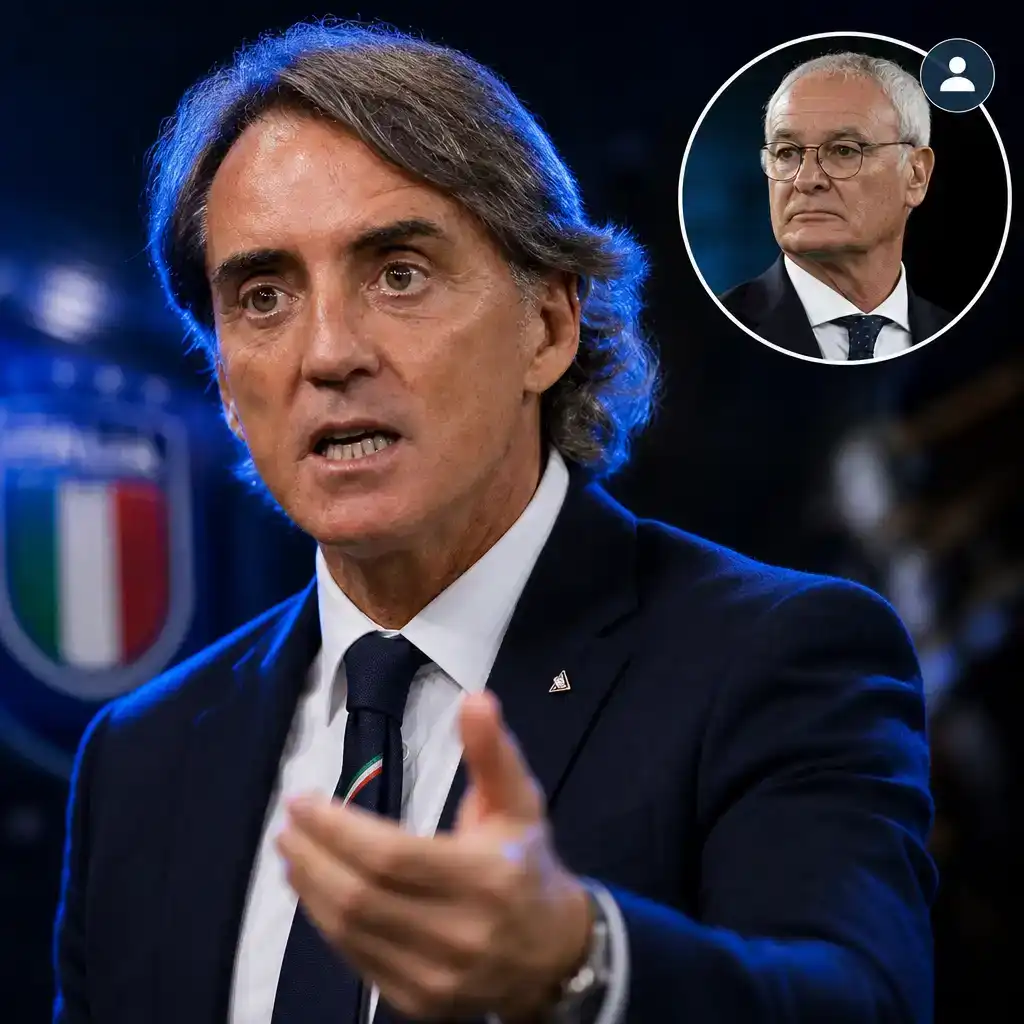
Roberto Mancini will return as Italy coach for a second spell, with the Italian Football Federation turning to its former European Championship winner after another failed World Cup campaign and a disorderly search for Gennaro Gattuso’s replacement.
ANSA confirmed the appointment after earlier reports cited a source close to the process. FIGC president Giovanni Malagò told the federation’s Federal Council, simply: “Mancini is the coach.”
Mancini, 61, will be presented alongside Claudio Ranieri on July 29. Ranieri has been appointed technical director, replacing Paolo Maldini, whose brief and turbulent federation tenure lasted just 16 days.
The appointments settle the immediate vacancies. They do not erase the questions raised by a recruitment process that included two reported refusals, a blocked candidacy and the rapid resignations of two senior officials.
Why did Italy bring Mancini back?
Mancini’s record provides the obvious answer. He coached Italy from 2018 to 2023, overseeing 58 matches and guiding the national side to the Euro 2020 title, played in 2021 because of the pandemic.
He also presided over Italy’s failure to qualify for the 2022 World Cup, however, before leaving abruptly in 2023 and taking charge of Saudi Arabia. His most recent position, with Qatar’s Al-Sadd, ended in June 2026, according to Football Italia.
Malagò said Mancini had apologised for the way he left the Italy job three years earlier. The federation president described that apology as a prerequisite for any return, making the appointment a rehabilitation as much as a reunion.
“Time was running out,” Malagò said, calling Mancini “the right person.”
That urgency followed Italy’s third consecutive failure to reach the World Cup. The four-time champions have not appeared at the tournament since 2014, a record that turns every coaching appointment into a national audit of what has gone wrong.
How did Italy miss another World Cup?
Gattuso left in April after Italy were eliminated by Bosnia and Herzegovina. The match finished 1-1 before Bosnia won the penalty shootout 4-1.
Italy’s task became more difficult when Alessandro Bastoni was sent off before halftime. Pio Esposito and Bryan Cristante later missed their penalties in the shootout.
After the defeat, Gattuso told Rai: “I apologise, but it’s unjust.” His departure opened another coaching search while extending a sequence of qualifying failures that now covers three tournament cycles.
Italy’s recent eliminations were:
- Defeat by Sweden in the playoffs for the 2018 World Cup
- Defeat by North Macedonia in the playoffs for the 2022 tournament
- Defeat by Bosnia and Herzegovina on penalties in the latest qualifying campaign
Mancini therefore returns with a mixed international record. He delivered Italy’s first European title since 1968 but could not take the team to Qatar in 2022. The federation is now asking him to repair a problem he previously helped solve at continental level, but not in World Cup qualifying.
What happened to the other candidates?
The search moved through several prominent names before returning to Mancini.
Former Manchester City manager Pep Guardiola was the FIGC’s first choice but declined the position. El País reported that Carlo Ancelotti, now coaching Brazil, also rejected an approach.
Andrea Pirlo then became Maldini’s preferred candidate. That appointment did not proceed because of Pirlo’s relationship with Russian betting company Fonbet.
Malagò offered a narrower account than reports suggesting Pirlo was legally blocked from taking the job. He said Pirlo could have ended the contract but that the appointment no longer appeared appropriate. Malagò accepted responsibility for stopping it and denied that the decision reflected a dispute with Maldini or adviser Leonardo.
Pirlo said attempts to assign political meaning to his commercial relationship attributed views to him that he had never expressed. European Parliament vice-president Pina Picierno had argued that Italian football required an “ethical and managerial revolution” and that selecting Pirlo would point in the opposite direction.
The distinction matters. Pirlo was not declared legally ineligible. His candidacy became politically and institutionally unacceptable to federation leadership, which is a different mechanism with the same practical result.
Why did Maldini and Leonardo resign?
Paolo Maldini and Leonardo resigned on Monday, only 16 days after joining the FIGC. Their departure exposed the limits of the federation’s new power-sharing arrangement almost immediately.
Maldini had been appointed technical director and was expected to influence the coaching decision. When his preferred candidate was overruled, both he and Leonardo stepped down. Malagò denied a personal conflict, but the process still demonstrated that final authority remained with the federation president and council.
Earlier reporting had identified Giorgio Chiellini as a leading possibility to replace Maldini. The job instead went to Ranieri, giving the former Leicester City, Roma and Chelsea manager an oversight role above the returning national coach.
That structure may be designed to provide institutional stability after several weeks of uncertainty. It also means Mancini’s second tenure will begin under different supervision from his first.
The July 29 presentation should provide more detail on how responsibilities will be divided between Mancini, Ranieri and Malagò. For now, the enforceable outcome is clear: Mancini has the coaching job, Ranieri has the technical brief, and the officials originally hired to guide the appointment have gone.