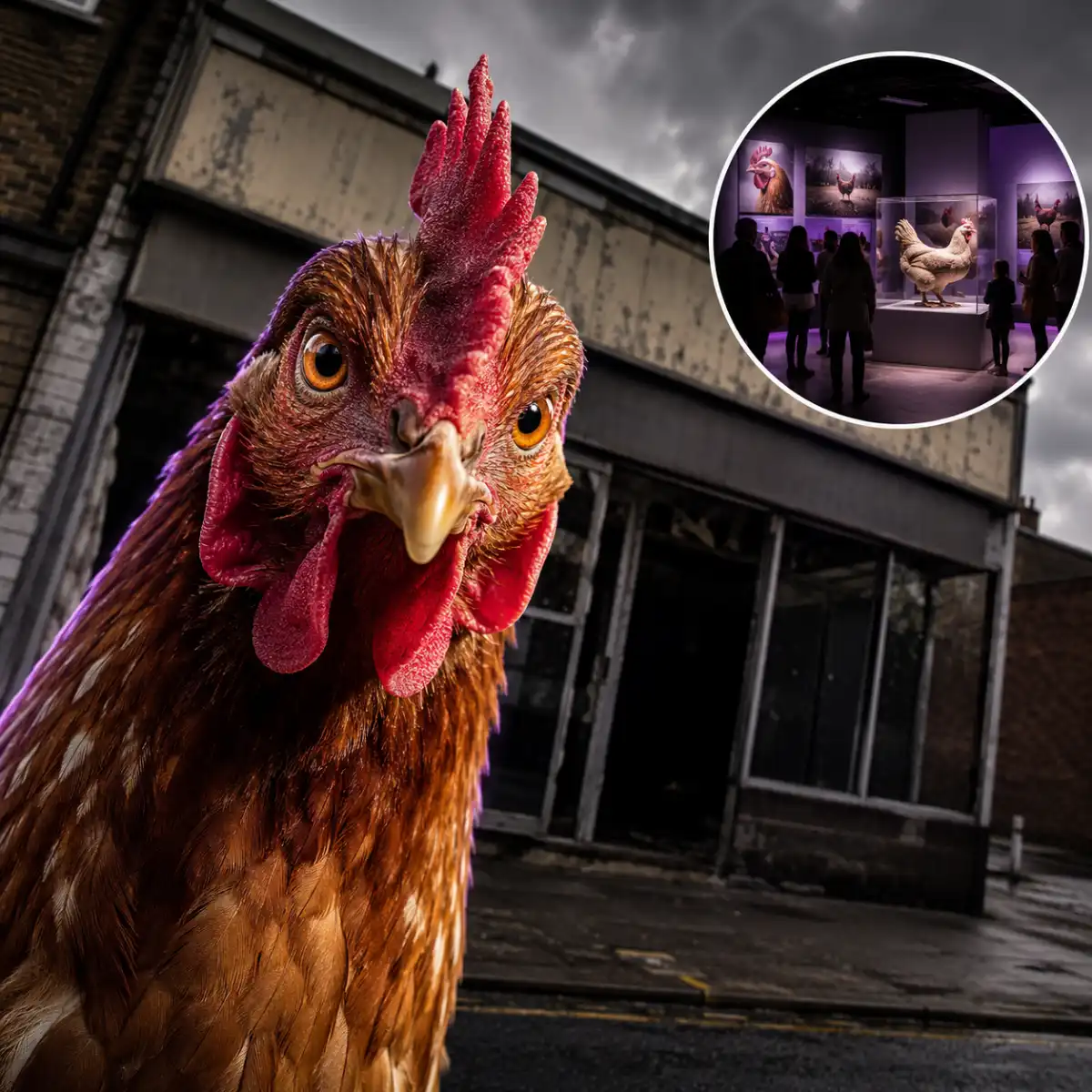
PETA’s proposed Chicken Empathy Museum has an appropriately pointed setting: a vacant former KFC in Fleetwood, Lancashire. The animal rights group wants to replace fried chicken meals with exhibits about the intelligence and emotional lives of chickens, plus vegan food and some considerably less comfortable reminders of industrial slaughter.
For Fleetwood, though, the proposal is also about an empty high-street building in a town with an unusually high shop-vacancy rate. That gives the idea a practical question beyond its headline value: could an intentionally provocative museum bring visitors to Lord Street?
At present, nobody can answer that. As of July 30, 2026, PETA had not publicly identified the current owner, secured the property or submitted planning documents.
What would the Fleetwood museum contain?
PETA approached Landwood Property Auctions to ask whether the former restaurant could be lent or donated for educational use. The group said displays would explore chickens’ cognition, social relationships and emotional complexity.
The proposed attraction would include:
- Educational material about chicken behavior and intelligence
- PETA’s chicken mascot
- Slaughterhouse equipment, including kill cones and shackles
- A café or food service offering vegan dishes
Scientific reviews have found that chickens demonstrate social learning, distinct personalities, sophisticated cognition and complex emotional responses. That broadly supports the educational basis of PETA’s proposal, even if the presentation is designed to make a former fast-food restaurant do some very visible moral accounting.
“PETA would be delighted to help transform a place once linked to suffering into one that inspires compassion,” PETA Vice President of Vegan Projects Dawn Carr said.
“What better use for a former fried-chicken restaurant than a place dedicated to understanding and respecting the birds who have long paid the ultimate price for fast food?”
Why has the plan stalled?
The immediate problem is ownership. Landwood Property Auctions said it sold the building in summer 2025 and is no longer involved. It directed PETA to HM Land Registry to locate the current owner.
The former restaurant occupies about 2,126 square feet across two connected retail units. It previously accommodated as many as 62 diners but has reportedly remained empty for some time.
No outlet had reported by July 30 that PETA had reached the owner or received permission to use the site. There was also no evidence of a lease, purchase agreement or formal planning application. KFC had not commented on the proposal, according to reporting carried by the Daily Star.
In other words, the museum currently consists of a public pitch, a suggested address and a menu that does not yet need printing.
Local councillor Mary Belshaw nevertheless welcomed the possibility. She described it as “a novel idea” and said she would prefer “a chicken empathy museum” to another large vacant property on Fleetwood’s high street.
“Who knows? It could become a huge attraction for the town,” she said.
Could an unusual museum help Fleetwood’s high street?
Belshaw’s response reflects a wider local concern. Wyre Council recorded 39 empty ground-floor units out of 251 in Fleetwood in July 2025, producing a vacancy rate of 15.54 percent. The average across the council’s four town centres was 10.16 percent.
Council monitoring documents continued to identify vacancies on Lord Street in June 2026. Against that backdrop, an attraction capable of generating national attention may appeal even to residents who are not persuaded by PETA’s vegan campaigning.
Whether it could produce steady visitor numbers is another matter. The concept is unusually specific, and its graphic exhibits may limit its appeal to families or casual shoppers. But niche museums can still give people a reason to visit a town centre, particularly when the alternative is a shuttered restaurant contributing no activity at all.
The scale of Britain’s poultry industry also gives the proposed displays a substantial subject. The Department for Environment, Food and Rural Affairs reported 2 million tonnes of home-fed poultry meat in 2025. That included a record 1.9 million tonnes of table chicken, while domestic production met 80 percent of UK demand.
PETA’s argument is that those large figures can obscure the individual animals involved. The museum would try to reverse that perspective, using one former chicken restaurant as a setting for the case.
Is this a museum project or a publicity campaign?
Fleetwood is not the only place where PETA has proposed such an attraction. On July 13, the organization made a parallel offer involving Colonel Harland Sanders’ original headquarters and the Claudia Sanders Dinner House in Shelbyville, Kentucky.
That proposal was also described as the “world’s first” Chicken Empathy Museum and included slaughter equipment, memorabilia and a vegan café. PETA founder Ingrid Newkirk said the attraction would ask visitors to recognize the “thinking, feeling individuals” behind chicken products.
The competing claims underline how preliminary both projects remain. PETA has used similar property proposals before, including pitches involving a Louisiana processing plant in 2009 and a Tyson facility in Kansas in 2024. No evidence was found that either became an operating museum.
That history suggests the Fleetwood plan may function partly as a campaign in itself. By proposing an animal-rights exhibit inside a former KFC, PETA gains attention for its message whether or not the doors ever reopen.
The organization regularly uses entertainment and gaming brands in the same way. It has asked Nintendo to remove Cow’s nose ring from Mario Kart World, promoted a vegan guide for Palworld, pushed for its chicken mascot to join Super Smash Bros. and urged Sean Evans to replace the chicken wings on Hot Ones with vegan alternatives.
For now, the Fleetwood proposal remains an idea rather than an attraction. Its next step is less theatrical but essential: finding the person who actually owns the building.