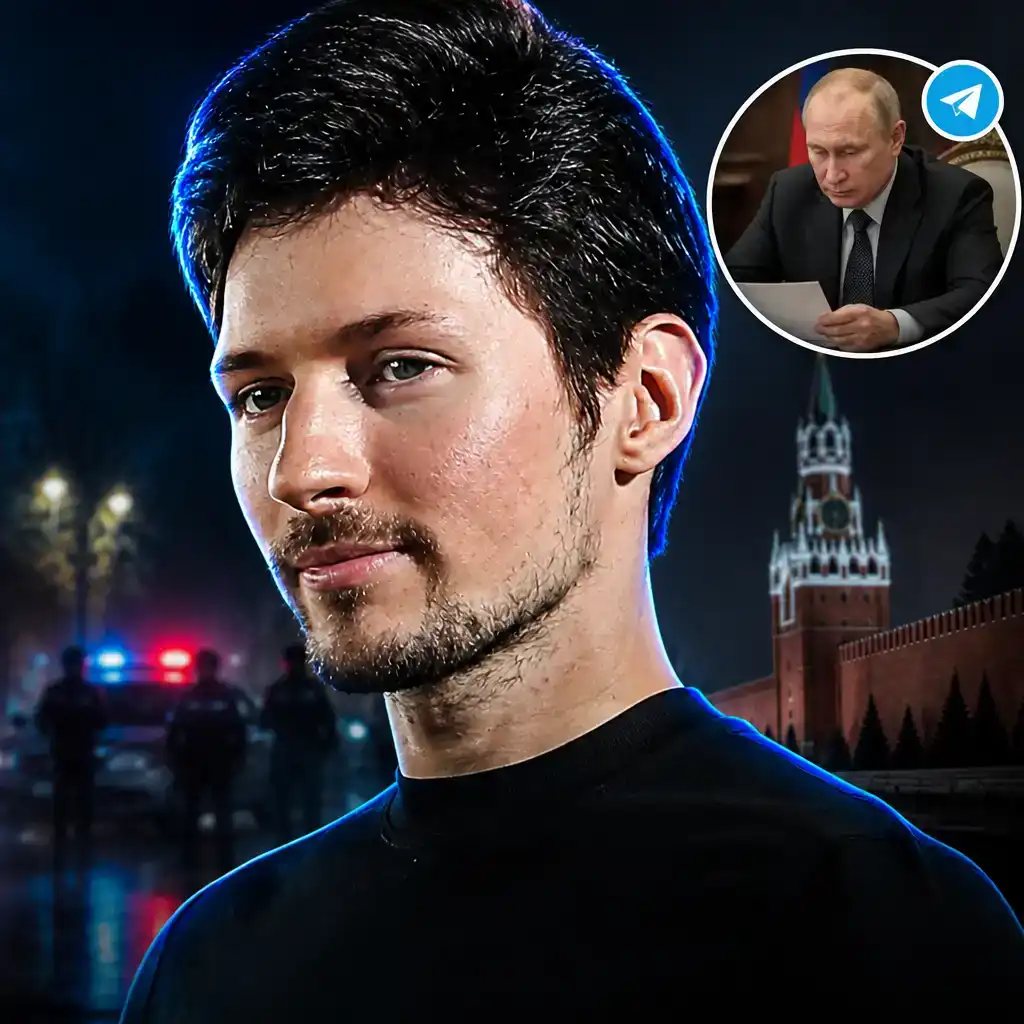
The Pavel Durov terrorism charge marks a significant escalation in Russia’s campaign against Telegram, but the immediate legal effect is less dramatic than some headlines suggest. The Federal Security Service, known as the FSB, says Durov has been placed in international search proceedings after allegedly refusing to remove tools used to organize attacks inside Russia.
The FSB announced the charge on Wednesday, accusing Telegram of leaving up “channels, chats and bots” allegedly used by Ukrainian intelligence services and organizations Russia classifies as terrorist or extremist. Authorities say those services supported sabotage, mass killings, terrorism and cyber fraud.
Pavel Durov has not personally responded. Telegram’s official account on X instead posted a longstanding photograph of its cofounder raising his middle finger. It was concise, although not especially useful as legal analysis.
What has Russia actually issued against Durov?
Russian officials described Durov as being placed on an international wanted list. Some reports characterized the measure as an international arrest warrant, but those terms are not interchangeable.
As of July 29, 2026, no public Interpol Red Notice for Durov had been located. Interpol also makes clear that its notices are requests for cooperation between police forces, not international arrest warrants in their own right.
That distinction matters because Russia cannot simply make a domestic charge automatically enforceable worldwide. Any attempt to detain or extradite Durov would depend on further legal action, the country where he was located and whether that jurisdiction accepted Russia’s case.
Durov was born in Russia and now holds French and Emirati citizenship. His international travel could become more complicated if Russia secures cooperation from Interpol or individual governments, but the FSB’s announcement alone does not establish that such cooperation has been granted.
What does the FSB claim Telegram enabled?
The FSB says Ukrainian operatives used Telegram services to recruit and direct people inside Russia. One specific allegation concerns “Da Vinchik,” a dating bot that authorities claim was used to approach young Russians.
According to the FSB, 46 Telegram users aged between 12 and 22 have been detained since July 2025 over alleged assaults, arson and related activity. The Associated Press reported the claims but said it could not independently verify them.
Russian authorities have also attached much larger figures to their case against the platform. RIA Novosti reported that officials linked more than 153,000 crimes since 2022 to Telegram use, including 33,000 categorized as extremist, terrorist or sabotage-related. Those figures reflect the Russian government’s classifications and allegations, rather than independently established findings.
The criminal case reportedly began in February 2026 under Article 205.1 of Russia’s Criminal Code, which covers assistance to terrorist activity. Durov said at the time: “Every day authorities invent new pretexts to restrict Russians’ access to Telegram,” accusing the government of trying to suppress privacy and free speech.
After receiving a summons in April, he joked that he was suspected of defending constitutional protections for speech and private correspondence.
Why Russia has not simply blocked Telegram
Moscow has steadily tightened control over major communications services, blocking platforms including Twitter, Facebook and Instagram while restricting access to YouTube, WhatsApp and Telegram. At the same time, it has promoted MAX, a state-backed messaging service that says it will provide user data to authorities when requested.
Human Rights Watch reported that Telegram had 95.7 million monthly users in Russia in February 2026. MAX had 77.5 million. Roskomnadzor began restricting Telegram that month, but Durov later claimed that 65 million Russians were still reaching the service daily through virtual private networks, or VPNs.
Telegram is difficult for the Kremlin to remove cleanly because it serves several competing functions. Russian troops use it, state and pro-government channels distribute propaganda through it, and critics of the Kremlin rely on it for information and organization. A full ban would therefore disrupt systems the Russian state and military also use.
That leaves Moscow pursuing a more selective strategy: slow access, promote a domestic replacement and increase legal pressure on the company’s leadership. It is less tidy than an outright ban, but considerably more practical.
How private is Telegram in practice?
Telegram is routinely described as an encrypted messaging platform, but that label needs qualification. According to the company, only Secret Chats use end-to-end encryption, meaning the message can be read only on the participating devices.
Ordinary Cloud Chats use client-server encryption. Telegram stores those conversations in its cloud infrastructure so users can access them from multiple devices. That design makes the service convenient, but it is not the same privacy model used by applications where end-to-end encryption is enabled by default.
Durov has long promoted Telegram as resistant to censorship and has generally favored limited moderation. Supporters view that approach as protection against state surveillance. Critics argue that it has also allowed criminal networks and extremist groups to use the platform with fewer obstacles.
The current Russian case turns that moderation dispute into a criminal allegation. The FSB’s position is that Telegram knew about specific infrastructure used to coordinate attacks and failed to remove it. Durov’s broader argument is that demands framed as public safety measures are being used to weaken privacy and political speech.
Durov’s conflict with Moscow goes back years
Durov cofounded Telegram in 2013. Before that, he created VKontakte, Russia’s largest domestic social network and its closest equivalent to Facebook.
He sold his remaining VKontakte stake in 2014 after pressure from Russian authorities. Durov said officials had demanded access to information belonging to Ukrainian pro-democracy activists and that he refused to provide it.
The latest confrontation therefore follows an established pattern rather than beginning a new one. Russian authorities want greater control over communications infrastructure used inside the country. Durov has built his public identity around resisting those demands, although Telegram’s actual privacy architecture is more complicated than its reputation sometimes implies.
He is also under investigation in France over allegations that Telegram did not do enough to prevent criminal activity and failed to cooperate sufficiently with law enforcement requests. Durov denies wrongdoing in that case.
For now, the Russian charge raises political and travel risks without producing a publicly confirmed Interpol notice. The more important operational question is whether Moscow can pressure Telegram without cutting off a communications network that its own institutions, soldiers and supporters continue to depend on.