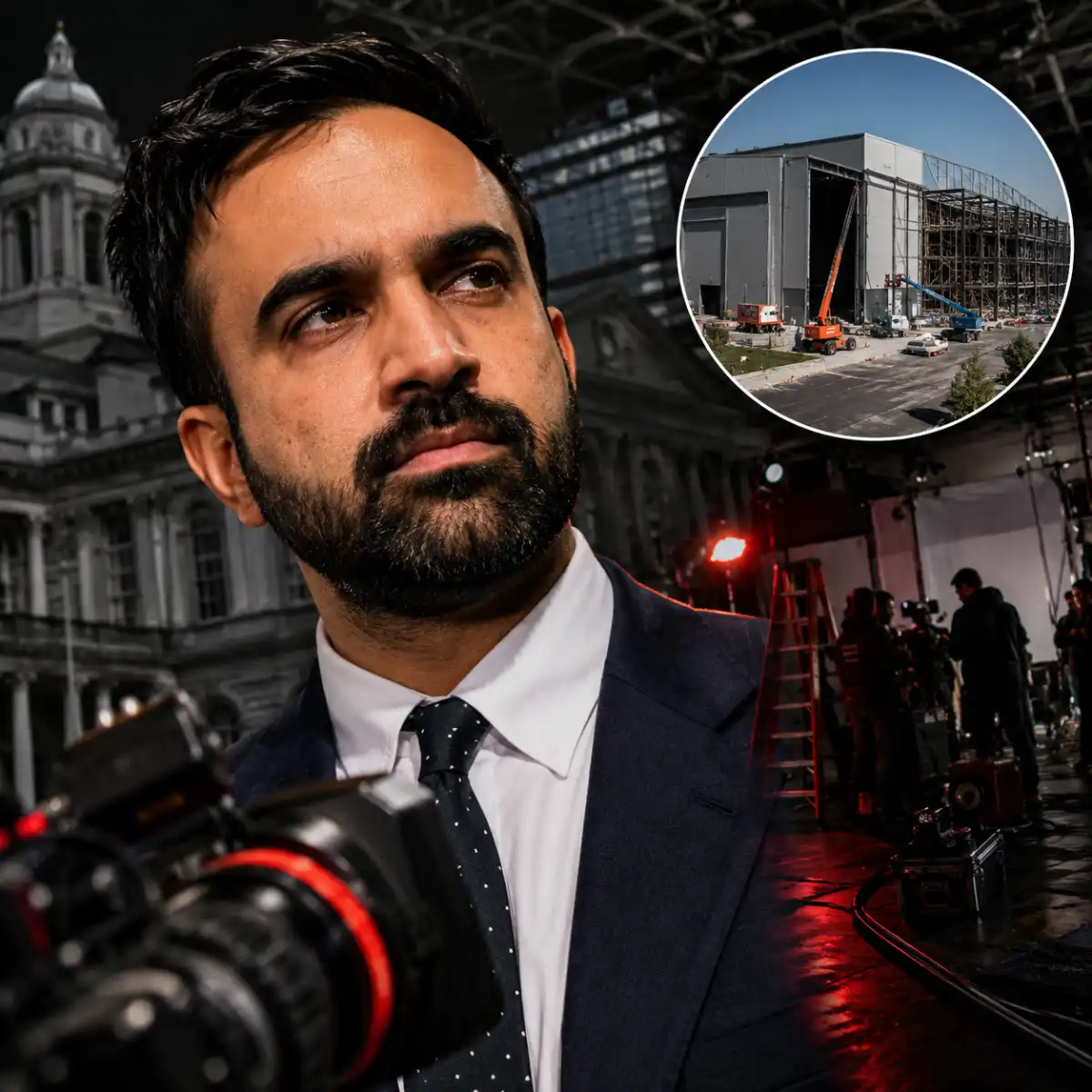
For New York film and TV production, Zohran Mamdani’s cultural fluency was always the easy part. The harder question is whether the mayor can turn that familiarity into steady work for the crews, drivers, caterers and craftspeople who cannot pay rent with a promotional campaign.
Seven months after taking office on January 1, 2026, Mamdani has given the industry more attention inside City Hall, installed new leadership, streamlined permit applications and publicly courted productions. New York is also showing signs of a post-strike recovery. But employment remains below pre-pandemic levels, major films are still difficult to secure, and nearby New Jersey is competing with expanded studios and generous incentives.
The stakes extend well beyond actors and directors. City figures from 2019 credited film and television with about 185,000 jobs, $18.1 billion in wages and $81.6 billion in economic output. City Council Speaker Julie Menin has since described the broader media and entertainment sector as a $104 billion industry supporting more than 305,000 jobs, more than finance, she noted.
Why Mamdani looked like a natural industry ally
Mamdani arrived at City Hall with unusually direct ties to the creative world. His mother, filmmaker Mira Nair, won the Caméra d’Or at Cannes for Salaam Bombay! and went on to direct Monsoon Wedding, Mississippi Masala and The Namesake. His father, Mahmood Mamdani, is a scholar at Columbia University.
Before entering politics, Mamdani performed as a rapper under the names Young Cardamom and Mr. Cardamom. He also worked in connection with Nair’s 2016 Disney film Queen of Katwe, helping coordinate a soundtrack that included music from his Young Cardamom period.
His 2025 mayoral campaign brought that background into politics. Its short-form videos showed a confident grasp of TikTok pacing and visual storytelling, helping Mamdani communicate policy to younger voters without making every clip look as if it had been approved by 14 committees.
That biography made him an appealing figure to artists and freelancers struggling with New York’s cost of living. Yet production companies make location decisions based on budgets, tax credits, stages, labor, parking, permits and schedules. Cultural credibility may open the conversation. It does not close the financing gap.
What City Hall has changed so far
On January 12, Mamdani appointed Rafael Espinal as commissioner of the Mayor’s Office of Media and Entertainment. Espinal is a former City Council member and former executive director of the Freelancers Union, giving him experience with both city government and the unstable working conditions common across creative fields.
The appointment placed affordability at the center of the administration’s entertainment policy. Mamdani said the office should receive greater priority within City Hall and promised “active and affirmative outreach” to companies considering New York shoots.
In May, the office introduced an updated E-Apply Film Permit System. The platform was designed to remove repeated steps, tailor questions to individual productions and improve technical reliability. Permit software is not glamorous, but neither is losing a shoot because several agencies cannot agree on where a truck may park.
The administration also promised broader coordination tools, including an interagency production playbook and a filming-location database. As of early August, City Hall had not announced that either project was complete. Producers still want predictable timelines, faster approvals and clearer communication among police, transportation officials and neighborhood representatives.
In July, the media office and the Department of Small Business Services also announced free creative-industry training. The first program was a music-production boot camp at Queensborough Community College, connecting the administration’s cultural strategy to workforce development rather than promotion alone.
Is New York production actually recovering?
The available evidence points to a comeback, though not a complete one. New York City processed nearly 5,500 production permits for 1,760 projects during most of 2025. The city’s “Made in NY” workforce pipeline graduated 380 participants that year.
In the third quarter of 2025, city permit volume was down 5 percent from the same period a year earlier, while the number of projects rose 13 percent. Across New York State, 52 film and television productions began principal photography during the quarter, a 73 percent annual increase and the strongest result since 2021.
CBRE’s June 2026 tri-state report found that production starts had returned to levels seen before the 2023 writers’ and actors’ strikes, a recovery it said other major American production markets had not matched. Even so, regional industry employment stood at only 86 percent of its pre-pandemic level. National consolidation and studio cost controls continued to limit overall production.
The city’s May listings included American Horror Story Season 13, Daredevil: Born Again Season 3, Dexter: Resurrection Season 2 and A Quiet Place: Part III. Activity was spread across all five boroughs, although the city warned productions to plan around security and permitting restrictions linked to the 2026 FIFA World Cup.
New York’s constant contradiction remains intact: productions want the city because so much happens here, then encounter logistical trouble because so much happens here.
Tax credits bring work and uncomfortable questions
The largest financial tools are controlled by New York State, not the mayor. The state film production tax credit offers eligible projects 30 percent of qualified costs and is funded at $700 million annually through 2036. The Production Plus program provides additional incentives to companies making multiple projects in the state.
A separate $100 million Independent Film Production Tax Credit opened for applications on July 13. Empire State Development says qualifying independent productions can receive 30 percent of eligible costs. Awards are available on a first-come, first-served basis, with the current application window running through November 12 while funding remains available.
That program may be especially important to independent filmmakers, who have less room than major studios to absorb New York’s high labor, property and logistical costs. It also fits Mamdani’s political emphasis on smaller employers and working artists.
Still, the value of production subsidies is disputed. A New York State-commissioned economic-impact study concluded that the main film credit was “at best” break-even and more likely represented a net cost to the state. That finding complicates the familiar argument that every public dollar automatically returns as jobs and local spending.
The policy test is therefore not simply whether tax credits attract projects. It is whether those projects create durable employment, support local businesses and justify the public expense. Espinal acknowledged that standard in July, saying production was “building momentum” but that success should be judged by whether workers actually feel the effect.
New Jersey is competing for the same crews
New York’s nearest rival does not need to recreate Manhattan. New Jersey can offer access to many of the same performers, technicians and suppliers while promoting lower-friction facilities and aggressive tax benefits.
Its Film and Digital Media Tax Credit Program provides transferable credits for eligible expenses. Certain studio partners and film-lease production companies may qualify for a 40 percent base credit. Paramount received a New Jersey studio-partner designation in October 2025, while Netflix had already secured one connected to its long-term production plans in the state.
CBRE estimated that New York and New Jersey together offered more than $1.2 billion in annual incentives in 2026. The region’s soundstage inventory has expanded 43 percent since 2020.
More stages can strengthen the overall regional production market, but the shared labor pool creates a harder accounting question. A shoot moving across the Hudson River may look like a loss for New York City without producing an equivalent number of new jobs for the wider region. It may simply relocate existing activity toward the larger subsidy.
New York also continues to compete with Georgia, California, Canada, the United Kingdom and Ireland. Exchange rates, weather, travel costs and executive preferences can matter alongside incentives. City Hall can improve permits and coordination, but it cannot control every line in a studio budget.
The workforce is the real measure of success
Mamdani has consistently presented film and television as a labor issue. When the city launched its “Make it in NY” campaign in June, he said retaining production protected “crew members, craftspeople, caterers and drivers” whose livelihoods depend on the sector.
The campaign featured New York-based filmmakers and performers including Darren Aronofsky, Spike Lee, Natasha Lyonne, Amy Schumer, John Krasinski and Celine Song. Their participation gave the effort visibility, but its practical audience was the less famous workforce behind each production.
That includes grips, gaffers, set dressers, location managers, costumers, stagehands, production assistants, hair and makeup artists and thousands of freelancers moving between short contracts. They endured the combined effects of the COVID-19 shutdown, the 2023 strikes and subsequent streaming cutbacks. National motion-picture and video employment remained roughly 100,000 jobs below its October 2022 peak in early 2026.
Affordability matters because experienced workers cannot sustain New York’s production base if housing and transportation costs push them out of the city. Mamdani’s broader agenda, including rent relief and expanded public services, therefore overlaps with production policy more directly than a red-carpet appearance would.
Residents also have legitimate demands: better notice, cleaner streets, fewer unnecessary disruptions and proof that production benefits reach neighborhoods rather than stopping at studio gates. Making filming easier cannot mean making daily life less manageable.
Mamdani now has to deliver the unglamorous part
The mayor has established that entertainment will not be an afterthought. He appointed a commissioner familiar with freelance labor, upgraded the permit system, supported training and joined a public campaign to attract productions. New state incentives for independent films have also widened the financial toolkit.
What remains unfinished is more important than the branding. Productions need reliable interagency decisions, workable parking plans, clear rules for small crews and meaningful help resolving neighborhood disputes. Workers need enough projects to build stable careers. Taxpayers need evidence that expensive incentives produce more than temporary spending and favorable headlines.
Mamdani’s media instincts helped him win office, but the industry’s recovery will be judged through production starts, employment and paychecks. If City Hall can make New York more dependable for shoots while keeping creative workers in the city, his cultural background may become more than a useful political narrative. Until then, the cameras are returning, but the verdict is still in development.