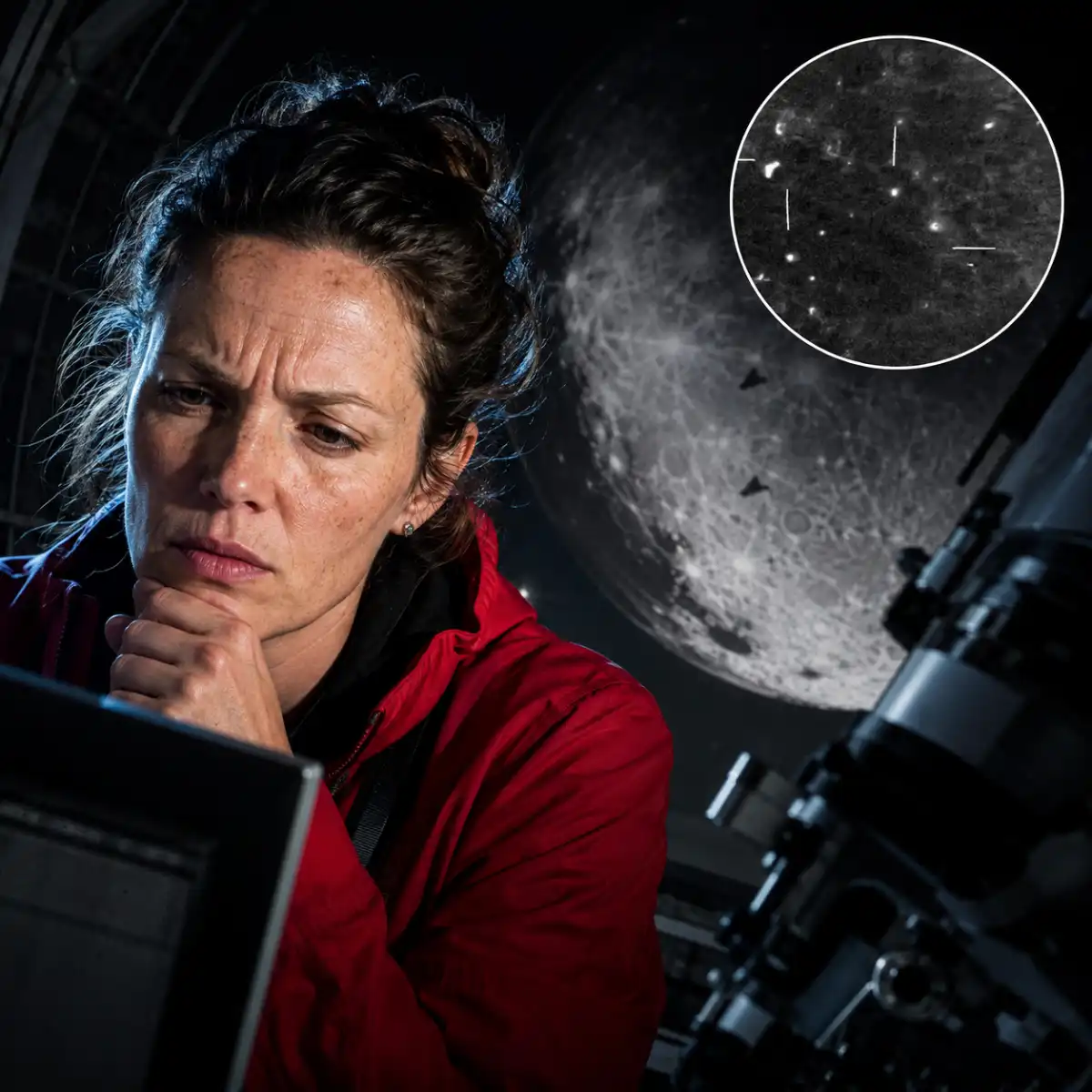
A viral alien base on the Moon claim rests on a March 2026 preprint that has not been peer reviewed or independently confirmed. The paper says high-speed telescope footage captured more than 20 unidentified objects near or crossing the lunar disc. Its authors go considerably further, arguing that “the Moon serves as a base for UFOs.” The available evidence does not establish that conclusion.
The study, titled UFO Dynamics on the Moon, is attributed to Ukrainian researchers Boris Zhilyaev, Vladimir Petukhov and Sergey Pokhvala. It lists the Main Astronomical Observatory of the National Academy of Sciences of Ukraine in Kyiv as their affiliation.
That observatory is a legitimate research institution within Ukraine’s national academy. However, the paper appears as a ResearchGate preprint and as an attachment on an observatory forum. It is not a peer-reviewed journal article or an official conclusion endorsed by the wider academy. Institutional affiliation is not the same thing as institutional approval, an occasionally inconvenient distinction online.
What did the Ukrainian researchers report?
According to the preprint, the team recorded the sky around the Moon from Vinarivka, a village south of Kyiv. The researchers used an Intes-Alter M603 telescope with an ASI 294 Pro camera, collecting video at intervals of 0.05 seconds. They processed the footage with SharpCap 4.0 and MATLAB.
The paper identifies more than 20 objects in recordings made on September 7, 2025, at 23:05:02 UTC and 23:27:49 UTC. The authors separate the features into two categories:
- “Atmospheric” UFOs, which appeared stationary
- “Continental” UFOs, which seemed to travel across the Moon’s visible surface
The researchers describe flashes lasting between 100 and 500 milliseconds, with brightness changing at frequencies of several hertz. They estimate that some apparent disc-shaped objects measured roughly 25 to 40 kilometers across.
They also report toroidal, or ring-shaped, objects approximately 36 kilometers wide, supposedly moving as fast as 11 kilometers per second. Those figures sound precise, but their reliability depends on a crucial assumption: that the detected features were physical objects at or near the Moon.
Why does the paper mention an advanced civilization?
The strongest claims appear in the discussion section, where the authors describe the objects’ apparent dimensions and speeds as unprecedented. They argue that the observations can be treated as evidence of a “technologically advanced civilisation.”
The paper also proposes that UFOs could travel from the Moon to Earth in about 20 minutes, later appearing as UAP, or unidentified anomalous phenomena, in the atmosphere.
No independent telescope observations currently support that scenario. The preprint does not provide the kind of publicly available raw footage, calibration material, external replication or peer-reviewed analysis needed to demonstrate that the features represent machines, much less technology created by a non-human civilization.
The emotional pull of the claim is easy to understand. A nearby lunar outpost turns a few unclear images into a much larger story about humanity’s place in the universe. But the size of that conclusion also raises the standard of evidence. An unusual shape in processed telescope footage cannot carry the entire argument by itself.
What happened during the August 2025 observation?
Another major part of the viral account comes from an observation recorded on August 16, 2025. The researchers say they detected a toroidal object at 06:52 UTC while filming the Moon against a bright daytime sky.
The preprint acknowledges that the reported objects had low contrast. Special image processing and false-color displays were used to make them more visible. The authors interpreted low and similar red, green and blue intensity values as evidence that the object was “highly obscured” and therefore difficult to detect.
That interpretation has not been independently reproduced. When a claimed discovery becomes visible mainly after substantial processing, outside researchers generally need the original files and a complete record of every processing step. Otherwise, it can be difficult to determine whether the resulting shape reflects a physical object, sensor behavior, compression, atmospheric interference or the analysis itself.
Daylight observations add further complications. Bright background light, atmospheric turbulence and reduced contrast can all affect what a camera records near the lunar disc.
How were the size and speed estimates calculated?
The authors report a rotation period of about 180 seconds for the ring-shaped features. They estimate centrifugal acceleration at 2,200 centimeters per second squared, which they compare with roughly twice Earth’s gravitational acceleration.
Their reconstructed images supposedly show toroidal objects measuring 36 ± 3 kilometers across and reaching speeds of 11 kilometers per second. Yet those calculations depend heavily on the assumed distance to the detected features.
An image can reveal angular movement across a camera’s field of view, but angular movement alone does not establish how far away something is. Without a reliable distance measurement, researchers cannot confidently calculate an object’s true size or velocity.
A nearby insect or bird could appear to cross the Moon rapidly. Aircraft, satellites, atmospheric distortion, telescope tracking problems, reflections, sensor noise and digital artifacts can also produce surprising results. If a feature assumed to be near the Moon was actually much closer to the telescope, its calculated dimensions and speed would shrink dramatically.
This distance problem is not a minor technical objection. It sits at the center of the paper’s most extraordinary conclusions.
What standards apply to UAP footage?
NASA’s 2023 independent UAP report warned that many anomalous sightings are captured with instruments that were not designed or calibrated to study unidentified objects. Missing metadata can make an object’s movement, size and nature difficult, or sometimes impossible, to determine.
For a strong scientific case, investigators would need information such as:
- Original, uncompressed video and image files
- Telescope and camera calibration records
- Exact location, timing and observing geometry
- Weather and atmospheric conditions
- Tracking information for aircraft and satellites
- Independent recordings from other locations
- A reproducible account of all image processing
Synchronized observations would be particularly important. If multiple telescopes at separated locations recorded the same feature, researchers could use parallax to estimate its distance. That would help distinguish something near the camera from an object in Earth orbit or at lunar distance.
Without such measurements, “unidentified” describes the limits of the available information. It does not identify an alien craft by elimination.
Have these researchers faced similar questions before?
Related work from Ukraine’s Main Astronomical Observatory attracted attention in 2022. That earlier report described fast-moving “cosmic” and “phantom” objects over Kyiv.
Later reporting said Ukraine’s national science agency rejected that work as lacking scientific rigor and containing major errors in its distance calculations. Harvard astrophysicist Avi Loeb also argued that the objects would become far less remarkable if they were much closer than the researchers had assumed.
The new lunar study has not yet resolved the same basic concern. ResearchGate identifies it as a preprint and cautions that preprints and early-stage research may not have undergone peer review. Its listing also shows no resolved citations establishing an independent body of research that confirms the findings.
Peer review would not automatically prove or disprove the observations. It would allow outside specialists to inspect the methods, calculations and alternative explanations before the conclusions are presented as established science. For a claim involving a hidden lunar civilization, that inspection is not an excessive request.
What have official UAP reviews concluded?
Public interest in UAP has grown sharply in recent years, but official investigations have consistently emphasized data quality rather than extraterrestrial explanations.
NASA has said meaningful UAP research requires calibrated instruments, reproducible evidence and hypotheses that can be tested and potentially disproved. The U.S. All-domain Anomaly Resolution Office reached a similar conclusion in its historical review of government cases. It reported finding no verifiable evidence that a UAP incident represented extraterrestrial activity or that a government or private organization possessed alien technology.
Those conclusions do not mean every unusual observation has been explained. They mean investigators have not found reliable evidence connecting unexplained sightings to non-human visitors.
Ground-based lunar imaging is particularly vulnerable to uncertainty. Meteoroid impacts can produce brief flashes, while satellites may cross the camera’s field of view. Atmospheric seeing, optical reflections, tracking errors, sensor artifacts and digital processing can create other apparent shapes or movements. Several explanations may need to be tested before researchers can say what a feature was.
What evidence would be needed to confirm the claim?
The Ukrainian preprint may provide material for further investigation, but it does not currently demonstrate that UFOs operate from the Moon. Moving from an intriguing telescope anomaly to evidence of non-human technology would require several additional steps:
- Release the raw footage and complete calibration files
- Publish precise observing conditions and geometry
- Obtain simultaneous confirmation from multiple locations
- Measure distance independently rather than assuming lunar proximity
- Rule out atmospheric, terrestrial and instrumental causes
- Submit the methods and conclusions to independent peer review
Until those steps are completed, the reported fleet of more than 20 UFOs remains an interpretation of ambiguous telescope data. The features may deserve examination, but their unidentified status does not transform them into evidence of a secret base.
For now, the episode says more about how quickly a dramatic scientific claim can circulate than it does about life beyond Earth. The preprint raises questions that astronomers and UAP researchers can test. It does not substantiate its central conclusion that a technologically advanced civilization is operating from the Moon.