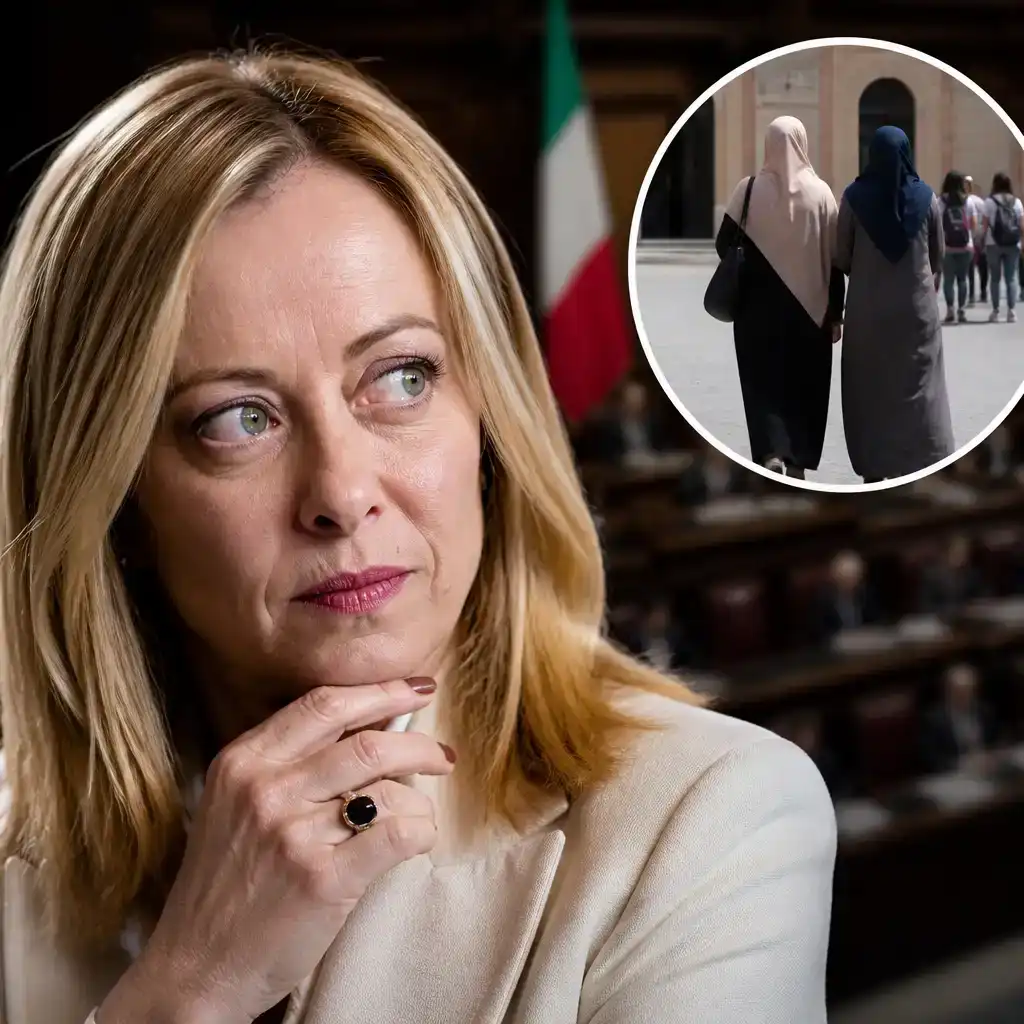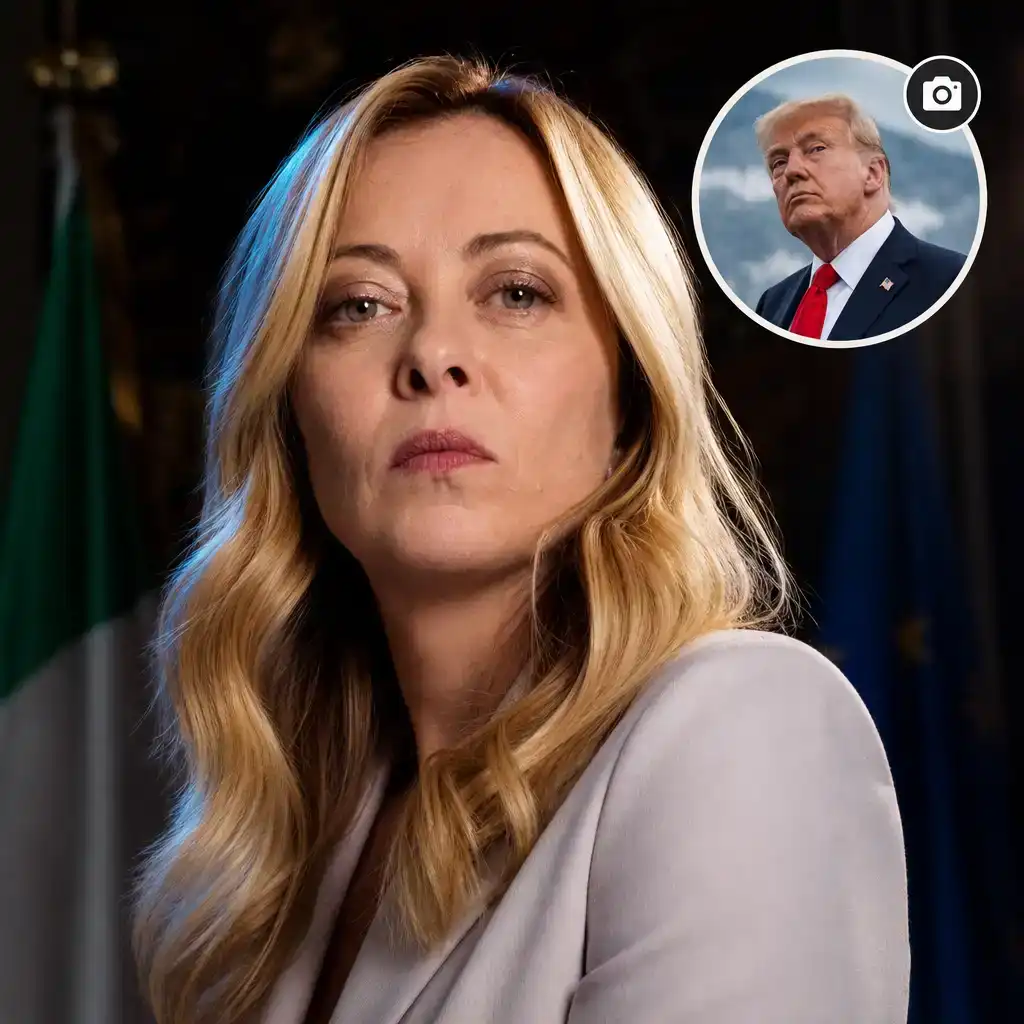
A once-useful political friendship has turned into a very public grievance session. Trump’s G7 photo claim has drawn a sharp denial from Italian Prime Minister Giorgia Meloni, who said the US president had invented the story that she “begged” him for a picture at this week’s summit in France.
Meloni said she was “frankly stunned” by Donald Trump’s remarks, calling them entirely “made-up.” The fallout has already moved beyond social media: Italian Foreign Minister Antonio Tajani has cancelled a planned trip to the United States early next week.
What Trump said about Meloni at the G7
Trump and Meloni were filmed speaking closely at the G7 summit in Evian-les-Bains, in eastern France. At one point, the two sat on a small sofa and appeared deep in conversation, with Meloni smiling as they talked.
Afterwards, Meloni told reporters that her relationship with Trump had not changed and that there had been “no recriminations.” That version lasted roughly as long as diplomatic warmth often does in 2025: until the next interview.
In a phone interview with Italy’s La7 television channel, Trump claimed: “She begged me to take a photo with her; I felt sorry for her.”
He added: “She’s probably happy I spoke to her.”
La7 did not broadcast Trump’s original English audio, instead airing the remarks voiced over in Italian. Still, the comments landed clearly enough in Rome.
Meloni says neither she nor Italy begs
Meloni responded in a short Instagram address to her roughly seven million followers, making clear she did not see this as normal political friction.
“I don’t know why the US president behaves this way towards allies,” she said, adding that it was not the first time such a thing had happened.
She then widened the criticism beyond the personal slight.
“I can only say it is regrettable he does not show the same determination towards the enemies of the West and towards the enemies of the US, [enemies] whose leaders he instead appears to be far more accommodating with.”
Then came the line that will travel furthest in Italian politics: “But there is one thing he needs to remember: neither I nor Italy ever beg.”
The BBC has asked the White House for comment.
A close relationship has been deteriorating for months
The exchange is notable because Meloni was once seen as one of Trump’s closest contacts in Europe. Elected in 2022, she was the only European leader to attend his inauguration in January 2025, and many in the European Union viewed her as a possible bridge to the returning US president.
That role has become much harder to maintain since Trump’s decision to go to war with Iran. Meloni has been openly critical of the US conflict with Tehran, and Trump had already turned on her in April during an interview with Italian daily Corriere della Sera.
“I thought she had courage, but I was wrong,” he said at the time.
Meloni also publicly rejected Trump’s criticism of Pope Leo XIV, after he accused the pontiff of being “weak on crime and terrible on foreign policy.” She called those remarks unacceptable.
So, yes, the photo comment is petty. But it did not arrive in a vacuum. It is the latest installment in a relationship that has moved from strategic convenience to televised irritation.
Italian politicians rally around Meloni
Trump’s remarks prompted an unusual show of cross-party support for Meloni at home. Italian President Sergio Mattarella quickly phoned the prime minister to offer his support.
Politicians across the spectrum also defended her, though they did not all resist the chance to make their own point.
- Filippo Sensi, a senator from the opposition Democratic Party, said no one had the right to address an Italian prime minister in such an arrogant tone.
- Giuseppe Conte, leader of the Five Star Movement, said Italy did not deserve humiliation and warned that seeking favors from Washington should never come at the cost of national dignity or national interest.
- Lucio Malan, Senate group leader for Meloni’s Brothers of Italy party, said Trump’s comments fit a broader pattern of offensive remarks about European leaders and damaged Trump’s own image and authority.
- Matteo Salvini, leader of the League and a government ally, kept it brief: “Whoever attacks Giorgia, attacks all of us.”
Malan also argued that the G7 footage suggested a very different interaction from the one Trump described. In his view, what may have irritated Trump most was Meloni’s willingness to say no to Washington when she thought it was necessary.
Europe is becoming less patient with Trump
The photo comment was more than a personal row over who wanted a picture. European leaders who once tried to manage Trump through accommodation now appear more willing to challenge him publicly.
UK Prime Minister Keir Starmer has pushed back against Trump’s criticism of UK and allied forces in Afghanistan. Several European leaders, including Meloni, have also criticized Trump over the war with Iran and refused to allow US bombers to use their air bases.
Diplomats say the shift has been building since earlier this year, when the US threatened Greenland. That episode helped revive discussions in European capitals about strategic autonomy, a polite phrase for doing more without assuming Washington will be steady, available, or especially subtle.
The changing tone may also reflect voter sentiment ahead of elections across the continent. Right-wing European parties that initially saw Trump’s movement as a natural ally are increasingly putting distance between themselves and their American counterparts.
In short, Meloni may want working ties with Washington, but not at the price of being cast as a supplicant in someone else’s story.