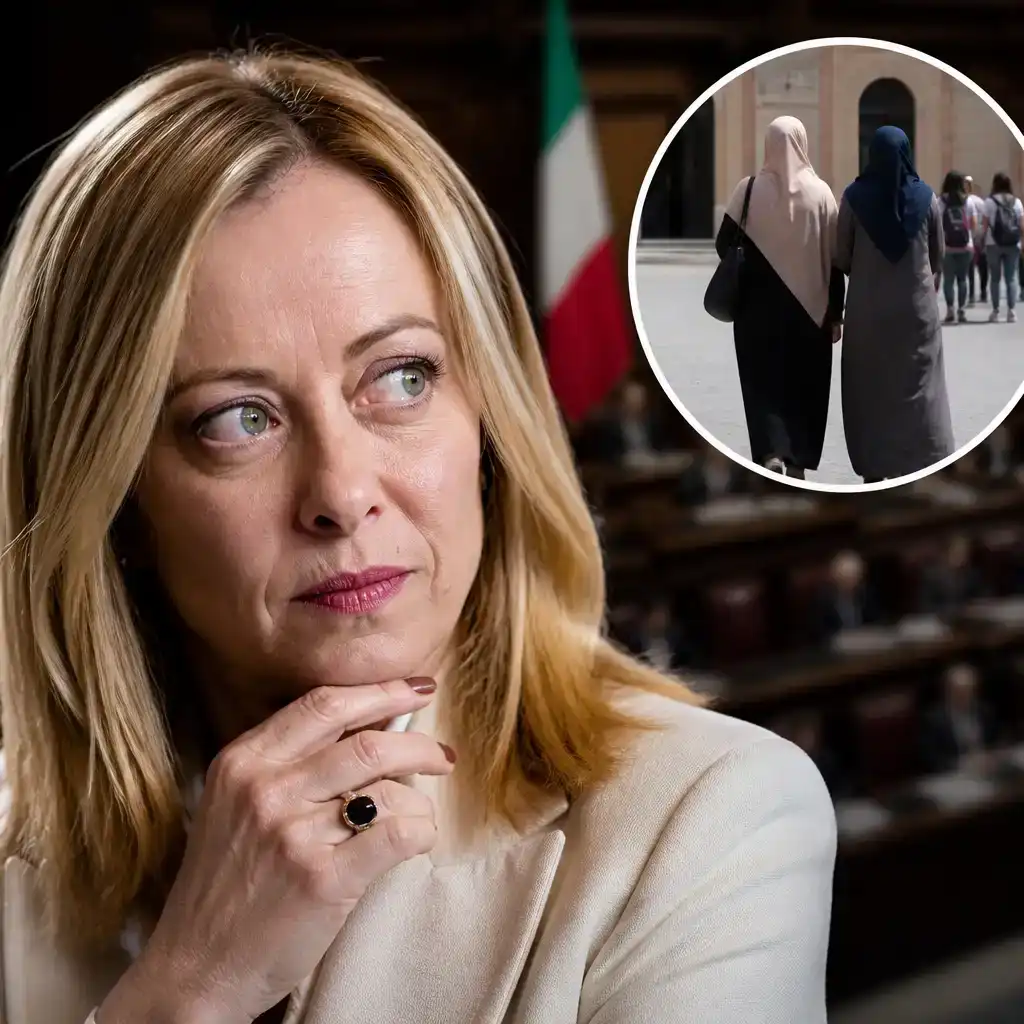
Italy’s burqa ban has left worshippers at Milan’s al-Wahid mosque wondering why the government has devoted so much attention to clothing that is rarely seen in the country’s classrooms. The measure covers burqas and niqabs, both of which conceal the face, and has been presented by Prime Minister Giorgia Meloni as a matter of equality and identification.
Mulayka Laura Enriello, a 58-year-old secondary school mathematics teacher, said some pupils wear the hijab, which covers the hair but leaves the face visible. She has never encountered a student wearing a full-face garment during her career.
“Those girls who want to wear a hijab to school do so, no one bothers them, neither teacher nor student,” Enriello said.
According to the state-run ANSA news agency, only about 500 to 600 female students across Italy wear full-face coverings. That is a notably small population around which to construct a national political dispute, but scarcity has rarely discouraged political enthusiasm.
Why does Meloni want face coverings banned in schools?
Meloni announced the restriction during a rally for her nationalist conservative Brothers of Italy party, known by its Italian initials FdI. She framed it as protection for young women and a defence of shared social standards.
“You must go to school with your face uncovered,” Meloni said. “And in Italy no one, in the name of a real or supposed tradition, can decide that a young woman must hide herself.”
Enriello described the approach as inhumane. If a pupil arrived wearing a burqa, she said, the proper response would not be to send her away.
“I have to treat her as a minor who probably thinks she is doing something good,” she said.
Yahya Pallavicini, imam of the al-Wahid mosque and vice president of the Italian Islamic Religious Community, called the policy a “false problem”. In his view, it places disproportionate attention on a practice followed by a tiny minority and distorts public perceptions of Islam.
“This is an attempt to present a unified model of society, a society that is white supremacist and if something is different it is caricatured by the specious use of the burqa,” Pallavicini said.
He also accused the government of “intellectual dishonesty” by using one of the least publicly accepted expressions of Muslim faith to cast suspicion on a much broader community.
How did the veil become a political symbol?
Brothers of Italy is not alone in presenting Muslim clothing as incompatible with secular Western society. At the League party’s annual rally in Pontida, female activists from the French far-right group Collectif Nemesis staged a performance in which they removed full-face coverings as the audience shouted “libertà”, or “freedom”.
Renata Pepicelli, professor of Islamic Studies at the University of Pisa, compared the display with events organised by French colonial authorities in Algeria in 1958. During those ceremonies, groups of Algerian women removed and burned their veils to demonstrate support for Paris, sometimes under coercion.
Pepicelli said the veil remains a political “battlefield”, with its removal used to signal which social group has the power to define acceptable behaviour. She argued that Meloni’s policy belongs to that broader climate rather than responding to any significant problem inside Italian schools.
The government decree does not explicitly mention burqas or niqabs. Instead, it prohibits attending school with a full-face covering or “in any other modality that prevents identification”. The wording is neutral on paper, although the political presentation has left little doubt about the clothing being targeted.
What does Italian law already say about covered faces?
Italy already prohibits people from wearing items in public that make identification difficult, unless they have a “valid reason”. The crucial question has long been whether religious observance qualifies as one.
Nico Tonti, a researcher in the Department of Legal Studies at the University of Bologna, said that exception sits at the centre of the legal tension between religious freedom and public order.
“Over the years, jurisprudence has progressively recognised religious observance as a valid reason to exclude the conduct from prosecution,” Tonti said.
Although the school directive has taken effect, Parliament can still examine whether it is proportionate to the government’s stated goals and whether it complies with constitutional protections for religious freedom.
That scrutiny may focus on whether a broad prohibition is necessary when the number of affected pupils is so low, and whether schools could meet identification requirements through less restrictive measures. The legal debate is therefore not simply about whether faces must sometimes be visible. It is also about whether the state can turn a limited administrative concern into a general restriction on religious practice.
Why has the restriction appeared now?
The timing has encouraged suspicions that the policy is aimed as much at voters as classrooms. Campaigning for Italy’s 2027 election is taking shape, and Meloni faces growing competition on her right.
National Future, the party founded in February by former general Roberto Vannacci, has reached 8 percent in opinion polls. Its rise threatens to draw nationalist voters away from Meloni’s coalition, particularly on immigration, security and identity.
Lorenzo Castellani, professor of History of Political Institutions at LUISS University, said Meloni is trying to present a tougher nationalist agenda.
“Meloni is approving this legislation to give a strong signal to right-wing voters, for whom security and immigration are among the main concerns,” Castellani said.
He expects her election campaign to concentrate on three subjects:
- immigration
- security
- political stability
The first two allow Meloni to compete with Vannacci on identity politics. The third gives her a more practical argument: she can present herself not only as a leader making promises, but as one with a government capable of carrying them out.
How does government stability strengthen Meloni?
Italy is not generally associated with durable governments, but Meloni has acquired a useful record on that front. Earlier this month, her administration passed the 1,412 consecutive days achieved by Silvio Berlusconi, becoming the country’s longest-lasting government since World War II.
Castellani expects Meloni to make continuity a central part of her pitch in 2027. Her likely argument will connect tighter immigration controls and security policies with the claim that only a stable government can implement them.
That helps explain why a school rule affecting perhaps a few hundred pupils has received national attention. The dispute allows Meloni to reassure conservative voters, compete with a challenger further to the right and present her government as willing to act.
For Muslim teachers and religious leaders in Milan, however, the policy addresses a largely theoretical classroom problem while making a real minority more conspicuous. The government sees an assertion of national values. They see political theatre built around pupils whom most Italian teachers have never encountered.