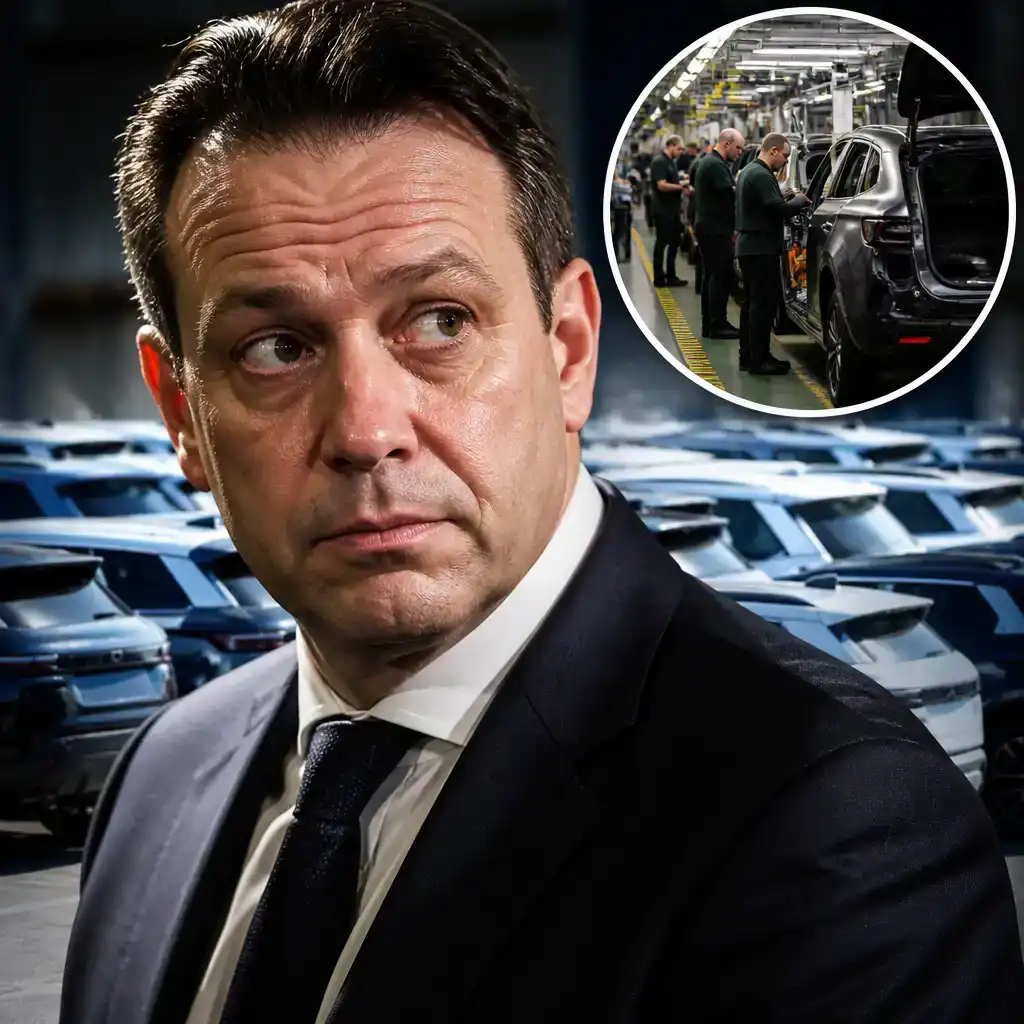
The Jaguar Land Rover job cuts will remove about 4,000 roles worldwide over the next two years, with most of the impact expected at its UK head office and among salaried and management staff. The carmaker wants to save £1.7 billion while confronting weaker sales, Chinese rivals, US tariffs and the expensive shift to electric vehicles. A major cyberattack has made the calculation even less pleasant.
JLR, which employs about 43,000 people globally according to the company figure cited in the announcement, hopes to secure most departures through voluntary redundancy. Other reports put its workforce closer to 44,000, including roughly 30,000 in Britain. Early accounts suggested all 4,000 positions would be UK-based, but JLR later described the reductions as global and concentrated in Britain.
Affected employees will receive emails, and the voluntary application window remains open until 4 October. If too few people apply, compulsory redundancies will follow on less generous terms. Corporate flexibility has limits, particularly when the savings target has nine zeroes.
Why is JLR cutting thousands of roles?
Chief executive PB Balaji said the automotive industry faces technological change, intense competition and continuing geopolitical uncertainty. He promised that JLR would support employees with “care, fairness and respect” during the process.
The company has been losing ground to Chinese manufacturers that have expanded rapidly with competitively priced electric and hybrid vehicles. China was once viewed mainly as a growth market for Jaguar and Land Rover models. It is now also home to increasingly capable competitors, which was not the preferred version of the business plan.
Tariffs imposed by US President Donald Trump have added another problem. Unlike BMW and Mercedes-Benz, JLR has no American factory that could reduce its exposure to import duties.
Ian Robertson, a former BMW director, argued that JLR should have established production in the United States earlier. BMW operates its largest plant in Spartanburg, South Carolina, while Mercedes-Benz manufactures vehicles in Tuscaloosa, Alabama. JLR’s absence leaves it more vulnerable when Washington raises the cost of imported cars.
Robertson also said the company had moved too slowly on its latest electric vehicle programme. Brexit created further complications, although JLR’s factory in Slovakia provides some manufacturing flexibility.
How badly have sales and profits fallen?
For the year ending in March, JLR said revenue had fallen by about a fifth, from £29 billion to £22.9 billion. It identified US tariffs and the cyberattack as the main causes. Separate quarterly figures showed revenue declining by nearly 10%, while pretax profit dropped 69% to £109 million.
The company now wants to lower the number of vehicles it must sell to break even to about 300,000. It also plans five product launches within 12 months, suggesting that JLR intends to solve its difficulties through a combination of new models, lower costs and fewer employees.
At the same time, it expects to invest between £15 billion and £18 billion over five years in electrification and digital technology. The apparent contradiction is deliberate rather than accidental: JLR is reducing its current cost base while spending heavily on what it believes will keep the business viable later.
That strategy carries obvious risks. Electric vehicle development requires large upfront investment, competition is already severe, and delays can become very expensive. Cutting experienced technical and management staff during that transition may improve short-term accounts while leaving less room for mistakes.
What did the cyberattack cost Britain?
The 2025 cyberattack forced JLR to halt production for nearly six weeks. Sky News reported that the disruption directly cost the company about £200 million. The Cyber Monitoring Centre estimated the wider damage to the UK economy at roughly £1.9 billion.
Those figures show why the restructuring matters well beyond JLR’s payroll. Company-sponsored research estimated that the manufacturer supported £17.9 billion of UK gross domestic product in 2024, including £8.7 billion in the West Midlands. Thousands of suppliers and other organisations depend on its factories continuing to operate.
David Bailey, professor of business economics at the University of Birmingham, described JLR as “as strategically important as it gets for the UK economy”. He said the shutdown had affected national output because so many jobs and companies sit within its supply chain.
The attack therefore exposed a broader industrial weakness. Concentrating so much regional activity around one manufacturer creates efficiency when production runs normally. When the computers stop working, the consequences spread with impressive speed.
What support will workers receive?
The Unite union wants JLR to prioritise retraining and redeployment before imposing compulsory dismissals. General secretary Sharon Graham said Britain’s automotive sector had endured years of underinvestment under both Conservative and Labour governments. She also called the zero emission vehicle mandate “unsustainable”.
Liam Byrne, chair of the House of Commons Business and Trade Committee, described the reductions as a “body blow for workers, families and communities across the West Midlands”. He called for urgent assurances that affected employees would receive maximum help finding new work, regardless of whether their departures were technically voluntary.
Prime Minister Keir Starmer’s official spokesman acknowledged that the announcement would create uncertainty for workers, families and surrounding communities. Business Secretary Jonathan Reynolds said the government’s focus was making JLR “as competitive as possible”. He plans to remain in contact with the company, but the government has ruled out a bailout.
That leaves ministers trying to protect a strategically important manufacturer without writing it a rescue cheque, while JLR tries to fund new technology by removing thousands of existing roles. Neither task comes with an inexpensive option.
Is the electric vehicle mandate responsible?
Critics have blamed some of the pressure on the UK’s zero emission vehicle mandate, introduced by the previous Conservative government and retained by Labour. The policy requires an increasing share of new cars and vans sold in Britain to produce no tailpipe emissions, reaching 100% by 2035.
Shadow transport secretary Richard Holden said the mandate and high energy costs were “crippling the British automotive industry” and pledged to abolish the policy.
Its direct effect on JLR is less straightforward because the company earns most of its revenue overseas, where the UK sales rules do not apply. The mandate also has supporters. The UK Sustainable Investment and Finance Association has argued that a clear timetable is essential for attracting investment into charging networks and other electric vehicle infrastructure.
JLR’s own spending plans reinforce that complication. The company may object to the pace and cost of the transition, but it is still committing billions to electric vehicles and digital systems. The dispute is therefore not simply about whether electrification happens. It is about who pays for it, how quickly it arrives and how many workers remain employed while the industry gets there.