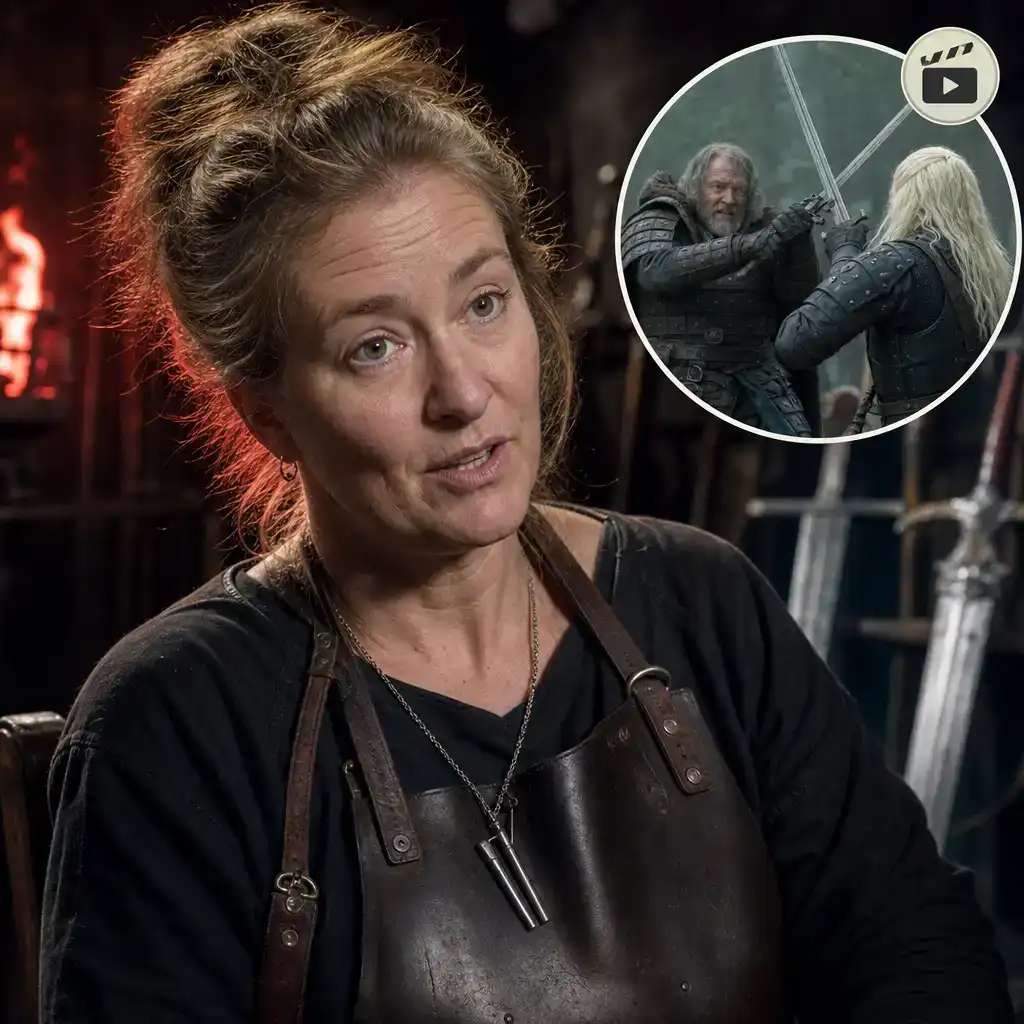
“I was like a kid in a candy shop,” he said.
The job was not just to hand out blades and hope for the best. The team had to match the right weapon to the right scene, and sometimes adjust quickly as blocking, camera distance or choreography changed.
Why one sword is never enough
Actors are filmed using different versions of a sword depending on what the camera needs and what the performer is doing.
Aaron said steel swords can be used for close-up shots, where weight, shine and texture matter most. Lighter aluminium versions are used when actors need to move around with them but are not doing heavy stunt work.
For more active scenes, the production switches again.
“If they’re doing something a bit more active, maybe they’re walking over dangerous terrain or they’re going to be fighting with it, then they get a synthetic version: cast polyurethane painted to look as close to the original as possible,” he said.
For falls, rolls and other stunt work, performers use a rubber version that is fully flexible. Not glamorous, perhaps, but notably better than landing on a rigid prop sword.
How the armoury team keeps continuity intact
Aaron also had to make sure background extras carried the correct swords as they moved closer to camera. That matters because a weapon that looks fine in the distance may suddenly become very visible once a shot changes.
“Knowing what swords look like in real life helped quite a lot,” he said.
The pace on set meant the armoury team had to stay close and respond quickly. Aaron said the director liked to experiment and make small adjustments to shots, which meant the correct version of a sword might need to be swapped immediately.
“The director likes to really experiment with different things and change the shot slightly, and we have to be right there to change the sword,” he said.
For the third series, Aaron was also asked to make a set of daggers used during filming, adding another set of sharp-looking objects that, ideally, were not sharp in practice.