Donald Trump has never been particularly shy about praising himself. But one exchange with journalist Lesley Stahl produced a statement that might be among his most memorable: Donald Trump insisted he was more humble than his interviewer could possibly understand.
The remark came during an interview on CBS's 60 Minutes, when Stahl challenged Trump about his public persona and apparent enthusiasm for boasting about his own achievements.
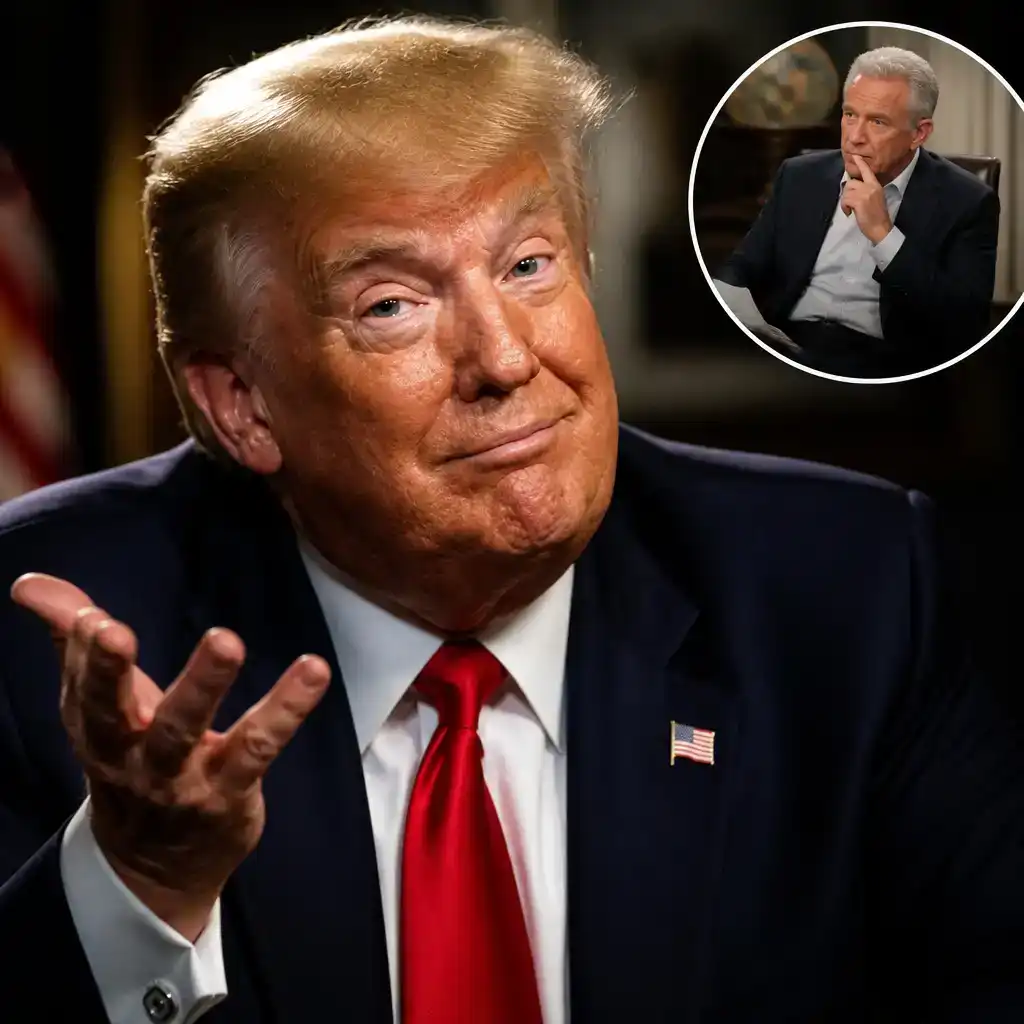
Asked whether he considered himself a humble person, Trump replied: "I think I'm much more humble than you would understand."
It was an extraordinary way to demonstrate modesty. Rather than simply acknowledging the question, Trump suggested that even his humility existed on a level his interviewer could not fully appreciate.
The exchange, also highlighted in reporting by The Washington Post, became a memorable example of Trump's distinctive approach to interviews, with supporters and critics drawing very different conclusions from the same sentence.
Trump's definition of humility raises an obvious contradiction
Humility is generally associated with modesty, an awareness of personal limitations and a reluctance to exaggerate one's own importance.
Trump's response presented a rather different interpretation.
By telling Stahl that his humility exceeded her understanding, he effectively turned a question about modesty into another assertion of personal superiority.
That contradiction is what makes the exchange so striking. The statement does not simply claim that Trump is humble. It implies that his interviewer lacks the ability to recognise just how humble he really is.
For critics, the irony practically writes itself.
Yet the remark also fits the confrontational communication style that has helped define Trump's public image. Instead of accepting the premise of an uncomfortable question, he redirected the exchange towards the person asking it.
Why supporters and critics heard two different messages
The exchange prompted contrasting reactions online, illustrating how Trump's remarks can be interpreted through sharply different political perspectives.
Supporters viewed the answer as a clever comeback to an interviewer they regarded as hostile. From that perspective, Trump was refusing to let Stahl define his personality or dictate the terms of the conversation.
Critics saw something considerably less flattering: a politician apparently boasting about a personal quality that is fundamentally at odds with boasting.
Both interpretations depend partly on whether the audience understands the response as deliberate provocation or a sincere assessment of Trump's character.
The available exchange does not establish which interpretation Trump intended. It does, however, show how a single sentence can function simultaneously as a defensive response, a personal claim and an invitation to ridicule.
Lesley Stahl's question exposed Trump's unusual interview strategy
The significance of the moment lies partly in the simplicity of Stahl's question.
She was not asking Trump to explain a complicated policy, defend an economic forecast or address a disputed political allegation. She was asking him to assess an ordinary human characteristic.
That left little room for technical explanations or competing statistics.
Trump nevertheless answered with the same confidence associated with his broader public persona, making a sweeping claim about himself while challenging the interviewer's capacity to understand him.
The result was a response that shifted attention away from whether he possessed humility and towards whether Stahl was qualified to recognise it.
That distinction matters because the exchange demonstrates how a politician can change the dynamics of an interview without necessarily resolving the question being asked.
Was it a clever comeback or an accidental self-parody?
In my view, the most revealing part of Trump's answer is not the apparent contradiction itself, but the way he transforms a potentially uncomfortable question into an assertion of authority. The response is rhetorically effective because it gives supporters a moment of defiance to celebrate, even as it gives critics an obvious reason to question his self-awareness. Whether the irony was intentional remains uncertain, but the exchange illustrates how Trump's confidence can become both a political strength and a source of ridicule.
There is also a broader distinction between winning an exchange and answering a question.
A sharp response may entertain an audience, frustrate an interviewer or dominate the subsequent discussion. None of those outcomes necessarily establishes whether the underlying claim is true.
In this case, Trump's statement offered no evidence of his humility. It simply asserted that his interviewer was unable to appreciate it.
Why Trump's humility remark remains memorable
The enduring appeal of the exchange comes from its unusual simplicity.
Unlike political controversies requiring lengthy explanations, the contradiction is immediately understandable. A man famous for projecting confidence declares that his modesty is greater than someone else can comprehend.
For admirers, it is another example of Trump refusing to be intimidated by a journalist. For detractors, it captures the tension between his self-image and the conventional meaning of humility.
The same words support two very different readings, and neither requires a complicated political argument.
Perhaps that is why the moment remains so effective as a piece of television. Stahl asked a straightforward question about humility, and Trump answered by suggesting that even his modesty was exceptional.
Few politicians could make humility sound quite so much like a competitive achievement.