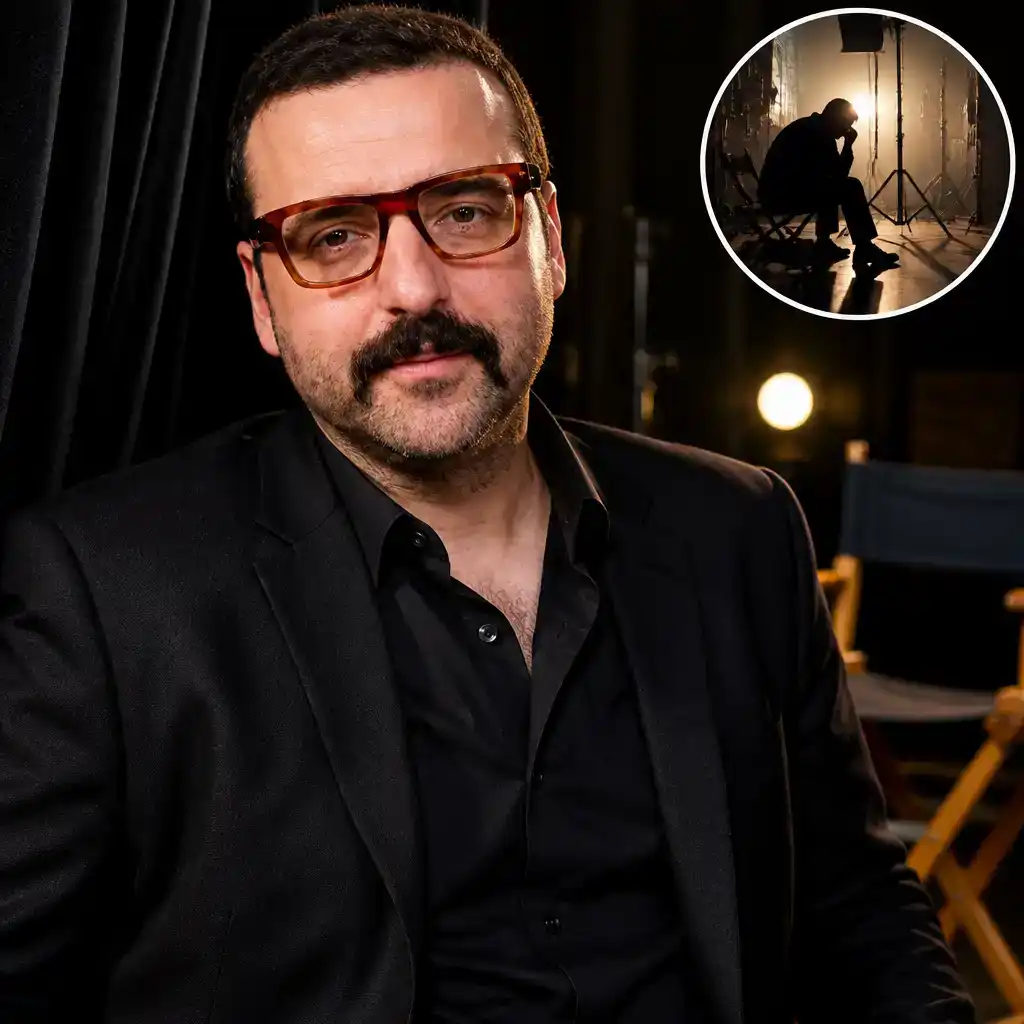
David Krumholtz steps away from acting after 34 years in the business, although “quits” would be too tidy a description. The 48-year-old Oppenheimer actor called it an “indefinite break,” said his career was “on hold” and made clear that he remains open to worthwhile offers. Hollywood has apparently reached the stage where even leaving requires an availability disclaimer.
In a now-deleted Threads post published Monday, Krumholtz described himself as “frustrated, fed up, fried.” He said he had finally sent what he called “the definitive email” after years of fearing that a pause would leave him broke and unable to return.
“A huge wave of relief washed over me,” he wrote. “Not sure what I’m going to do for money instead, or how I’m going to do it, but I just removed a humongous burden, one that I truly didn’t fathom the weight of until it was gone.”
Why is Krumholtz putting his career on hold?
Krumholtz said he spent the past year competing for roles that offered less money and less opportunity, despite more than three decades of experience. His complaint was not simply that auditions can be difficult. That has never been a well-kept industry secret. He argued that the basic financial arrangement between performers and studios has deteriorated.
“Exploitative art isn’t art,” he wrote. “And artists deserve a fair pay percentage for work that assists their employers in making profits.”
The New York City-born actor began working as a teenager in the early 1990s. He recalled an industry in which pay was fairer, performers could build momentum and commercial success generally led to another opportunity.
“While talent was never a surefire marker of success,” he wrote, helping a studio make money once meant a performer was likely to be hired again. In his view, the consolidation and corporatization of Hollywood changed those unwritten rules “drastically.”
Krumholtz said his representatives and union had advised him to “hang in there.” His post suggested that patience is less reassuring when the bills continue to display such admirable consistency.
Social media has become another unpaid audition
Another source of frustration was the expectation that actors must constantly market themselves online. Krumholtz said he was being pushed to reinvent his public image for likes and followers so he could qualify for fan conventions and internet advertising.
That extra work, he argued, now helps replace income that acting in film, television or theatre once provided on its own.
“I, along with many talented folks, not just actors, are being mass demoted,” he wrote. “Imagine you excel in your career for 34 years, just to be drastically demoted for it.”
His comments point to a particular problem for veteran character actors. These performers may have long résumés and familiar faces without the financial insulation available to the small group of stars who command enormous salaries. Experience does not disappear, but the bargaining power attached to it can.
Krumholtz has worked steadily across film and television, appearing in 10 Things I Hate About You, the Harold & Kumar films, Numb3rs and The Santa Clause franchise. In Christopher Nolan’s 2023 blockbuster Oppenheimer, he played physicist Isidor Isaac Rabi.
Hollywood’s employment figures support his complaint
Krumholtz’s post was personal, but the industry contraction behind it is measurable. According to the United States Bureau of Labor Statistics, employment in motion-picture and video production fell by 49,000 jobs between February 2016 and February 2026, a decline of 21 percent.
Production activity in Los Angeles has also dropped sharply. FilmLA figures cited by Fortune showed annual shoot days falling from 36,792 in 2022 to 19,694 in 2025. That is close to half the work disappearing in three years, which tends to make “hang in there” sound less like a plan and more like office decoration.
National actor employment fell 17 percent from May 2023 to mid-2025, according to Otis College data reported by NPR. The decline affects newcomers and established performers alike, though veterans face the added indignity of watching decades of credits fail to translate into reliable income.
SAG-AFTRA members ratified a new four-year studio contract in June 2026, with the union highlighting protections involving artificial intelligence. Those contractual gains matter, but stronger minimum terms can offer only limited comfort when fewer productions are hiring.
SAG-AFTRA President Sean Astin told the Associated Press in February that studios appeared to want “to work as partners again.” No union official, representative or co-star has publicly responded directly to Krumholtz’s announcement.
Residual income is not providing much of a cushion
Krumholtz had already offered a blunt example of declining long-term earnings. In June, he estimated that his annual residual payments from The Santa Clause franchise had fallen to about $150.
He played Bernard, the head elf, in the 1994 film starring Tim Allen and returned for the 2002 sequel. Krumholtz skipped the third movie in 2006 before reprising the role in the 2022 Disney+ series.
“They’re minimal because the movie plays so much,” he said of the residuals. “This is how residuals work: Every time it plays, you make less. It’s a grade scale.”
The franchise remains a holiday fixture, but familiarity does not necessarily produce substantial continuing income for its cast. A popular film can be widely available while the performer’s residual cheque becomes increasingly symbolic.
Is he actually retiring from acting?
Krumholtz explicitly left the door open. “If you want to work with me as an actor, I am interested,” he wrote. “If you believe in what I can do as an actor, I believe in you.”
What he no longer intends to do is keep pleading for jobs that fail to provide financial security. He said he could still act to make an impact rather than for “a measly buck,” framing the decision as a change in terms rather than a permanent exit.
His recent work also remains visible. Krumholtz played Zor-El in DC’s Supergirl, which opened on June 26, 2026. He also appears in Mr. Irrelevant: The John Tuggle Story, scheduled for release on December 25, 2026.
As of August 19, Krumholtz had not announced a reversal or another job. Independent reporting also described his move as an indefinite step back, not a retirement.
“It’s a goddamn shame,” he wrote, “but I have to be responsible for what I can control and change and that’s me and my heart.”
For now, relief appears to be the clearest result. The career remains available for the right project. The begging, he says, does not.