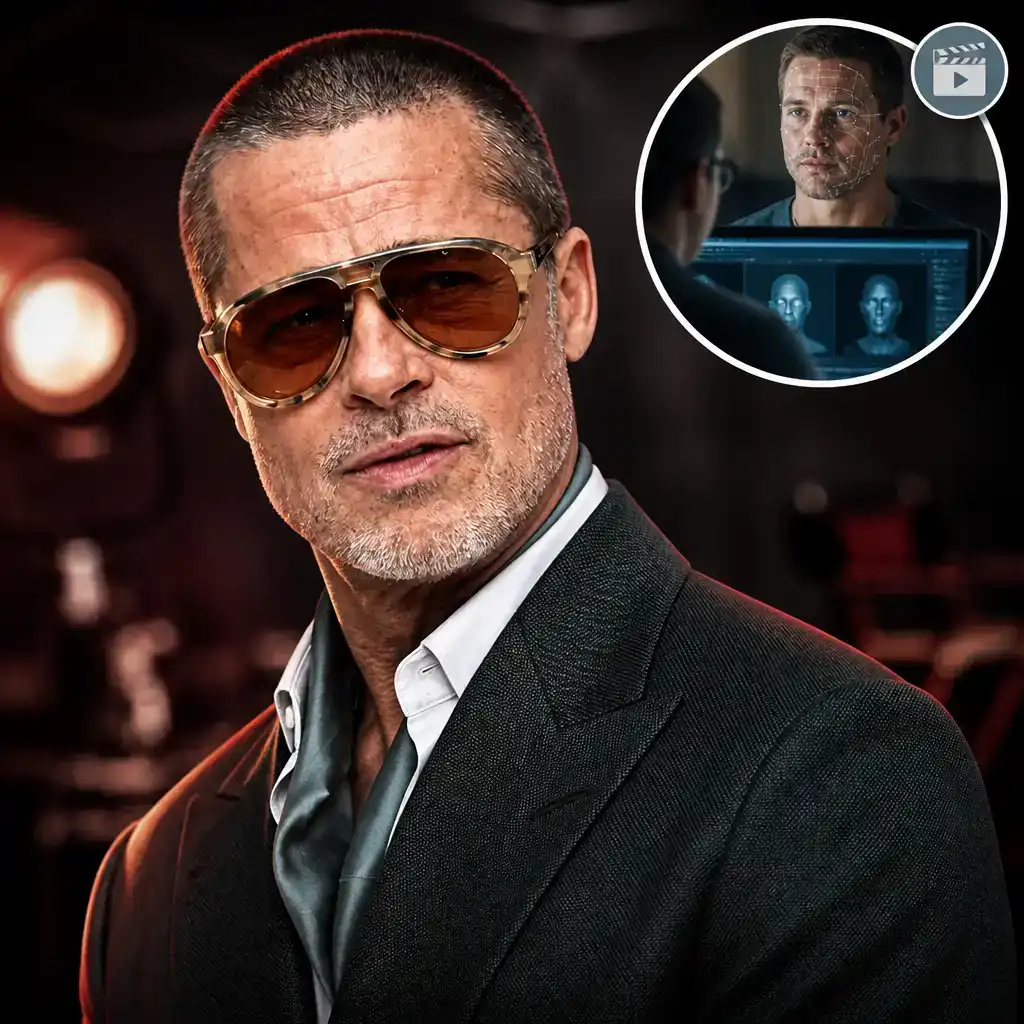
Brad Pitt believes AI in movies could make it easier to produce films costing between $40 million and $90 million, particularly when visual effects would otherwise push the numbers beyond what studios will tolerate. The larger question, inconveniently, is whether those savings create more films or simply fewer jobs.
In an Esquire interview, the Oscar-winning actor drew a line between artificial intelligence used as a production tool and technology used to imitate performers. He is open to the first, wary of the second and unusually prepared when it comes to protecting his own digital likeness.
“There’s a lot of pushback against AI, but AI is going to be the very thing that, if used as a tool, is going to help these mid-budget films, $40 to $90 million-budgeted films, get made,” Pitt said.
That range is well above what most people would call low-budget or independent filmmaking. Pitt is talking about studio dramas and action films caught between cheaper genre projects and enormous franchise productions, a category Hollywood has spent years praising while often declining to finance it.
Could artificial intelligence really lower film costs?
Pitt’s argument already has at least one practical example behind it. Netflix co-CEO Ted Sarandos said the Argentine science-fiction series The Eternaut used generative AI for a visual-effects sequence that would not otherwise have been financially feasible within the show’s budget.
Used narrowly, the technology could assist with previsualization, visual effects, stunt planning, crowd scenes and de-aging. Those applications may allow filmmakers to attempt sequences that would previously have been cut, simplified or reserved for much larger productions.
But lower costs do not automatically produce more films. They can also give companies a convenient reason to hire fewer visual-effects artists, extras and other crew members. Jodie Foster highlighted that tension at the Aspen Ideas Festival in July. She supported limited uses such as previsualization but warned that AI-assisted crowd replication is already removing jobs.
“We’re getting rid of a lot of jobs,” Foster said. She argued that performers should be paid every time their likeness is replicated, and said filmmakers must “dominate AI, and never lose sight of that.”
So the economic case remains unfinished. AI may help a director stretch a budget, but it may also stretch the definition of how many humans a production believes it needs. Studios, famous for voluntarily sharing savings with workers, will presumably require some supervision.
Can AI reproduce a Brad Pitt performance?
Pitt did not dismiss the possibility that artificial intelligence could generate something resembling his acting. His concern is that resemblance is not the same as authorship.
“Well, it depends on who’s creating it, you know? Who’s behind it, who’s telling the story,” he said. Pitt imagined a filmmaker directing an AI-generated version of him by requesting an emotion, reviewing the output and refining it. Technically, that process might produce a performance, but not necessarily the one he would have chosen.
“They could, but the final product might not be my choices and what I found and discovered in the thing,” he said, calling the wider adoption of AI “gonna be a very interesting experiment.”
That distinction matters because an actor’s work is not merely a collection of facial expressions waiting to be sorted by software. Timing, interpretation and unexpected choices are part of the performance, even if a sufficiently advanced system can create a convincing exterior.
Pitt made a similar point about AI-generated music. He said he recently heard an artificial intelligence song that was “pretty damn good,” although its repetitive quality gave it away. “It’s not going to be the same as hearing her voice, a woman’s voice, a person’s voice,” he added.
Who controls an actor’s digital likeness?
Pitt said studios have encouraged performers to undergo body scanning, a process commonly used for stunts, battle scenes, de-aging and digital effects. He has been scanned repeatedly over the past two decades, but his contracts have required that he retain ownership of the files and destroy them.
“I’ve been scanned for the last 20 years, and I’ve always put in my contract: I own them and I destroy them,” he said. “I should have kept them! All this time I’ve always had them destroyed, because I’m paranoid Ozark boy.”
Destroying the scans gives Pitt some control over authorized production assets. It cannot prevent third-party systems from generating unauthorized versions of him from existing footage and images.
That problem became visible in February, when ByteDance’s Seedance 2.0 produced a viral, unauthorized fight scene featuring digital versions of Pitt and Tom Cruise. The Screen Actors Guild-American Federation of Television and Radio Artists, better known as SAG-AFTRA, called such videos “blatant infringement.” The Motion Picture Association also demanded that the platform stop infringing activity.
The dispute showed that controlling digital identity requires more than careful personal contracts. It also depends on platforms respecting ownership, companies obtaining consent and performers having rights that can actually be enforced after the imitation has already travelled across the internet.
What protections do actors now have?
SAG-AFTRA members have approved a new four-year film and television contract addressing many of the concerns Pitt raised. The agreement was ratified in June with support from 91.4% of participating voters.
Under its terms, producers seeking to use synthetic performers must provide notice and bargain with the union. They must also demonstrate that a synthetic performer offers “significant additional value” beyond hiring a live performer or using an authorized digital replica. The contract includes provisions governing the licensing of performances for AI training.
SAG-AFTRA President Sean Astin said the agreement “strengthens protections around artificial intelligence and digital identity.” Those safeguards do not settle every issue, but they create rules around consent, compensation and the use of replicated performances rather than leaving actors to discover their digital doubles after release.
Pitt’s ability to negotiate ownership and destruction of scans also reflects his position in the industry. Less powerful performers may not have enjoyed comparable leverage before union-wide protections arrived. The technology may be new, but unequal bargaining power has managed to survive every software update.
What films is Pitt making next?
Pitt’s next project is Heart of the Beast, in which he plays a special forces soldier who survives a plane crash with his dog. After that, he is expected to return as Cliff Booth, the role that earned him an Academy Award for Once Upon a Time in Hollywood.
The follow-up, titled The Adventures of Cliff Booth, was written by Quentin Tarantino and will be directed by David Fincher. Esquire described it as less of a conventional sequel and more like the episodic television Tarantino watched growing up, with recurring characters whose individual adventures can stand alone.
Tarantino decided he did not want the project to become his planned 10th and final film. Pitt then asked for permission to show the screenplay to Fincher, who previously directed him in Seven, Fight Club and The Curious Case of Benjamin Button.
“Quentin gave me his blessing,” Pitt said. “Finch and I were on a plane and I gave him the script, and by the time we landed he said, ‘I’m doing it.’”
For now, Pitt’s position on AI is neither full endorsement nor blanket rejection. He sees a tool that could preserve a threatened class of studio film, provided it remains under human direction. The contracts, labor disputes and unauthorized replicas surrounding that tool suggest the experiment is already underway, whether everyone agreed to participate or not.