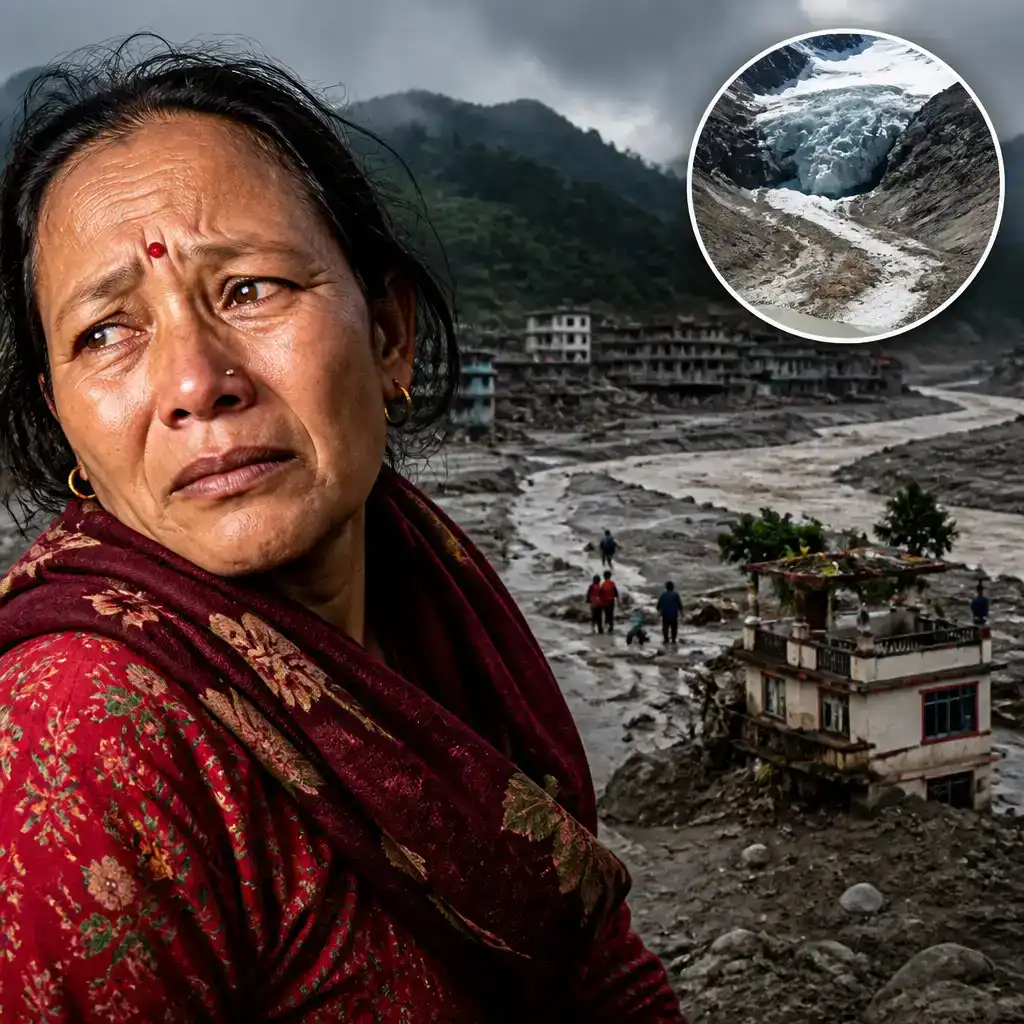
Scientists say climate change intensified the Nepal floods that killed more than 1,400 people across Nepal and China last month, with thousands more still missing. The disaster began when a vast section of rock and glacier broke away from Langtang Lirung mountain on August 26, unleashing water, ice and debris into communities downstream.
A report released Thursday by the World Weather Attribution group found that no single bout of extreme weather caused the collapse. Instead, researchers described a “compound crisis” involving sustained warming, retreating glaciers, thawing permafrost and unstable geology. Mountains, it turns out, respond poorly when several structural problems arrive at once.
World Weather Attribution uses peer-reviewed methods to examine how global warming influences extreme events. Its report, Rapid Warming in the Himalaya Exacerbates Geohazard Cascades Beyond Adaptation Limits, concluded that rising temperatures had progressively weakened the Himalayan slope before it failed.
How did warming make the mountain unstable?
According to the researchers, persistent warming has pushed the freezing threshold higher in the Himalayas. That has exposed ice and permafrost embedded deep inside mountain rock to warmer temperatures and longer periods of thawing.
“Relentless warming has lifted the altitude of the freezing threshold on the high Himalaya, exposing ice and permafrost deep in the bedrock to higher and longer thaw temperatures, weakening mountain slopes,” the report said.
Walter Immerzeel, a mountain hydrologist at Utrecht University and co-author of the study, said the region was experiencing “fundamental, irreversible shifts”. Glacier loss and deteriorating permafrost are removing material that once helped hold mountain slopes together.
The study found that July and August were the warmest months recorded locally, with temperatures about 5 degrees Celsius, or 9 degrees Fahrenheit, above normal. Heavy snowfall in late 2025 also produced additional meltwater before the collapse.
Researchers said Nepal’s magnitude 7.8 earthquake in 2015 may have weakened the slope further. They could not determine its exact contribution, leaving geology with at least one unanswered question amid a disaster already crowded with causes.
Why is the disaster raising questions about adaptation?
The findings add to concern that some climate-related hazards are moving beyond what protective infrastructure and emergency planning can reasonably handle. In high mountain regions, warming can trigger a sequence of connected threats, from melting ice and unstable rock to sudden floods far below.
Nepal, a predominantly rural country of about 30 million people, produces only a small share of global greenhouse gas emissions compared with industrialised nations. Yet it faces a reconstruction bill estimated at $4.78bn after the flood.
“There is no doubt that climate change is one of the drivers, and therefore obviously it needs to be discussed in the context of loss and damage,” Friederike Otto, a professor of climate science at Imperial College London, told reporters.
Loss and damage refers to the financial and other support sought by vulnerable countries facing climate impacts they did little to create and can no longer avoid through adaptation alone.
Prime Minister Balendra Shah is expected to address the United Nations General Assembly on the issue next week. The appearance will be his first foreign trip as Nepal’s leader and will place the catastrophe before governments still debating who should pay for mounting climate destruction.
What is the latest death and missing-person toll?
Nepal’s disaster authority said Wednesday that it had increased the number of people listed as missing to 6,150 after collecting and verifying information from affected districts.
Authorities have recovered 1,403 bodies in Nepal, but only 105 have been identified. The limited number of identifications has left many families without confirmation of what happened to relatives swept away by the flood.
Chinese state media reported a further 43 deaths and 519 missing people in Tibet. Across Nepal and China, the combined toll now stands at:
- 1,446 confirmed deaths
- At least 6,669 people missing
The figures may change as searches continue and officials reconcile reports from devastated areas. For now, the scale of the loss reflects both the force of the collapse and the vulnerability of communities below a rapidly warming mountain system.