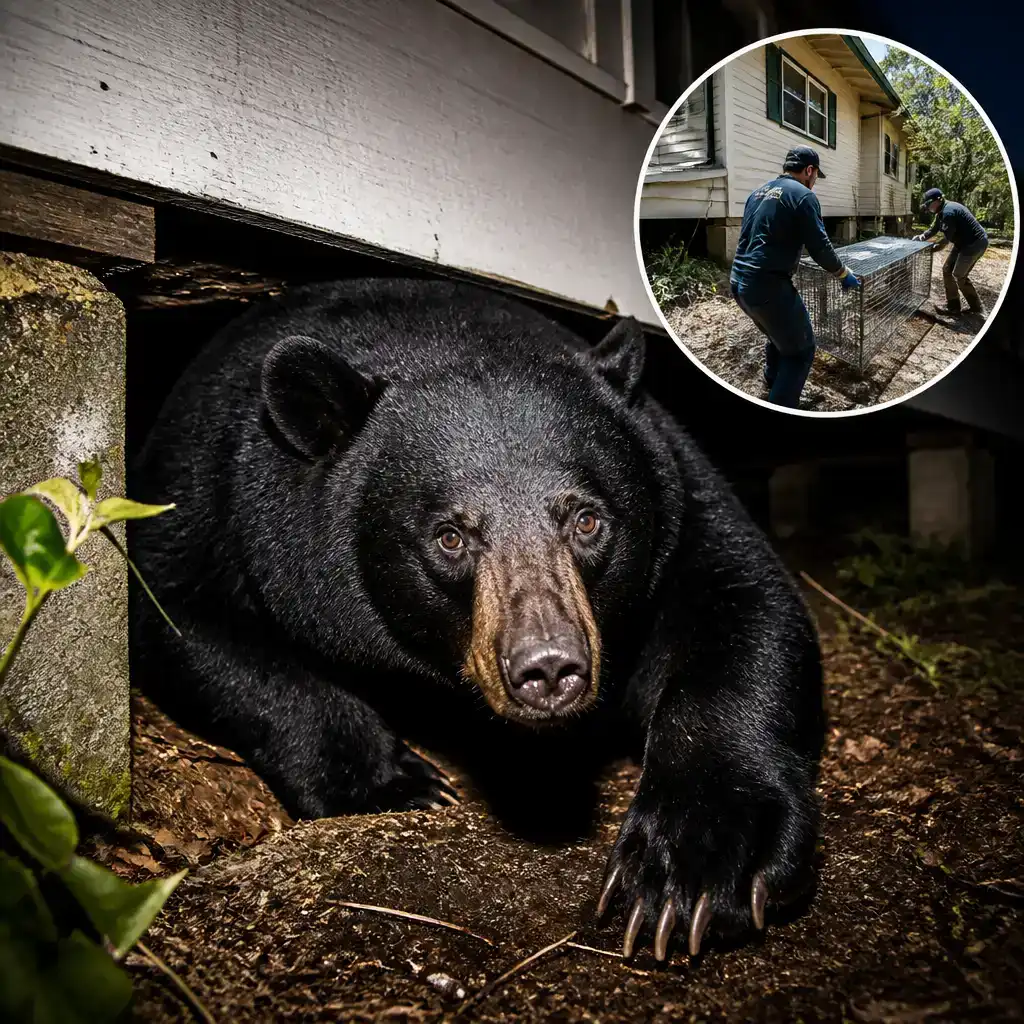
A 550lb black bear living beneath a California home was finally evicted after weeks of failed efforts. Then bears began appearing under other houses nearby.
The sightings have turned one Altadena homeowner’s extraordinary problem into something closer to a neighbourhood trend — although wildlife officials cannot confirm whether the same unusually persistent animal is responsible.
The original bear, tagged Yellow 2120 by the California Department of Fish and Wildlife, had occupied a crawlspace beneath Ken Johnson’s home since late November. Volunteers removed it in early January, but reports of bears sheltering beneath at least two other Altadena properties emerged within days.
A 550lb house guest proves difficult to evict
Johnson’s ordeal began when the large bear settled beneath his Los Angeles County home and declined to leave. The arrangement lasted for weeks, with the animal effectively acquiring accommodation while contributing little beyond considerable anxiety.
The Department of Fish and Wildlife repeatedly attempted to trap the bear but was unsuccessful.
The breakthrough came when the Bear League, a Lake Tahoe-based non-profit that promotes coexistence between people and bears, travelled to Altadena. Its volunteers used paintball guns to force the animal out of the crawlspace.
The removal appeared to bring the long-running episode to a close. That impression did not last.
New sightings raise questions about Yellow 2120
KTLA reported on Monday that another resident, living roughly half a mile from Johnson, had photographed a bear beneath their house.
By Tuesday, a bear described by a local outlet as the same animal had reportedly sought refuge beneath another Altadena property.
Wildlife officials, however, have cautioned against assuming that Yellow 2120 simply moved down the road in search of a more accommodating crawlspace.
“It’s such a prevalent area for bear activity that this very well could be a different bear, so we can’t say that it’s the same,” Cort Klopping, a Department of Fish and Wildlife information officer, told the Los Angeles Times.
Without confirmation from the bear’s tag or another reliable identifier, the sightings could involve Yellow 2120, another local bear or more than one animal. The reports establish that bears have entered multiple crawlspaces, but not that a single serial squatter is responsible.
Why crawlspaces keep attracting bears
The Bear League has continued helping Altadena residents, including by installing electrified deterrent mats intended to keep bears away from vulnerable areas beneath homes.
“We are grateful to have been able to help the bear and the residents and hope we can continue to do so,” the organisation said in a statement.
For the group’s volunteers, calls about bears beneath houses are not particularly unusual. The non-profit said it receives several such reports each day in the Lake Tahoe region, where bears routinely move through residential areas and sometimes enter homes or vehicles while searching for food.
Authorities urge residents and visitors in bear country to secure rubbish bins, lock away food and prevent animals from gaining access to buildings. Crawlspaces offer darkness, shelter and relative quiet — useful qualities for a bear and less desirable ones for the person paying the mortgage above it.
California’s bear population is expanding its range
California is home to an estimated 49,000 to 71,000 black bears, according to the Department of Fish and Wildlife. Black bears are the only bear species living wild in the state and are concentrated primarily along the north coast, in the Cascade region and across the Sierra Nevada.
Despite the alarm caused by finding a large animal beneath the floorboards, black bears are generally not confrontational. Only one fatal black bear attack has been recorded in California.
The more immediate problem in Altadena is preventing repeated encounters that could endanger residents or lead to harsher consequences for the animals. Securing food, rubbish and access points can make homes less attractive before a bear becomes settled enough to require eviction.
For now, Yellow 2120’s whereabouts remain uncertain, as does the identity of the bears photographed beneath the other properties. What is clearer is that the crawlspace problem did not leave Altadena when Johnson’s bear did.