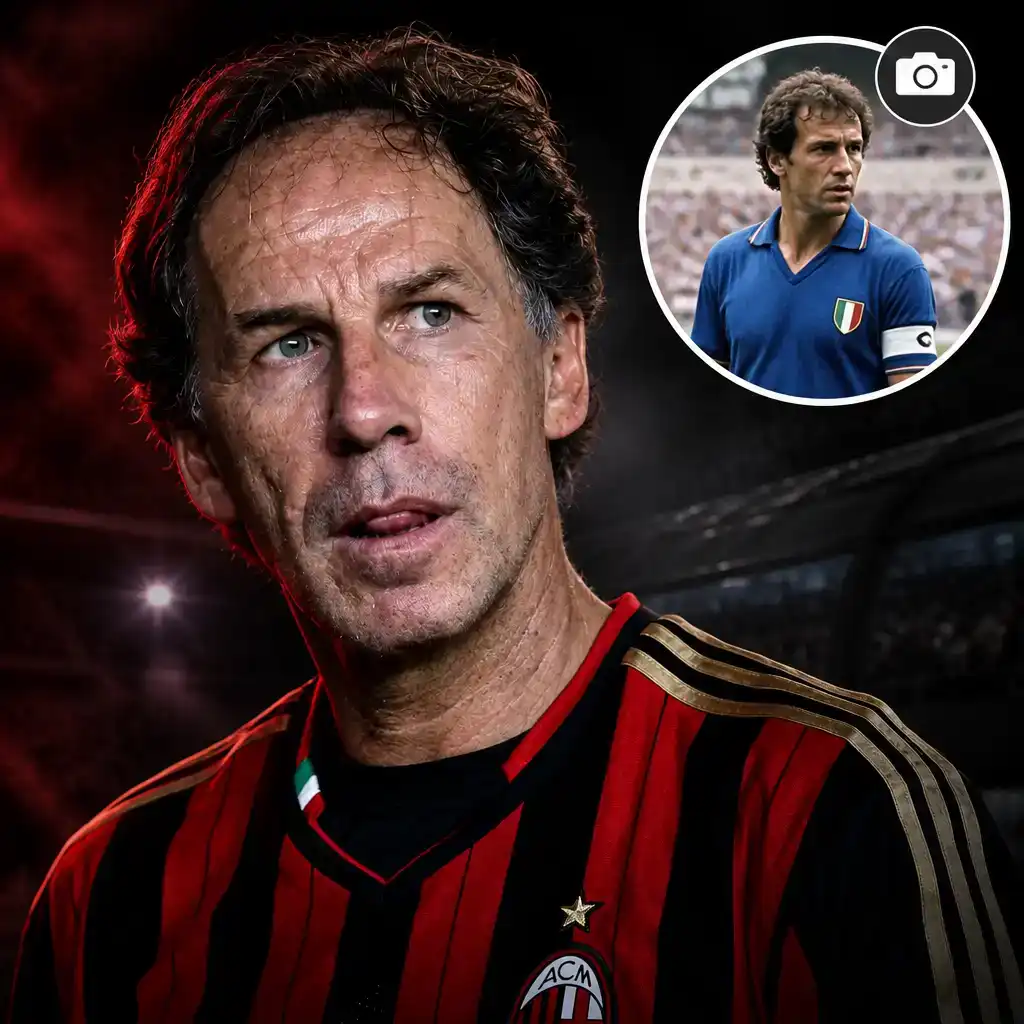
Franco Baresi, the one-club captain who made more than 700 appearances for AC Milan and helped Italy win the 1982 World Cup, has died aged 66. Milan announced his death on Friday. No cause was disclosed.
“The entire history of AC Milan is in tears,” the club said.
Baresi underwent surgery in August 2025 to remove a pulmonary nodule and later began immunotherapy. His final public appearance came at the Milano Cortina Winter Olympics opening ceremony in February, when he and former Inter Milan defender Giuseppe Bergomi carried the torch into San Siro.
“His example and integrity will be forever etched into the Club’s DNA, just as his iconic number 6 shirt is,” Milan said, adding that the club’s condolences to his family were shared by every Rossonero supporter.
Italian Prime Minister Giorgia Meloni said the country had lost both a great sporting champion and “an example of loyalty, professionalism, and dedication.”
How Baresi became the centre of AC Milan’s revival
Baresi joined Milan’s youth system and made his senior debut in April 1978, aged 17. Four years later, he stayed when the club dropped into Serie B for the second time in three seasons, a decision that became central to his standing at Milan.
That same summer, he was part of Italy’s World Cup-winning squad in Spain. Milan then appointed him captain at just 22.
Across a 20-year first-team career, Baresi led the Rossoneri through their dominant period in the late 1980s and early 1990s. His honours with the club included:
- Three European Cup or Champions League titles
- Six Serie A championships
- Two Intercontinental Cups
- Three European Super Cups
- Four Italian Super Cups
Milan owner Gerry Cardinale said Baresi represented “the values, character and excellence that define this club.”
“Even as he battled his greatest challenge over the last year, he was always there for the club, quietly reminding us all what it means to wear these colours,” Cardinale said. “Franco’s legacy is profound and will endure forever.”
Why the No. 6 shirt carries such weight
Baresi retired in 1997, and Milan withdrew his No. 6 jersey, making him the first player in Italian football to receive that distinction. The club also staged a celebration match featuring many of the leading players he had faced or played alongside.
His connection to Milan continued long after his playing career. He was appointed honorary president in 2020, maintaining a formal role at the club where he had spent his entire senior career.
In his final interview with La Gazzetta dello Sport last year, Baresi recalled already being a Milan supporter as a child.
“When I arrived at Milanello for the first time as a 14-year-old, it seemed like entering paradise,” he said of the club’s training centre.
That attachment survived relegation, rapid tactical and commercial change across Italian football, and Milan’s rise into a global force. One-club careers were never common at the highest level. They are even less so now, which makes more than 700 appearances over two decades a statistic requiring very little decorative language.
What Baresi achieved with Italy
Baresi’s international career stretched from Italy’s 1982 World Cup triumph to the 1994 final in the United States. In that later tournament, Italy finished runners-up after losing to Brazil in a penalty shootout.
Baresi was one of three Italian players who missed from the spot in the final. The moment became part of his career record, but hardly its definition. Reaching another World Cup final 12 years after being part of the winning squad reflected his longevity at elite level.
His individual standing was also recognised in 1989, when he finished second to Milan teammate Marco van Basten in the Ballon d’Or voting. For a defender in a period crowded with high-profile attacking players, runner-up was not exactly a minor endorsement.
Italian sports official Giovanni Malagò described Baresi as “an extraordinary champion who wore only two shirts for his entire career: those of Milan and Italy.” He said a tribute would be held at the national team’s next match.
How Inter’s rejection shaped a Milan dynasty
Baresi’s career could easily have developed on the other side of the city. As a young player, he had trials with Inter Milan but was rejected. Inter instead signed his older brother, Giuseppe Baresi, while Franco entered Milan’s youth system.
Both brothers later became captains. During the late 1980s, the sight of them exchanging pennants before the Milan derby became one of the fixture’s defining images. Inter’s original assessment did not age especially well, although football recruitment has produced worse decisions with considerably larger spreadsheets.
Former Italy captain Gianluigi Buffon remembered facing Baresi during his own Serie A debut for Parma on November 19, 1995. Buffon was 17 at the time.
“For a boy my age, finding myself on the field against champions like him was something incredible,” Buffon said. “From that day on, I had an even clearer understanding of what it meant to represent football with class, leadership, and respect. Ciao Franco. Rest in peace.”