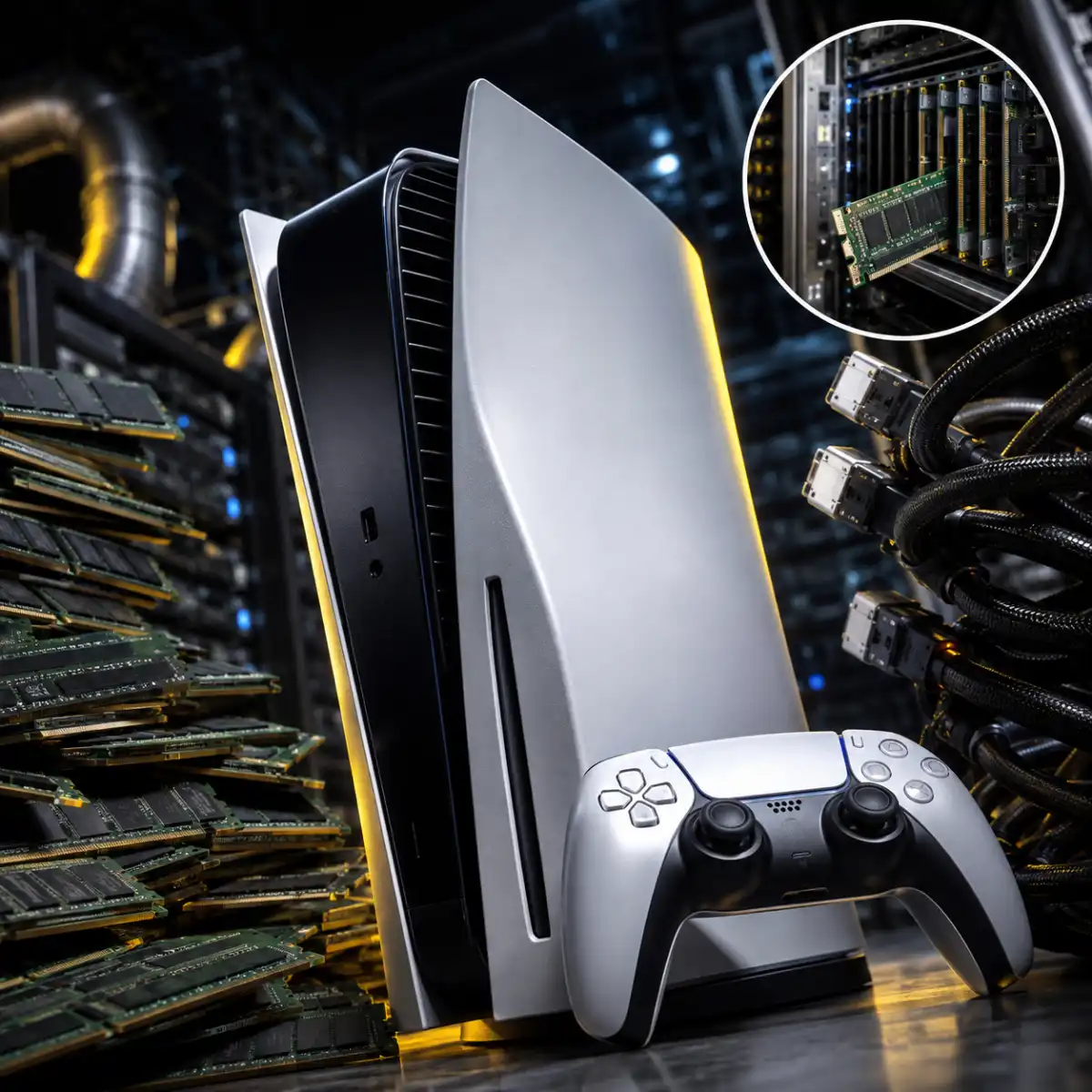
For anyone waiting for a cheaper upgrade, video game console prices are unlikely to offer much relief soon. Samsung says demand for memory used in artificial intelligence infrastructure is outpacing production, with supply conditions potentially becoming even tighter in 2027. That pressure could make consoles, graphics cards, phones and laptops more expensive to build, although the evidence does not support claims that prices must keep rising through 2029.
The immediate problem is that large AI customers are securing substantial amounts of memory under multiyear agreements. Consumer electronics must compete for what remains, and AI data centres are generally the more profitable customers. Household budgets, regrettably, do not get priority access.
Why is AI demand affecting gaming hardware?
Samsung Executive Vice President of Memory Kim Jaejune told investors that customer demand is growing faster than the company can add production.
“Despite our efforts to increase production, demand growth is outpacing our efforts,” Kim said during Samsung’s earnings call, according to the Associated Press.
He warned that unmet orders from 2026 are likely to carry into the following year, widening the gap between supply and demand. Samsung expects the constraints to be more severe in 2027 than in 2026 and to persist through 2028.
“We believe it will be unlikely to see any significant increase in incremental supply through 2028,” Kim said.
PC Gamer reported that long-term customer agreements already cover between 60% and 70% of Samsung’s production capacity. Kim said Samsung is prioritising customers able to guarantee substantial future demand for AI service infrastructure, helping the company reduce its own long-term financial risk.
Samsung is not alone in giving AI customers first access to limited capacity. Samsung, SK Hynix and Micron control more than 90% of the global DRAM market, according to Tom’s Hardware. When all three face intense demand from data centres, device manufacturers have relatively few alternative suppliers.
Does every type of memory face the same shortage?
Not necessarily, and that distinction matters for consoles. DRAM provides the fast working memory needed by processors, while NAND flash is used for storage, including the solid-state drives inside current consoles.
TrendForce expects DRAM supplies to remain tight during 2027. Apacer chief executive C.K. Chang has offered an even sharper warning, telling investors that DRAM supplied to module manufacturers could fall by more than 70% year over year in 2027.
The outlook for NAND is less severe. TrendForce forecasts that NAND supply growth will overtake demand during 2027, potentially easing storage constraints in the second half of that year. That conflicts with any broad suggestion that every memory component will remain equally scarce through 2028.
Micron chief executive Sanjay Mehrotra has taken a more cautious position. He said supply could improve gradually in 2028, but the company still cannot determine when production will fully catch up with demand.
The result is not one simple shortage with one expiry date. Different components may follow different price paths, leaving console manufacturers to manage a changing mix of costs rather than a single permanently rising bill.
What could this mean for console buyers?
Hardware prices have already moved well beyond the affordable positioning used at the beginning of this console generation. In the UK, the Xbox Series S, originally promoted as a lower-cost route into current-generation gaming, is now priced at £429.99 after launching at £249.99 and later carrying a £299.99 price.
Rumours have also suggested that Microsoft’s proposed Project Helix hardware and Sony’s eventual PlayStation 6 could cost more than £1,000. Those figures remain unconfirmed, however, and no cited pricing data shows that consoles will continue becoming more expensive until at least 2029.
Manufacturers also have options beyond repeatedly increasing retail prices. TrendForce says consumers are already responding to higher costs by buying fewer devices. If that continues, companies may:
- Reduce memory or storage specifications
- Delay new hardware launches
- Accept lower profit margins
- Keep older devices on sale for longer
- Design games and software for less powerful systems
For players, that could mean fewer dramatic hardware advances or longer waits between upgrades. PC developers may also need to ensure new games work on older machines, particularly as Nvidia graphics cards and other components become harder for mainstream buyers to justify.
Samsung’s profits show why priorities have shifted
Samsung reported second-quarter 2026 sales of 171.5 trillion South Korean won for the April-to-June period, an increase of about 129% from a year earlier. Operating profit reached 89.5 trillion won, up roughly 1,810% year over year.
Those are company-wide figures, not revenue generated solely by AI infrastructure. Still, they reflect how strongly Samsung and other semiconductor manufacturers are benefiting from the AI investment boom. Selling high-value memory to data-centre operators offers a more attractive return than reserving capacity for price-sensitive consumer devices.
The consequences extend beyond gaming. DRAM and NAND are also essential to smartphones, home computers and laptops, meaning shortages or higher component costs can affect almost anyone replacing an everyday device.
Samsung’s warning supports the view that memory pressure will remain serious through 2027 and possibly 2028. It does not prove that every console will rise in price, or that increases are guaranteed into 2029. The clearer conclusion is less dramatic but still uncomfortable: AI demand has changed who receives scarce components first, and ordinary buyers are unlikely to be at the front of that queue.